Best Spots to Catch Fluke Near Montauk
For many anglers, the pursuit of fluke, also known as summer flounder, is a quintessential New York fishing experience. But when it comes to the legendary waters surrounding Montauk, finding the true hotspots for these elusive flatfish can be a real challenge. With its powerful currents, diverse bottom structures, and vast expanses of open water, knowing precisely where to drop your line for the best chance at a trophy fluke requires insider knowledge and a strategic approach. This guide is your compass to navigating the prime fluke fishing grounds near Montauk, offering detailed insights to elevate your angling success.
Understanding Fluke in Montauk's Rich Waters
Before you even think about casting a line, it's crucial to understand the target. Fluke are not just any fish; they are ambush predators, perfectly camouflaged to lie in wait on the seabed, striking at unsuspecting baitfish or crustaceans that drift by. Their unique flattened body and ability to change color to match their surroundings make them masters of disguise, which is both their survival mechanism and why they can be so challenging and rewarding to catch.
The Life and Habits of Summer Flounder
Fluke, or Paralichthys dentatus to get a bit scientific, are an incredibly popular game fish in New York, and for good reason – they’re delicious and put up a fun fight. These fascinating fish are migratory, moving into our inshore waters and bays as the ocean temperatures rise in spring and summer. They'll spend their warmer months gorging themselves on baitfish like spearing, bunker, and sand eels, along with crabs and squid, before heading back offshore to deeper, warmer waters to spawn as temperatures drop in the fall. Around Montauk, their movements are heavily influenced by the powerful currents and the presence of abundant prey.
They have a distinct preference for specific types of bottom structure. Think sandy or muddy bottoms where they can easily bury themselves, but always near some form of structure like rocks, mussel beds, artificial reefs, or sudden changes in depth. These structures provide cover and create current breaks where prey fish congregate, setting up the perfect ambush point for a hungry fluke. Understanding this preference is key to locating them, especially in a dynamic environment like Montauk.
Their seasonal movements are quite predictable once you get the hang of it. Early in the season, as water warms, you'll find them in shallower bays and protected areas. As summer progresses and water temperatures peak, bigger fluke often move to deeper, cooler waters, concentrating around offshore humps, wrecks, and the ripping currents around Montauk Point. Keep in mind that a consistent temperature range, typically between 55 and 70 degrees Fahrenheit, is optimal for finding active fluke.
When and How Fluke Arrive in Montauk
The general fluke season in New York typically kicks off in May, but the real action around Montauk often starts to heat up in late May and June, peaking through July and August. This timing is directly tied to the influx of baitfish and the warming waters of the Atlantic Ocean and Long Island Sound. Montauk, being "The End," is often one of the first places to see significant numbers of larger fluke as they migrate along the coast. Anglers often keep a keen eye on "New York Fishing Seasons Explained" to ensure they're fishing within legal parameters and to plan their trips during peak activity.
Water temperature plays a colossal role. When the nearshore waters hit that sweet spot, baitfish become abundant, attracting the fluke. A sudden cold snap or prolonged period of strong winds can push fish out or make them lethargic, so paying attention to marine forecasts is critical. The best time of year to fish in New York for fluke is undoubtedly the warmer months, but the exact peak varies year to year based on these environmental factors.
Tides and currents are perhaps even more crucial than temperature when fishing around Montauk. Fluke are opportunistic feeders, and strong currents help dislodge bait from the bottom and carry it past their ambush points. The outgoing tide, especially around inlets and rips, is often considered prime time, as it flushes bait out to sea. However, a strong incoming tide can also be productive, particularly in areas like Napeague Bay or Gardiner's Bay where bait gets pushed into shallower zones. Learning to read the tides and understanding how they affect current flow in specific areas will drastically improve your chances.
Prime Fluke Fishing Grounds Around Montauk
Montauk offers an incredible diversity of fishing environments, from protected bays to wild ocean rips. Each area presents unique opportunities and challenges for the fluke angler. Knowing these distinct zones and what makes them tick is essential for a successful outing.
Nearshore Hotspots and Bays
For those with smaller boats or who prefer less intense conditions, Montauk Harbor and the surrounding bays offer fantastic fluke opportunities, especially early in the season or on days with rougher ocean conditions. Montauk Harbor itself, with its dredged channels, jetties, and boat traffic, stirs up bait and creates ideal ambush points. The edges of the channel, particularly where it drops off into deeper water, are prime targets. Many anglers find success drifting along the channel edges from the Coast Guard station all the way out towards the entrance.
Just west of the harbor lies Napeague Bay, a shallower, more protected body of water. This bay is a nursery for many baitfish species and, in turn, attracts hungry fluke. Look for subtle changes in depth, mussel beds, and sandy patches. It's an excellent spot for smaller boats to drift, particularly during an incoming tide. While the average fluke size here might be a bit smaller than offshore, it’s a great place to fill a cooler and perfect your drifting techniques. The protection from the open ocean swells makes it a favored spot for many local anglers.
Further west, you'll find Gardiner's Bay, another expansive and productive area for fluke. Known for its numerous sandy flats, scattered rocks, and grass beds, Gardiner's Bay holds a consistent population of fluke throughout the warmer months. Target areas around Jessup Neck, Cedar Point, and Shelter Island, focusing on depths ranging from 10 to 30 feet. Shoreline access is somewhat limited in these areas compared to others, but many public boat ramps provide access. Remember that while these bays are more protected, a strong wind can still create choppy conditions, so always check the marine forecast before heading out.
Offshore Structure and Rips
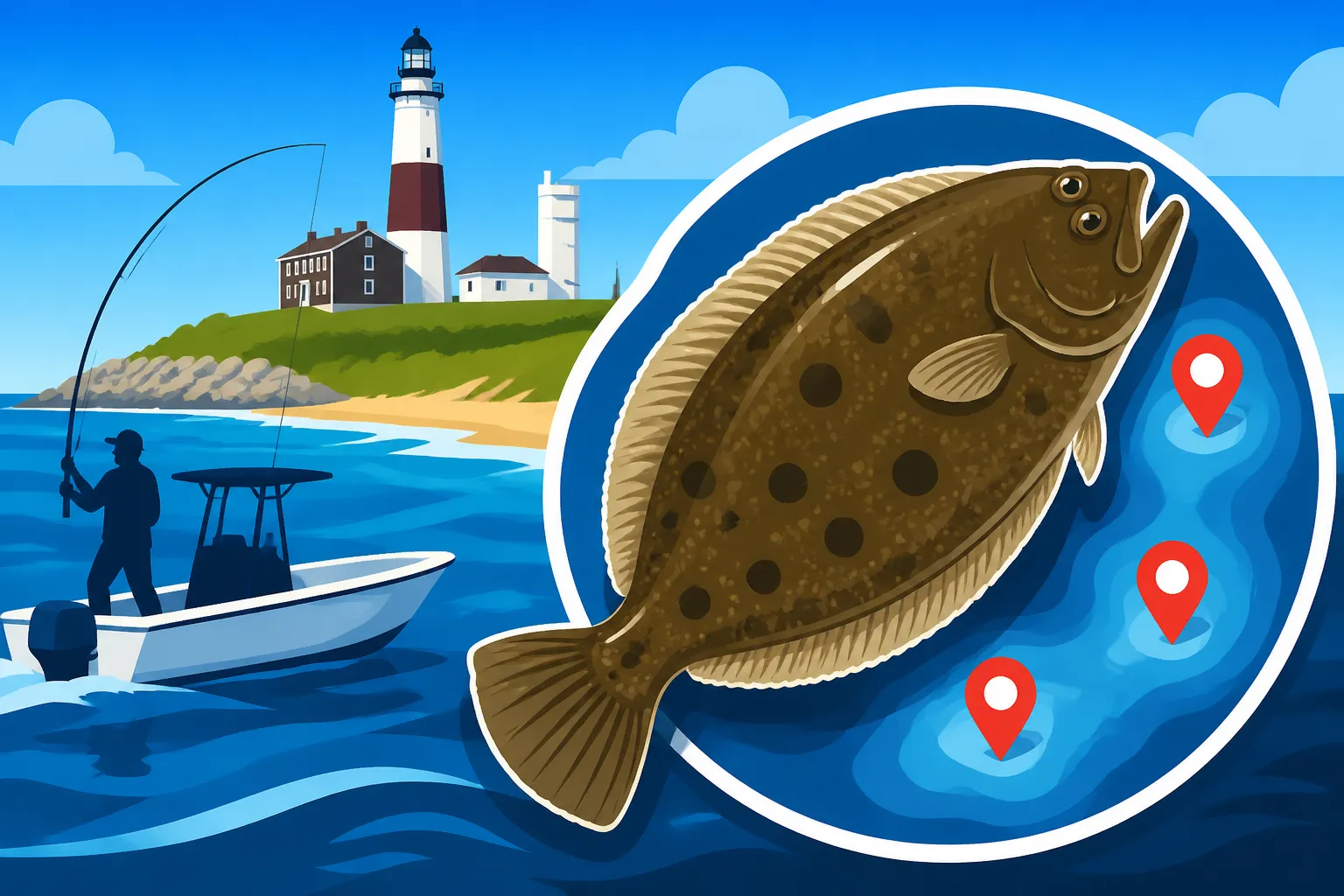
For those seeking larger, "doormat" fluke and more challenging fishing, the offshore grounds around Montauk are legendary. The ripping currents around Montauk Lighthouse are arguably the most famous fluke grounds on the East Coast. Here, the strong tides funnel through Block Island Sound, creating turbulent rips and eddies that disorient baitfish and concentrate feeding fluke. Drifting through these rips requires skill and attention to boat control, as the currents can be incredibly powerful, but the rewards can be immense. Look for sudden depth changes and the edges where fast water meets slower water.
Moving further offshore into Block Island Sound, you’ll encounter deeper waters and numerous humps, bumps, and ledges that hold big fluke. Areas like the Cartwright Grounds, southwest of Block Island, are renowned for their consistent action and potential for trophy fish. These spots are typically fished in 60-100 feet of water, requiring heavier tackle and a good understanding of bottom contour. Charters often frequent these areas because of their productivity. Finding these subtle changes in the seabed is where a good fish finder really shines, allowing you to pinpoint where the fluke are likely lying in wait.
Other notable offshore spots include areas off the south shore of Montauk, where various shoals and rocky patches create excellent habitat. These spots are less defined than the main rips but can be incredibly productive, especially when targeting fluke that have moved out of the shallower bays. Keep an eye out for concentrations of baitfish on your fish finder – where the bait is, the fluke are often not far behind. Be aware that conditions offshore can change rapidly, so proper safety equipment and a capable vessel are a must for these excursions.
Popular Wrecks and Reefs
Fluke absolutely love structure, and Montauk's waters are dotted with numerous wrecks and artificial reefs that serve as magnets for baitfish and, consequently, fluke. These structures provide excellent ambush points, as the fluke can lie partially buried in the sand or mud adjacent to the wreck, waiting for unsuspecting prey to swim by. While not always fished exclusively for fluke, many wrecks hold impressive populations, especially the bigger, older fish that prefer deeper, more complex environments.
Examples include the Shinnecock Reef, though a bit of a run from Montauk, it's a known producer. Closer in, there are several lesser-known wrecks and rockpiles that local charter captains and experienced private boaters keep under wraps. The key is often to drift across or just adjacent to the wreck, allowing your bait or lure to tumble over the structure's perimeter where fluke will be staging. It’s not about fishing directly in the wreck, but rather fishing the sandy edges.
Both natural rock formations and man-made structures create ideal fluke habitat. The trick is to identify where the current will sweep bait past the structure and position your boat accordingly. Depths around these structures can vary wildly, from 40 feet to over 100 feet, so be prepared to adjust your weight and presentation. These areas often require heavier tackle to deal with the snags that come with fishing near jagged metal and rocks, but the potential for a personal best fluke makes it all worthwhile.
| Fluke Hotspot | Typical Depth Range | Key Features | Best Tide |
|---|---|---|---|
| Montauk Harbor Channel | 15-30 feet | Dredged channel, jetties, current breaks | Outgoing |
| Napeague Bay | 10-25 feet | Sandy flats, mussel beds, protected waters | Incoming |
| Gardiner's Bay | 10-30 feet | Sandy flats, scattered rocks, grass beds | Both |
| Montauk Point Rips | 30-80 feet | Strong currents, eddies, extreme depth changes | Outgoing |
| Block Island Sound Humps | 60-100+ feet | Deep water, humps, ledges, natural structure | Both |
| Wrecks & Reefs | 40-100+ feet | Artificial and natural structures, adjacent sand | Both |
Essential Techniques and Tackle for Montauk Fluke
Fluke fishing isn't just about dropping a line; it's an art form, especially in the dynamic waters of Montauk. The combination of strong currents, varied bottom structure, and the fluke's ambush predation style means that your technique and tackle need to be on point.
Mastering the Drift for Fluke
Drifting is, without a doubt, the quintessential method for catching fluke in Montauk. Since fluke lie on the bottom waiting for prey, presenting your bait or lure naturally in the current is paramount. You want your offering to appear as a helpless morsel being carried along by the water. This means using enough weight to keep your bait close to the bottom, but not so much that it just drags lifelessly. The aim is a controlled "bounce" or "tumble" along the seabed.
Managing current and wind simultaneously is the biggest challenge when drifting. You're constantly adjusting your boat's speed and direction to achieve the perfect drift. Many anglers use a drift sock or sea anchor to slow their boat down on windy days, allowing for a more controlled presentation. Without one, the wind can push your boat too fast, causing your bait to lift off the bottom or skip unnaturally. A good drift speed is often between 0.5 to 1.5 knots, but this can vary depending on the specific spot and current strength. For more detailed insights, check out our guide on "Best Drift Speed for Fluke Fishing".
Understanding your boat's positioning relative to the bottom is also crucial. You want your line to enter the water slightly ahead of your drift path, allowing the weight to sink and reach the bottom just as your boat passes over the prime fishing zone. This requires constant monitoring of your fish finder and adjusting your line length. When you feel a bite, it's often a subtle tap or a sudden increase in weight. Don't set the hook too hard right away; instead, drop your rod tip slightly to give the fluke a moment to fully engulf the bait, then sweep-set with a firm, steady motion.
Top Baits and Lures
When it comes to enticing fluke, a combination of natural baits and artificial lures often works best. Natural baits are hard to beat because they appeal to the fluke's senses of smell and taste. Squid strips, spearing (silversides), and live killifish are perennial favorites. You can also use strips of fresh bunker, bluefish, or mackerel for added scent and durability. Presenting these baits on a traditional fluke rig with a long, thin strip of bait cut into a "worm" shape is incredibly effective.
Artificial lures have come a long way and are often used in conjunction with natural bait. Bucktail jigs are legendary for fluke fishing. They mimic a variety of baitfish and can be tipped with a strip of squid or a Gulp! Swimming Mullet for an irresistible combination. Popular colors include white, chartreuse, and pink. Vary your jigging retrieve – slow lifts and drops, subtle twitches, or just letting it drag along the bottom with the drift can all be effective. Gulp! baits, like the Swimming Mullet or Grub, are incredibly popular because their scent dispersion is fantastic, and they're incredibly durable.
Many successful anglers employ a "teaser" rig above their main bucktail. This often involves a smaller bucktail, a plain hook with a Gulp! or natural bait, or even a small soft plastic bait like a S&S Bucktails Rattling Smilin' Bill. The teaser adds another dimension to your presentation, mimicking a smaller baitfish darting above the main offering. The idea is that one of the baits will catch the fluke's eye, and often, larger fluke will strike the bigger offering on the bottom, while smaller fluke or other species might hit the teaser.
Rods, Reels, and Rigging
Choosing the right rod and reel setup is vital for effective fluke fishing. You want a medium to medium-heavy spinning or conventional rod, typically 6.5 to 7.5 feet long, with a sensitive tip but plenty of backbone to handle larger fluke and heavier weights. A fast action tip is preferred to detect those subtle fluke bites. For reels, a good quality spinning reel in the 4000-5000 size range or a conventional reel like a Penn Fathom or Shimano Tranx 300, spooled with 20-30 lb braided line, is ideal. Braid offers superior sensitivity and less drag in the water, allowing you to feel every bump and bite. Always use a monofilament or fluorocarbon leader of 20-30 lb test, about 3-5 feet long, to provide shock absorption and invisibility to the fish.
When it comes to rigging, the choices are plentiful. A simple bucktail jig, often adorned with a Gulp! trailer, is deadly on its own. For a more traditional approach, a hi-lo rig (also known as a "fluke rig") with a sinker at the bottom and one or two dropper loops for hooks above it is very popular. You can dress these hooks with natural bait or Gulp!. Another effective setup is a "fluke ball" or bullet sinker rig, where a sliding sinker is above a swivel, then a leader to a single hook or bucktail. This allows the fish to pick up the bait without feeling the weight immediately. Learning "How to Rig a Fluke Fishing Rod" with these various setups will greatly enhance your versatility.
Remember that weight is key. In Montauk’s strong currents, you might need anywhere from 3 to 10 ounces of lead to hold the bottom, sometimes even more in the ripping tide around Montauk Point. Always carry a variety of sinker sizes to adjust to changing conditions. The goal is to maintain bottom contact with the lightest weight possible for the most natural presentation.
Navigating Your Montauk Fluke Adventure
Embarking on a fluke fishing trip around Montauk requires more than just knowing where the fish are and what gear to use. It involves understanding the rules, making smart decisions about how you'll fish, and tapping into the local wisdom that only comes from experience.
Regulations and Responsible Angling
Before you even think about dropping a line, it is absolutely imperative to be familiar with the current fishing regulations set by the New York State Department of Environmental Conservation (DEC). Regulations can change annually, so always double-check the latest rules. Our comprehensive guide on "New York Fishing Regulations Explained" is a great resource, but always verify with the official DEC website. These regulations typically cover minimum size limits, daily bag limits, and specific open seasons for fluke.
For instance, the minimum size for fluke in New York waters is generally around 19 inches, with a daily bag limit of three fish per angler. However, these numbers are subject to change, and there might be specific regulations for certain areas or different times of the year. Violating these rules can lead to significant penalties, so it's not something to take lightly. Beyond species-specific rules, remember that anyone 16 years or older needs a valid fishing license. Our guide, "New York Fishing License Guide", provides all the necessary information on obtaining one. Furthermore, if you’re fishing for marine species, you'll also need to register with the "New York Recreational Marine Fishing Registry", which is usually free but mandatory.
Responsible angling goes beyond just following the rules. It means practicing good catch-and-release techniques for fish you don't intend to keep, ensuring minimal harm. This includes handling fish gently, using barbless hooks when appropriate, and releasing them quickly. It also involves being mindful of your environment, not leaving trash, and respecting other anglers and boaters on the water. Conservation is a collective effort, and preserving our fisheries for future generations starts with each of us.
Choosing Between Private and Chartered Trips
Deciding whether to take your own boat or book a charter is a common dilemma for Montauk anglers. Each option has its distinct advantages and disadvantages. If you own a capable vessel, have experience navigating Montauk's challenging waters, and possess the necessary gear, fishing from your private boat offers unparalleled freedom and flexibility. You can choose your spots, stay as long as you like, and customize your trip to your preferences. However, it also comes with the responsibilities of boat maintenance, safety equipment, fuel costs, and being your own captain and guide.
For many, especially those visiting Montauk or newer to the area, a fishing charter is an excellent option. Charters provide all the necessary gear, bait, and, most importantly, the expertise of a seasoned captain who knows the local waters intimately. They'll take you directly to the productive spots, advise on techniques, and often clean your catch at the end of the day. This is particularly appealing when targeting species like fluke in complex areas like the Montauk rips or offshore wrecks. There are many reputable services offering "Montauk Fishing Charters" that can get you on the fish.
When choosing a charter, do your homework. Look for captains with a strong track record, positive reviews, and proper licensing. Services like FishingBooker are fantastic resources for comparing different charter boats, reading reviews from other anglers, and booking your trip with confidence. You can filter by species, trip length, and even see what's included in the price. Asking questions upfront about what's included (bait, tackle, fish cleaning), what to bring, and their cancellation policy is always a good idea. While potentially more expensive upfront, a good charter often saves you time, effort, and provides a much higher chance of success. FishingBooker can help you find the perfect match for your budget and fishing goals.
Local Knowledge and Resources
The waters around Montauk are notoriously tricky, and conditions can change rapidly. Tapping into local knowledge is invaluable. A quick stop at a local bait and tackle shop, such as Paulie's Tackle of Montauk or Montauk Marine Basin, can provide current reports on what’s biting, where, and what baits are working best. The folks behind the counter are often anglers themselves and are usually happy to share insights. They'll also have up-to-date tide charts and marine forecasts, which are critical for planning a safe and productive trip.
Weather patterns, especially fog and strong winds, can impact safety and fishing success. Montauk is known for its sudden fog banks, so always have your navigation equipment in good working order and know how to use it. Paying attention to wind direction and swell forecasts will help you choose the most protected and fishable areas on any given day. Local Coast Guard stations also broadcast marine weather, which can be picked up on a VHF radio.
Beyond bait shops, online resources and community forums dedicated to New York fishing can be a goldmine of information. Websites and social media groups often have real-time fishing reports from other anglers. While you should always take online information with a grain of salt, it can provide valuable intel on general trends and productive areas. Many captains list their available trips on platforms like FishingBooker, allowing you to see what kind of fish they are targeting and what success they are having. Connecting with the local fishing community, whether in person or online, can shorten your learning curve and lead to more successful Montauk fluke adventures.
Disclaimer
Fishing involves inherent risks, including but not limited to changing weather conditions, slippery surfaces, and the use of sharp hooks and tools. Always prioritize safety, wear appropriate personal flotation devices, and adhere to all local, state, and federal fishing regulations. The information provided in this guide is for informational purposes only and should not be considered a substitute for professional guidance or personal judgment. Regulations can change, so always verify the latest rules with the New York State Department of Environmental Conservation (DEC) before fishing.