Why Are Circle Hooks Required for Striped Bass Bait Fishing?
There’s a good chance you’ve been out fishing for striped bass in New York and noticed something different about the rules: if you’re using bait, you must use a circle hook. This regulation can feel like an extra hurdle, especially if you’re used to traditional J-hooks, but it’s actually a critical step to protect these incredible fish from unintended harm and ensure healthy populations for years to come.
The Heartbreaking Reality of Deep Hooking Striped Bass
For a long time, many of us fished with J-hooks, and while they certainly caught fish, they also led to a disheartening problem: deep hooking. It’s a gut-wrenching experience to reel in a beautiful striped bass only to find the hook buried deep in its throat or gills, knowing that even a careful release might not be enough to save it. This isn't just a minor inconvenience; it's a significant factor in post-release mortality, and it had to be addressed for the health of our striped bass fishery.
Understanding the Vulnerability of Striped Bass
Striped bass, or "stripers" as many of us affectionately call them, are aggressive feeders. When they strike bait, particularly live or cut bait, they often inhale it quickly and deeply. Their mouth and gill anatomy, combined with this feeding behavior, make them particularly susceptible to swallowing a traditional J-hook. Imagine the fish, trying to get a quick meal, and without much thought, it gulps down the entire offering. A J-hook, with its straight shank and sharp, exposed point, is perfectly designed to embed itself wherever it lands, and often, that’s not in the relatively safe corner of the jaw.
The impact on a fish's health when it’s deep-hooked is severe. Hooks in the esophagus, stomach, or gills cause internal bleeding, organ damage, and immense stress. Even if you manage to remove the hook, the trauma can be fatal. For a species like striped bass, which faces various pressures including habitat loss and environmental changes, minimizing unnecessary deaths is paramount. New York anglers play a huge role in protecting these fish, and understanding their vulnerability is the first step in becoming a more responsible angler.
The Mechanics of J-Hook Damage
Think about how a J-hook works. When a fish takes the bait, you feel the bite, you "set the hook" with a sharp yank, and the hook, ideally, pierces the fish's mouth. But with an aggressive fish like a striper, especially when using natural bait that they tend to swallow, that hook can easily go past the mouth and into the more delicate internal structures.
Once a J-hook is embedded deep in the throat or gills, the challenge of removal becomes immense. Anglers often spend precious minutes trying to extract the hook, sometimes resorting to drastic measures or even cutting the line, leaving the hook inside the fish. This prolonged handling time, combined with the physical injury, drastically reduces the chances of survival for a released fish. The gills, rich with blood vessels, are particularly sensitive. A gill-hooked fish often bleeds profusely, and even if it swims away, it's likely to succumb to its injuries or become an easy target for predators. This grim reality was a driving force behind the push for more conservation-minded tackle choices.
How Circle Hooks Revolutionized Striped Bass Conservation
The introduction and eventual mandate of circle hooks for bait fishing striped bass in New York wasn't just a random rule change; it was a scientifically-backed decision to address a serious conservation issue. These hooks, initially met with skepticism by some, have proven to be an incredibly effective tool in reducing post-release mortality and securing the future of our striped bass population.
The Ingenious Design of a Circle Hook
At first glance, a circle hook looks a little odd compared to a traditional J-hook. Instead of a straight shank and a point that curves directly back towards the shank, a circle hook features a point that turns inward, pointing back towards the shank itself, forming a distinct circular or oval shape. It’s this seemingly small design difference that makes all the difference in fish conservation.
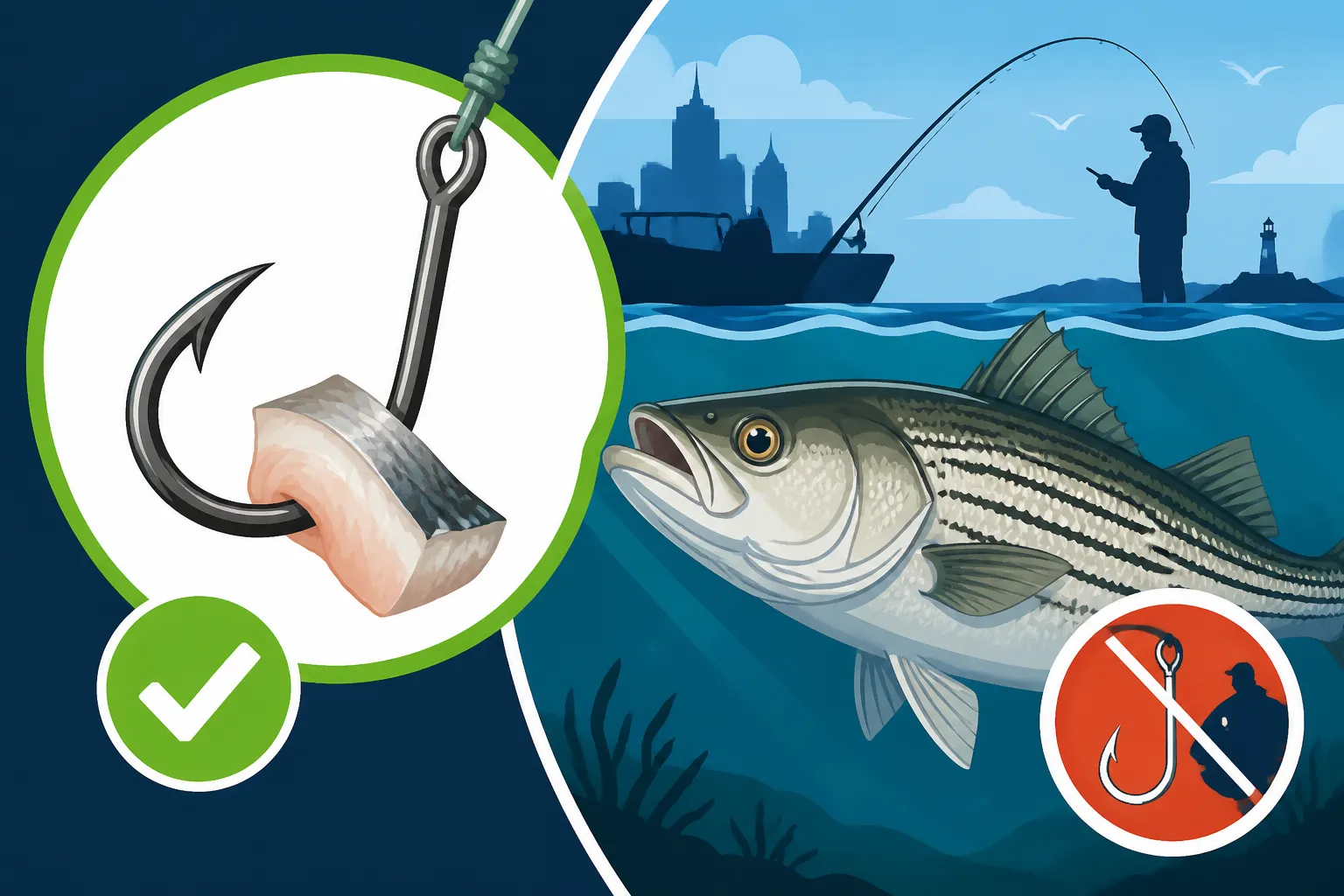
The magic of the circle hook lies in its self-setting nature. When a striped bass takes bait rigged on a circle hook, it often swallows the entire offering just as it would with a J-hook. However, as the fish turns and the line comes taut, the unique shape of the circle hook allows it to slide cleanly out of the fish's throat or gullet without snagging. As it exits, the inward-pointing tip catches almost invariably in the corner of the fish's jaw, precisely where it's designed to hook. This means the hook avoids vital organs like the gills or stomach, which are so often damaged by traditional hooks. You don't "set the hook" with a sharp yank; instead, the hook does the work itself as the line tightens. It's a completely different approach to hooking fish, and it's remarkably effective and humane.
Dramatically Improved Survival Rates
The evidence supporting circle hooks is compelling. Studies conducted by fisheries biologists and conservation groups have consistently shown that using circle hooks significantly reduces the incidence of deep hooking in many species, including striped bass. For fish that are caught and released – which is a huge part of striped bass fishing, especially for those targeting trophy fish or adhering to slot limits – this translates directly into a much higher survival rate.
Imagine the sheer volume of striped bass caught each year in popular areas like the Hudson River or the waters off Long Island. Even a small percentage reduction in mortality, multiplied across hundreds of thousands of angling trips, results in a massive number of fish saved. This conservation benefit is especially crucial when considering the health of the overall fishery. By ensuring more released fish survive, we are directly contributing to the long-term sustainability and abundance of striped bass populations in New York waters. It allows more fish to reach maturity, spawn, and contribute to future generations, reinforcing the vital role that responsible angling plays in ecosystem health.
New York's Mandatory Circle Hook Regulation for Striped Bass
New York State, like many other states along the Atlantic coast, recognized the critical need to protect its striped bass population. The data on deep hooking and post-release mortality was clear, leading to the implementation of regulations that directly impact how we fish for these magnificent creatures. This wasn't just a suggestion; it became a requirement, making it imperative for every angler to understand and comply.
The Specifics of the Regulation
The New York State Department of Environmental Conservation (DEC) officially requires the use of non-offset circle hooks when fishing for striped bass with bait. This regulation applies statewide, whether you're fishing in freshwater sections of the Hudson River where striped bass run, or in the saltwater estuaries and coastlines. The key phrase here is "with bait." If you're using artificial lures exclusively, like plugs, jigs, or soft plastics without any added organic bait, then circle hooks are not required. However, if you attach any form of natural bait—be it a chunk of bunker, a live eel, or even a piece of clam—to your artificial lure or directly to your line, then a non-offset circle hook becomes mandatory.
This regulation came into effect to align New York with other states in the Atlantic Striped Bass Management Plan, aiming for a consistent conservation effort across the species' range. It's important to remember that these rules, much like other aspects of the New York Fishing Regulations Explained, are subject to change. Always check the latest guidance from the DEC before you hit the water. Specifics like the required circle hook size can sometimes be found in the official regulations, but generally, it means matching the hook to your bait and target fish size. And for any questions about New York Striped Bass Length Requirements or other restrictions, the DEC website is your go-to resource.
What Anglers Need to Know and Do
For anglers, this means a shift in mindset and technique. First and foremost, if you plan on bait fishing for striped bass, you must have non-offset circle hooks in your tackle box. An offset circle hook has the point offset from the shank, which can increase the chance of deep hooking, negating some of the conservation benefits. Non-offset hooks are designed to keep the point in line with the shank for optimal performance. You can find a wide variety of these hooks from brands like Mustad, Gamakatsu, and Owner, easily available online at places like Amazon or your local tackle shop.
Beyond just having the right gear, understanding how to fish with a circle hook is crucial. The biggest mistake new circle hook users make is trying to "set the hook" like they would with a J-hook. A sharp, powerful jerk will often pull the bait right out of the fish's mouth without hooking it. Instead, you need to let the fish take the bait and then slowly tighten the line until you feel resistance. The fish will hook itself in the corner of its mouth as it turns and swims away. This patient approach might feel strange at first, but it's incredibly effective and dramatically reduces harm to the fish. Embracing this new technique is part of being a responsible angler in New York.
Best Practices for Using Circle Hooks Effectively
Adopting circle hooks for striped bass bait fishing isn't just about complying with a rule; it's about becoming a more skilled and conservation-minded angler. Like any new technique or piece of gear, there's a learning curve, but with a few best practices, you'll be confidently catching and safely releasing striped bass in no time. The goal is to maximize the benefits of these hooks for both you and the fish.
Choosing the Right Circle Hook
Not all circle hooks are created equal, and selecting the right one can make a significant difference. As mentioned, the regulation specifically calls for non-offset circle hooks. An offset hook has the point slightly angled out from the shank, which can increase the chance of the hook embedding in the gullet before it has a chance to slide to the corner of the mouth. Non-offset hooks keep the point in line with the shank, ensuring that self-setting action works as intended to secure a mouth hook. When you're browsing for hooks, whether it's at a local bait shop or on Amazon, always look for "non-offset" in the description.
Reputable brands like Mustad, Gamakatsu, and Owner offer excellent non-offset circle hooks in a variety of sizes and wire strengths. The size of the hook should always match the size of your bait and the target fish. For instance, if you're using large chunks of bunker or whole live eels, you'll need a larger hook (e.g., 8/0 to 12/0) to ensure the point is exposed after baiting. For smaller baits like clams or sandworms, a smaller hook (e.g., 3/0 to 5/0) will be more appropriate. A good rule of thumb is that the hook's gap should be wide enough to accommodate the bait without impeding the point. This attention to detail will optimize your chances of a solid, corner-of-the-mouth hookup.
Mastering the Circle Hook "Set"
This is perhaps the biggest adjustment for anglers transitioning from J-hooks. Forget the aggressive, sweeping hookset you've practiced for years. With circle hooks, that action is actually counterproductive. The key to successfully hooking a fish with a circle hook is patience and steady pressure.
Here's the refined technique:
- Detect the Bite: When a striped bass picks up your bait, you'll feel a distinct pull or tap. Don't react immediately with a jerk.
- Let the Fish Take It: Allow the fish to move away with the bait, letting the line come tight on its own. The fish needs to fully turn its head and start swimming off for the hook to properly engage.
- Reel, Don't Jerk: Instead of snapping the rod back, simply start reeling steadily. As the line tightens, the circle hook will slide into position and, almost magically, seat itself in the corner of the fish's jaw. You'll feel the rod load up, indicating a solid hookup.
It truly is a "reel-and-feel" approach rather than a "strike-and-set." This method takes some getting used to, but once you master it, you'll find your hookup ratio increases, and the stress of deep-hooking diminishes significantly. For those looking to improve their odds, reading up on How to Use Circle Hooks for Striped Bass can provide even more nuanced tips. This is especially useful when bait fishing for stripers in key locations like the Hudson River or during specific events like the Striped Bass Season on the Hudson Runs April Through November.
Safe Handling and Release
Even with the benefit of circle hooks, proper fish handling and release techniques remain paramount, especially since many striped bass caught in New York waters fall within "slot limits" or are targeted for Catch-and-Release Handling Rules. A legal fish might still be released if you're hoping for a bigger one, or if it exceeds the maximum size limit.
When you've got a striped bass on the line, fight it quickly and efficiently to minimize exhaustion. Once it's alongside the boat or on shore, avoid dragging it onto dry, abrasive surfaces. If you plan to release it, handle the fish as little as possible. Wet your hands before touching it to protect its slime coat.
With a circle hook, the hook is almost always in the corner of the mouth, making removal much easier and quicker. Use a dehooker or a pair of long-nosed pliers (which you can also find on Amazon) to quickly twist the hook out. Avoid sticking your fingers inside the fish's gills or holding it by the eye sockets. If you need to take a quick photo, support the fish horizontally with two hands. For larger fish, cradle them in the water.
Once the hook is removed, gently revive the fish by holding it upright in the water, facing into the current, until it regains its strength and swims away under its own power. This careful approach, combined with the effectiveness of circle hooks, dramatically boosts the survival rates of released striped bass, contributing to a healthier and more sustainable fishery for everyone. Understanding the nuances of New York Striped Bass Slot Limit Explained is also critical for responsible angling.
Circle Hooks vs. J-Hooks for Bait Fishing
To summarize the key differences and benefits, let’s look at a quick comparison between J-hooks and circle hooks when used for bait fishing, especially for species like striped bass. This table highlights why the shift to circle hooks was so important for conservation in New York.
| Feature | J-Hooks (Traditional) | Circle Hooks (Mandatory for Striper Bait) |
|---|---|---|
| Hook Point | Straight, often curves toward the shank | Curves inward, pointing to the shank |
| Hooking Action | Requires angler to "set" with a sharp jerk | Self-setting; fish hooks itself as line tightens |
| Common Hooking Zone | Deep in gullet, esophagus, or gills | Corner of the jaw, typically |
| Post-Release Survival | Lower, due to frequent deep hooking injuries | Significantly higher, due to jaw hooking |
| Angler Technique | Aggressive, immediate response to a bite | Patient, allow fish to take bait, then reel |
| Conservation Impact | Higher mortality in catch-and-release scenarios | Minimized mortality, supports fishery health |
| Regulation Status (NY Striper) | Generally prohibited with bait | Required with natural bait |
This table clearly illustrates why the New York DEC made the critical decision to mandate circle hooks for bait fishing striped bass, as detailed in the Striped Bass Circle Hook Requirement guidelines. It's a choice driven by conservation, aimed at ensuring that our vibrant populations of Fish Species You Can Catch in New York, especially these iconic stripers, continue to thrive.
The requirement for circle hooks when bait fishing for striped bass in New York isn't just another regulation; it's a testament to our collective commitment to conservation. It's a clear demonstration that anglers, working with wildlife agencies, can make a tangible difference in protecting our precious fisheries. By embracing these hooks and refining our techniques, we contribute directly to the health and longevity of the striped bass population, ensuring future generations can enjoy the thrill of battling these magnificent fish in New York's incredible waters. It’s an investment in the future of our sport and our natural resources.
Disclaimer
The information provided in this guide is for general informational purposes only and is not a substitute for official New York State Department of Environmental Conservation (DEC) regulations. Fishing rules and regulations can change frequently. Always consult the most current New York DEC fishing regulations guide before engaging in any fishing activities. Compliance with all state and local laws is the angler's responsibility.