How to Figure-Eight a Muskie Boatside
There's nothing quite like the heart-stopping moment when you've been casting for what feels like hours, finally feel that solid weight of a giant muskie on the end of your line, only for it to follow your lure right up to the boat and then… just stare. It's a common, frustrating scenario for many anglers targeting these elusive giants. This guide is all about mastering the "figure-eight" technique, a crucial boatside maneuver that can turn those frustrating follows into exhilarating strikes and successful catches, specifically for muskie fishing in New York waters.
Understanding the Muskie Follow and Why the Figure-Eight Works
Muskies, often called the "fish of a thousand casts," are apex predators in New York's freshwater systems, from the St. Lawrence River to the various lakes. They're notorious for their cautious yet curious nature, often shadowing a lure right to the boat without committing. This isn't just a fluke; it's a deeply ingrained part of their hunting instincts. Understanding this behavior is the first step to knowing how to trick them into striking.
The Muskie's Hunting Instincts
Muskies are ambush predators, perfectly camouflaged and incredibly patient. When they follow a lure, they're often doing a few things: assessing its size, speed, and behavior; waiting for a weakness; or simply being curious about something unusual in their territory. They are not always in a full-on feeding frenzy. Sometimes, a muskie will track a lure from a considerable distance, remaining hidden until the very last moment, only to reveal itself at the boat. This reveal can be startling for an angler, but it's also your golden opportunity. The fish is there, it's interested, but it hasn't committed. It's looking for that final, undeniable trigger that says "this is food, and it's getting away!"
Think about it from the muskie's perspective. It has seen your lure, possibly from the depths or from a weed line. It has followed it, perhaps at a consistent speed, assessing whether it's worth the energy expenditure to strike. But then, the lure reaches an unnatural barrier – the side of your boat. This is where the illusion of a free-swimming baitfish can break down. The muskie might hesitate, realizing something is off, or simply waiting for the "prey" to make a mistake. Without that final, frantic movement, many a muskie has simply turned and vanished back into the depths, leaving the angler wondering what went wrong. This is where the figure-eight becomes critical, providing that burst of chaotic, fleeing action.
Mimicking a Fleeing Baitfish
The figure-eight maneuver works because it perfectly mimics a baitfish that has suddenly realized it's in danger and is attempting a desperate escape. Imagine a shiner or a perch swimming along, only to suddenly encounter a large object (your boat). Its instinct would be to dart away erratically, making quick turns and changes in direction to evade a predator. This sudden, frantic behavior often triggers a muskie's natural predatory response – the impulse to strike before the meal gets away. The key is to keep the lure in the water and moving fluidly, without any pauses or breaks in the retrieve.
When you execute a figure-eight, you're not just moving the lure in a circle; you're creating an illusion of erratic movement right in front of the muskie's face. The lure's sudden change of direction, combined with an increase in speed or a slight dip in depth, can be the exact jolt needed to convert a hesitant follower into an aggressive attacker. The wide, sweeping turns of the figure-eight allow the muskie, which might be a good six feet or more in length, ample room to turn and strike. It's a calculated gamble, a last-ditch effort to entice the strike, and it's surprisingly effective because it taps directly into the muskie's primal hunting instincts.
Essential Gear and Setup for Successful Figure-Eighting
Before you even think about executing a perfect figure-eight, you need to ensure your gear is up to the task. Muskie fishing isn't for the faint of heart, and these fish demand heavy-duty equipment. Skimping on your setup will only lead to heartbreak when that trophy fish decides to make its move boatside. Having the right tools isn't just about catching the fish; it's about doing it safely and efficiently, for both you and the muskie.
Rod, Reel, and Line for Muskie
When it comes to muskie fishing, "heavy-duty" is the name of the game. You're not targeting panfish here. These are powerful, toothy predators that will test every component of your setup. Your rod should be long and have a heavy power rating, typically in the 8- to 10-foot range, with a fast action. The extra length helps with casting those big baits, provides leverage during a fight, and is absolutely crucial for creating those wide, sweeping figure-eight turns beside the boat. A shorter rod simply won't give you the reach or the leverage to maneuver a muskie lure effectively during the boatside dance.
For your reel, a robust baitcasting model with a powerful, smooth drag system is non-negotiable. Look for models designed for heavy lures and big fish, with a high line capacity. The gear ratio is also important, as you'll be cranking large baits, sometimes quickly. Many anglers find their muskie-specific rods and reels, along with other specialized gear, on platforms like Amazon, where a wide selection from various brands is available. Your line should be heavy braided line, at least 80 to 100-pound test. This isn't just about breaking strength; it's about abrasion resistance against sharp teeth and tough structures, and it also provides the necessary backbone for setting hooks into a muskie's bony mouth. Finally, a heavy fluorocarbon or wire leader is absolutely essential. A muskie's teeth can easily cut through regular monofilament or braid, so don't skip this critical component. These leaders often range from 100 to 150-pound test, ensuring your lure stays connected to your line.
Lure Selection and Readiness
The type of lure you're throwing for muskie often dictates how effectively you can execute a figure-eight. While many muskie lures can be figure-eighted, some are simply better suited for it due to their design and action. Bucktails are classic muskie lures and are fantastic for figure-eighting because they create a lot of flash and vibration, keeping the muskie's attention during the maneuver. Glide baits and jerkbaits, with their erratic side-to-side actions, also lend themselves well to the figure-eight, as their natural movement already mimics a distressed baitfish. Large crankbaits can also be effective, particularly those with a tight wobble that can be maintained through the turns.
Regardless of the lure type, sharpness of your hooks is paramount. Muskie mouths are incredibly bony, and dull hooks will result in missed opportunities. Always check your hooks before a trip and sharpen them regularly. Consider replacing factory hooks with heavier, sharper trebles designed for muskie. Beyond the lure itself, your readiness is key. Have a large, rubberized landing net easily accessible and ready to deploy. These nets are designed to protect the fish's slime coat and are crucial for quick, safe release. Additionally, have long-nosed pliers, bolt cutters (for cutting hooks in an emergency), and a hook-out tool readily available. All these tools can be found on Amazon or at your local tackle shop, and having them within arm's reach means you can handle a hooked muskie safely and minimize its stress.
Step-by-Step Guide to Executing the Figure-Eight
The figure-eight isn't just some random flailing of your rod at the boat. It's a deliberate, controlled maneuver that requires attention and practice. Getting the technique right can make all the difference in converting those follows into strikes. It's a dance between you, your lure, and the muskie, and every step counts.
The Approach to the Boat
The crucial phase of the figure-eight begins long before your lure reaches the boat. You need to maintain a consistent retrieve speed, mirroring what you've been doing throughout your cast, right up until the lure is boat-side. The biggest mistake anglers make is slowing down or stopping their retrieve too early, which signals to the muskie that the chase is over. Keep that lure moving, making it look like a confident, unaware baitfish. As your lure gets close, be hyper-vigilant. You must look for the follow. This means watching behind your lure, especially in clear waters, for that tell-tale shadow or flash of a muskie. They often lurk just behind or slightly to the side, maintaining a respectful distance.
Your focus shouldn't just be on the lure; it should be on the water around it. Position yourself on the boat so you have a clear view and enough room to execute the maneuver. If you're fishing with a partner, communicate! They can also help spot the muskie. Sometimes, the muskie will appear as just a dark torpedo, other times you might only see a flash of its tail. If you don't see a muskie, it doesn't mean it's not there. Sometimes they are simply too deep or too stealthy. So, it's always a good habit to perform a figure-eight on nearly every retrieve, especially when fishing for species like muskellunge in New York where these follows are so common. Consider it standard procedure, almost like checking your rearview mirror while driving.
Initiating the Figure-Eight
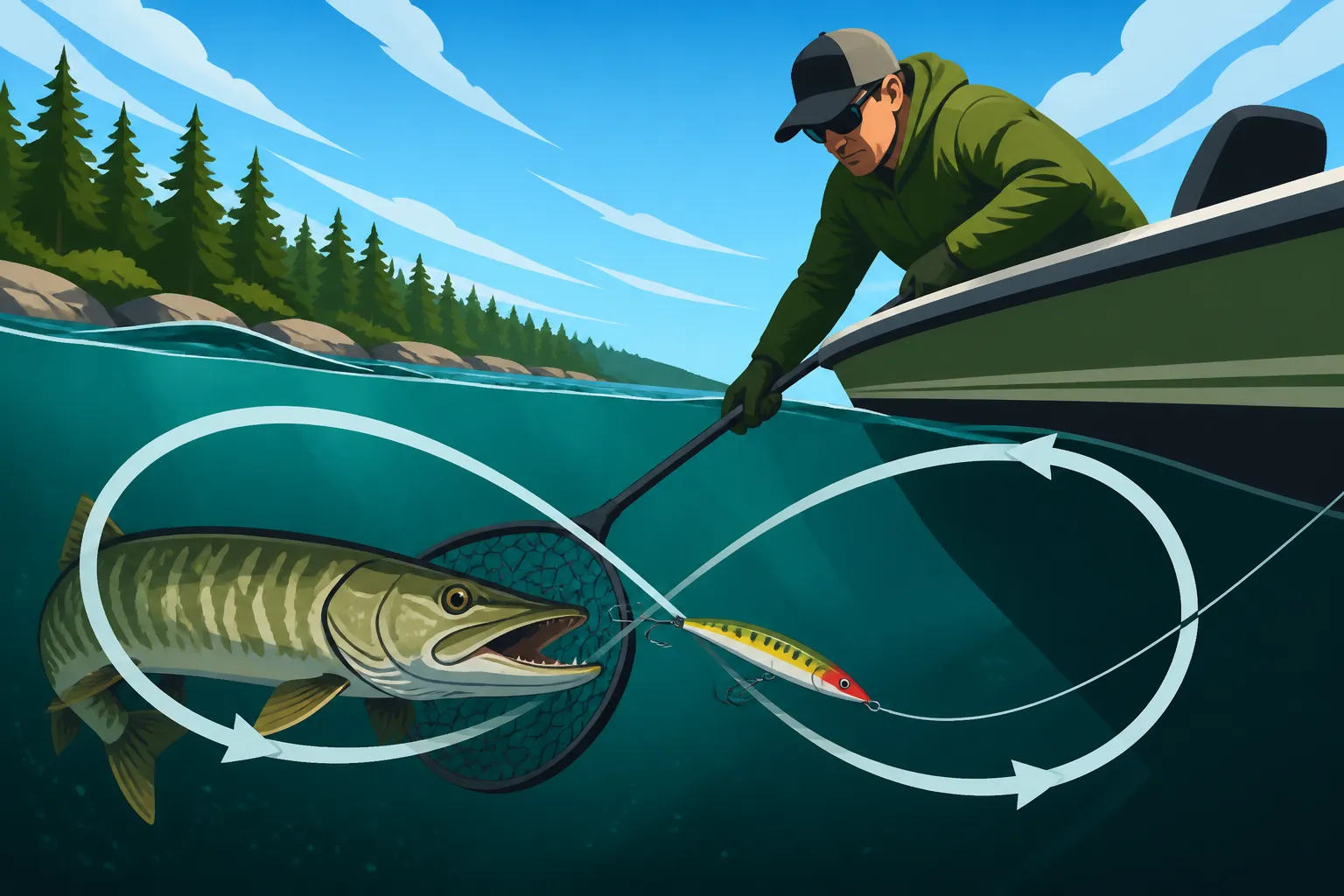
Once your lure reaches the boat and you've identified a follower (or even if you haven't, as a good practice), it's time to initiate the figure-eight. The key is a smooth, continuous transition from your straight retrieve into the pattern. Do not pull the lure out of the water or pause. As the lure approaches the side of the boat, smoothly sweep your rod tip down into the water (or just above the surface, depending on your boat's height and the lure's action). The goal is to guide the lure into a wide, sweeping "figure-eight" or "oval" pattern. Imagine drawing a large '8' on the surface of the water with your rod tip, keeping the lure immersed.
The width of your figure-eight is incredibly important. Many beginners make the mistake of drawing too small an '8', which doesn't give the muskie enough room to turn and strike. These fish are long and need space. Aim for loops that are at least as wide as your rod is long, perhaps even wider. Your rod tip should be doing most of the work, but don't forget to incorporate some reel retrieves as well, especially on the straightaways of the '8'. This keeps the blades of bucktails spinning and maintains the action of other lures. You're effectively continuing the retrieve, just in a different, more erratic pattern. The beauty of this technique is its adaptability, whether you're targeting muskie in the St. Lawrence River or in some of the larger New York's Finger Lakes.
Varying Speed and Depth
While a smooth, continuous motion is vital, a perfect figure-eight isn't always about uniform speed. Often, the trigger for a muskie strike is a sudden change in pace or depth. As you sweep your lure through the "8" pattern, experiment with slight accelerations and decelerations. For instance, as you come out of one loop and move into the next, you might briefly accelerate your retrieve, mimicking a panicked baitfish trying to escape. Then, as you complete the turn, you might slow it down slightly. This unpredictable action can be the final trigger for a hesitant muskie.
Similarly, don't be afraid to vary the depth of your lure slightly within the figure-eight. A slight dip or rise can add another dimension to the fleeing baitfish illusion. For example, as you sweep into a turn, you might lower your rod tip further into the water, causing the lure to dive a bit, then raise it as you come out of the turn. This dynamic movement can be incredibly enticing. Sometimes, a full "turn and burn" – a rapid, aggressive acceleration through one of the turns – is exactly what's needed to provoke a violent strike. Pay attention to the muskie's reaction (if you can see it). If it's still just following, try to increase the intensity or change the rhythm. If it suddenly gets agitated, that's your cue to keep up the pressure and anticipate a strike.
Common Mistakes and Advanced Tips for Figure-Eighting
Even experienced anglers can make mistakes when figure-eighting, especially when the pressure is on with a monster muskie at the boat. Knowing what pitfalls to avoid and having a few advanced tricks up your sleeve can significantly increase your success rate and ensure safer handling of these magnificent fish.
Avoiding Common Figure-Eight Blunders
One of the most common mistakes anglers make during a figure-eight is making the pattern too small. As mentioned, muskies are long, powerful fish. They need space to turn, open their large mouths, and commit to a strike. A tight, small figure-eight doesn't give them that room and can actually discourage a strike. Think wide, sweeping turns that extend well beyond the boat. Another critical error is stopping the lure. Even a momentary pause can kill the illusion of a fleeing baitfish and cause the muskie to lose interest and disappear. The motion must be continuous and fluid from the moment the lure reaches the boat until you either get a strike or decide the muskie isn't going to commit.
Not watching the muskie's reaction is another big blunder. If you're just mechanically performing the '8' without observing the fish, you're missing valuable cues. Is it getting closer? Is its dorsal fin flaring? Is it looking agitated? These are all signs that you're on the right track and might need to adjust your speed or depth to trigger the strike. Conversely, if it's just idly following, a more aggressive maneuver might be warranted. Lastly, anglers sometimes fail to have their net ready. When a muskie strikes boatside, it happens fast, and you need to be ready to quickly land the fish. A tangled net or one that's out of reach can cost you that trophy. Before you even start casting, ensure your net is deployed, untangled, and within arm's reach. This proactive approach applies to all types of muskie fishing, including chasing the New York's Biggest Muskellunge Ever Caught record.
Advanced Techniques and Safety
While the classic figure-eight is effective, don't be afraid to experiment with variations. Sometimes an "L" turn or an extended "oval" can be more effective than a perfect '8'. An "L" turn involves making a sweeping turn along the side of the boat, then quickly reversing direction and making another sweeping turn. This can sometimes create a more frantic, escaping baitfish action. Another advanced tip is to use the boat itself to your advantage. Muskies often like to use structure for ambushing prey. If a muskie is following, try to maneuver the lure around the prop wash or the boat hull itself, using it as cover. The muskie might feel more confident striking when it perceives the lure briefly disappearing behind an obstacle, only to reappear quickly. This can turn a follow into a territorial strike.
Safety is paramount when dealing with muskies. Their teeth are incredibly sharp, and large treble hooks are involved. Always wear appropriate eye protection and heavy-duty gloves. When a muskie strikes boatside, it's often violent and unexpected. Be ready for the sudden jolt. Make sure your hands and fingers are clear of the lure and the fish's mouth at all times. Use a long-handled net, and keep the muskie in the water as much as possible for unhooking and measuring. Minimize its time out of the water to reduce stress. If you're unsure about how to properly handle a muskie for release, look up resources on Catch-and-Release Handling Rules to ensure the fish's survival. Remember, the goal is not just to catch these magnificent fish, but to ensure they can be caught again. Many muskie anglers embrace catch-and-release, including those who have landed a World Record Catch-and-Release Muskie Caught on the St. Lawrence River. It's a testament to preserving these incredible fish and their natural habitat.
Table of Figure-Eight Techniques and Their Triggers
| Technique Variation | Description | Best Used When… | Potential Trigger |
|---|---|---|---|
| Classic Figure-Eight | Wide, fluid '8' pattern with continuous motion, rod tip guiding the lure just below the surface. | A muskie is following steadily but not committing. This is your go-to standard maneuver. Good for lures like bucktails and crankbaits. | Sustained erratic movement; perceived escape. |
| The "L" Turn / Oval | Instead of a symmetrical '8', perform a wider sweep along the boat, then a sharp, quick turn and another sweep in the opposite direction. | The muskie seems to be "checking out" the lure from a distance or is reluctant to come close to the boat. The sharp turn can create a more aggressive fleeing action. | Sudden, sharp change in direction; mimics a startled baitfish. |
| Speed Burst / Turn & Burn | Incorporate a sudden, aggressive acceleration of the lure during a turn or a straightaway of the figure-eight pattern. | The muskie is following very closely but seems hesitant, almost studying the lure. This shock tactic can provoke an immediate reaction. | Impulse to strike a rapidly escaping prey; "now or never" moment. |
| Depth Change | While performing the figure-eight, subtly dip the rod tip deeper on a turn, then raise it slightly on the straightaway. | The muskie is staying a bit deeper in the water column or seems uninterested in surface movements. This adds a vertical dimension to the escape. | Prey appearing to dive and resurface erratically. |
| Boat-Side Ambush | Use the boat's hull or prop wash as temporary "cover" by sweeping the lure tight against it before bringing it back out into the pattern. | The muskie is cautious and might be using the boat as a visual barrier. This can make the lure seem to "disappear" and reappear, triggering an ambush instinct. | Sudden reappearance of prey; triggers ambush predator instinct. |
Mastering the figure-eight is a rite of passage for muskie anglers, a testament to patience, observation, and quick reflexes. It truly can make all the difference between a thrilling story of a boatside strike and a frustrating tale of "the one that got away." So next time you're on the water, maybe learning How to Fish for Muskellunge in the famous Fishing New York's St. Lawrence River and Thousand Islands region, remember to always be ready to perform that critical figure-eight.
Disclaimer
This article is for general informational purposes only and does not constitute professional advice. Laws, prices and regulations vary by location and change over time. Consult a qualified professional for guidance on your specific situation.