How to Fly Fish in New York
Embarking on the journey of fly fishing in New York can feel incredibly daunting. You’ve probably heard seasoned anglers talk in hushed tones about "matching the hatch" or "reading the water," making it sound like an arcane art only accessible to a chosen few. But don't let that intimidate you! This comprehensive guide is here to demystify fly fishing across New York State, from the renowned trout streams to the exhilarating saltwater flats, providing you with the knowledge and confidence to cast your first line or refine your existing skills.
Understanding New York's Diverse Fly Fishing Landscape
New York State, often lauded for its bustling urban centers, actually boasts an incredible array of natural beauty and diverse fishing opportunities. When it comes to fly fishing, this diversity is a huge advantage, but it also means you need to understand the different environments you might encounter. From gin-clear mountain streams to vast Great Lakes tributaries and the salty churn of the Atlantic, New York truly has it all for the fly angler.
Freshwater vs. Saltwater Opportunities
When most people think of fly fishing, they picture a serene angler in waders, casting gracefully on a trout stream. And while New York certainly delivers on that classic image, it offers so much more. Our state is uniquely positioned to provide both exceptional freshwater and thrilling saltwater fly fishing experiences, sometimes within a relatively short drive of each other.
Freshwater fly fishing in New York is incredibly varied. You have the classic coldwater fisheries, home to native brook trout, wild browns, and robust rainbows in places like the Catskills and Adirondacks. These often involve smaller streams, precise casting, and a keen eye for insect hatches. Then there are the larger rivers and lakes, including the Great Lakes tributaries, where you can target powerful migratory species like Chinook and Coho salmon, and hard-fighting steelhead. Here, the gear and tactics shift dramatically, favoring heavier rods and different presentation styles. Beyond the coldwater realm, our countless lakes and warmwater rivers offer fantastic opportunities for species like largemouth and smallmouth bass, northern pike, and even panfish on a fly. The beauty of freshwater is its accessibility; there are public access points and pristine waters almost everywhere you look.
However, don't overlook the incredible saltwater fly fishing New York has to offer, particularly around Long Island and the New York City area. Targeting striped bass on the fly in the vast expanse of Long Island Sound or the numerous bays can be an electrifying experience. Imagine casting into breaking schools of bunker with stripers chasing them, or stalking bluefish in the surf. It's a completely different challenge, often requiring heavier gear, different flies, and a solid understanding of tides and currents. The sheer power of these saltwater species on a fly rod is something every angler should experience. Deciding between fresh and salt often comes down to personal preference for the challenge, the environment, and the target species, but New York allows you to explore both with abandon.
Key Regions for Fly Fishing in New York
New York's geography blesses us with several distinct regions, each with its own character and species for the fly angler. Knowing these hotspots can help you plan your next adventure and ensure you have the right gear and expectations.
The Catskill Mountains are arguably the birthplace of American dry fly fishing, and for good reason. Rivers like the Beaverkill, Willowemoc Creek, and the Esopus are legendary. These freestone rivers and spring creeks are teeming with wild brown trout and brook trout, demanding delicate presentations and an intimate knowledge of entomology. Anglers here often spend as much time observing the water for rising fish and emerging insects as they do actually casting. It’s a truly immersive experience, rich in history and tradition. The challenge here is the educated fish and often technical casting required in brushy environments. If you want to dive deep into delicate trout fishing, the Catskills are your mecca. For more information on trout fishing in this iconic region, check out our guide on the Best Trout Streams in the Catskills.
Moving north, the Adirondack Mountains offer a wilder, more remote fly fishing experience. Here you'll find countless ponds, lakes, and streams, many accessible only by hiking or paddling. While trout are still a primary target, often native brook trout in pristine waters, you'll also find opportunities for smallmouth bass and northern pike. The Adirondacks are less about delicate dry fly presentations and more about exploring untouched waters, often with a float tube or canoe. It’s a place for anglers who love solitude and adventure as much as catching fish. The sheer volume of water here means endless exploration.
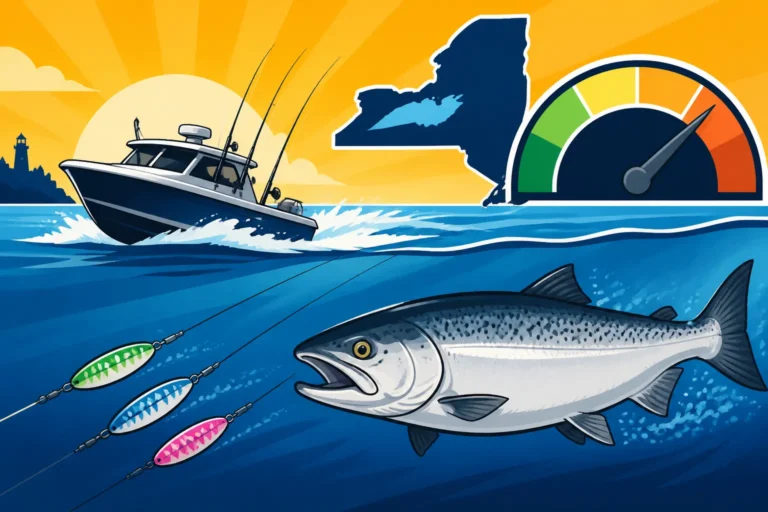
Then there are the Great Lakes Tributaries, specifically those flowing into Lake Ontario and Lake Erie. These rivers, like the Salmon River, Oswego River, and Oak Orchard Creek, come alive in the fall, winter, and spring with massive runs of Pacific salmon (Chinook and Coho) and steelhead (migratory rainbow trout). This is power fishing on a fly rod. Anglers use heavier rods, often 8-10 weights, and techniques like nymphing with egg patterns or stripping large streamers. The fish here are big, strong, and make incredible runs. It’s a completely different ballgame than delicate Catskill trout fishing, focused on brute strength and endurance. The sheer number of fish in these systems during a run can be astounding, creating an almost communal angling experience. Our guide on Lake Ontario Fishing in New York: Where to Go provides more details on these incredible fisheries.
Finally, Long Island and the surrounding saltwater areas offer a completely different, adrenaline-pumping experience. From the shallow bays to the open ocean, you can target striped bass, bluefish, false albacore, and even fluke with a fly rod. This requires durable, corrosion-resistant gear, heavier lines, and a willingness to brave the elements. Casting large flies into a stiff breeze or strong current is often the norm. Places like Montauk, known for its incredible "fall run," become epicenters for striped bass enthusiasts. The tidal movements and marine baitfish patterns dictate much of the fishing here. If you're looking for an intense fight and the thrill of saltwater species, this region is a must-visit. If you're interested in pursuing striped bass, take a look at our article on Fishing the Hudson River in New York: Where to Go, which also highlights opportunities for these incredible fish further upriver.
Essential Gear for New York Fly Fishing
Alright, let's talk gear. This is often where new fly anglers get hung up, feeling like they need to spend a fortune or understand an entirely new language. While it's true that fly fishing has specialized equipment, it doesn't have to break the bank, and understanding the basics is simpler than you might think. The key is choosing the right tools for the job, especially given New York's diverse fisheries.
Rods, Reels, and Line Selection
Choosing your fly rod, reel, and line is like picking the right tools for any craft – you wouldn't use a sledgehammer for delicate surgery, right? In fly fishing, the "weight" of your rod (a number from 0 to 14+) determines its power and the size of fish and flies it can handle.
For general trout fishing in New York's Catskill or Adirondack streams, a 4-weight or 5-weight rod, typically 8.5 to 9 feet long, is an excellent all-around choice. This setup offers enough backbone to fight most trout you'll encounter while still being light enough for delicate presentations and enjoyable casting. It's truly versatile. You'll pair this with a matching 4- or 5-weight floating fly line, which is essential for presenting dry flies and lighter nymphs. The reel for trout fishing is primarily a line holder; you don't typically fight fish off the reel unless you hook into a truly massive one. For a solid starter setup, you can often find decent combos on platforms like Amazon that include a rod, reel, and line, making it easier to get started without too much individual component matching.
If you're looking to target larger warmwater species like bass, northern pike, or even heavier trout on bigger rivers or lakes, a 6-weight or 7-weight rod is a better option. These rods have more power for casting bigger, wind-resistant flies (like poppers or streamers) and provide more leverage to control stronger fish. For bass fishing especially, you might use a weight-forward floating line, or even an intermediate sinking line to get your flies down to depth.
For the truly powerful Great Lakes salmon and steelhead runs or saltwater species like striped bass, you'll need to step up significantly. An 8-weight or 9-weight rod, often 9 to 10 feet long, is the standard. These rods are built to cast heavy flies and battle incredibly strong, fast-running fish. For these applications, a good disc-drag reel is crucial, as these fish will often peel line off your reel at high speeds. Your fly line choice will depend on the depth and current; sinking tip or full-sinking lines are common for getting flies down to steelhead and salmon in deep runs, while weight-forward floating or intermediate lines work for striped bass in shallower areas or on the surface. Understanding the species you're after will directly influence your rod choice, and our guide on Best Rod Weight for New York Trout Streams offers a deeper dive into selecting the right rod for specific conditions.
Here's a quick comparison table:
| Rod Weight (Typical Length) | Target Species (NY) | Common Line Type | Primary Use |
|---|---|---|---|
| 3-4 wt (7.5-8.5 ft) | Small stream trout, panfish | Floating | Delicate presentations, small flies |
| 5-6 wt (8.5-9 ft) | General trout, smallmouth bass, moderate warmwater | Floating (WF) | All-around versatility, medium flies |
| 7-8 wt (9-10 ft) | Largemouth bass, pike, light steelhead, smaller stripers | Floating, Sinking Tip, Intermediate | Heavier flies, stronger fish, some wind |
| 9-10 wt (9-10 ft) | Steelhead, salmon, striped bass, bluefish, pike | Sinking Tip, Full Sinking, Intermediate | Heavy flies, powerful fish, long casts in wind |
Waders, Boots, and Apparel
Beyond your rod and reel, what you wear and how you keep yourself comfortable and safe on the water is paramount. New York's fishing seasons can span everything from scorching summer days to icy winter mornings, so your apparel needs to be adaptable.
Waders are often the first major clothing investment for many fly anglers. Chest waders are the most popular choice as they allow you to wade deeper and provide warmth and protection. Breathable waders, typically made from GORE-TEX or similar materials, are fantastic for warmer weather or active hiking, as they allow sweat to escape. Neoprene waders, on the other hand, offer superior insulation and are preferred for cold weather or ice fishing. Consider the thickness of neoprene (usually 3mm or 5mm) based on how cold the water you’ll be in generally is. A good pair of waders should fit comfortably, allowing for layering underneath without being too baggy. Investing in quality waders is wise; cheap waders often leak quickly, leading to miserable experiences on the water.
Wading boots are just as critical as your waders. They need to provide excellent traction on slippery rocks and riverbeds, which are common hazards in New York streams. Felt soles offer the best grip on slimy rocks, but they can be problematic in areas where invasive species transfer is a concern, as they can harbor organisms. Rubber soles with studs or interchangeable sole systems are becoming increasingly popular, offering a good balance of grip and environmental responsibility. Make sure your boots are comfortable for walking, as many prime fishing spots require a hike to access.
Underneath your waders, layering is key. In cold weather, moisture-wicking base layers (no cotton!) will keep you warm, followed by fleece or synthetic mid-layers. In warmer weather, lighter synthetic pants or shorts are sufficient. On top, again, layers are your friend. A good fishing shirt (often UPF-rated for sun protection) and a waterproof, breathable rain jacket are essential for New York's unpredictable weather. Don't forget a hat for sun protection and polarization, and polarized sunglasses are a non-negotiable item – they cut glare and allow you to see fish and structure underwater. A comfortable vest or sling pack for carrying your fly boxes, tippet, and tools rounds out the essential apparel, keeping everything you need within easy reach.
Must-Have Fly Patterns for New York
The world of fly patterns is vast and can feel overwhelming, but for New York, there are certainly some staples that you'll want to have in your fly box. The key is to carry a variety that can imitate different insect life cycles and forage fish.
For trout fishing, especially in the Catskills or Adirondacks, you'll want a selection of:
- Dry Flies: These imitate adult insects on the surface. Classic patterns include the Adams (a great all-around mayfly imitation), Elk Hair Caddis (for caddisflies), and ant or beetle patterns for terrestrial season. Different sizes are crucial; sometimes fish are keying in on tiny size 20 midges, other times on larger size 12 caddis.
- Nymphs: These imitate immature insects underwater and are often responsible for 80-90% of a trout's diet. Patterns like the Pheasant Tail, Hare's Ear, Prince Nymph, and Squirmy Wormy are perennial favorites. Having them in various sizes and with or without beadheads (for weight) is important.
- Streamers: These imitate baitfish or larger aquatic creatures. Woolly Buggers (in black, olive, or white) are arguably the most versatile streamer and a must-have for any fly box. Clouser Minnows can also be very effective for larger trout and bass.
When targeting steelhead and salmon in the Great Lakes tributaries, your fly box will look a bit different:
- Egg Patterns: These imitate fish eggs, which are a primary food source for steelhead during the spawning runs. Glo-Bugs and Sucker Spawn patterns in various colors (chartreuse, orange, pink) are essential.
- Stonefly Nymphs: Large, dark stonefly imitations can be very effective, especially earlier in the runs.
- Streamers: Bigger, flashier streamers, sometimes called "intruder" style flies, are used to trigger aggressive strikes from these powerful fish. White, black, and chartreuse are popular colors. Our article on Best Fly Patterns for New York's Lake Ontario Steelhead offers more specific recommendations for these powerful fish.
For warmwater species like bass and pike:
- Poppers: Surface flies that create a commotion, drawing aggressive strikes. Frog and baitfish imitations are popular.
- Streamers: Again, Woolly Buggers are great. Larger baitfish patterns like Clouser Minnows or Deceivers (often in chartreuse, white, or blue/white) are excellent for imitating shad, shiners, or alewives.
For saltwater striped bass and bluefish:
- Clouser Minnows: A highly versatile and effective baitfish imitation, often tied in white/chartreuse, grey/white, or blue/white.
- Deceivers: Another classic baitfish pattern, known for its lifelike movement.
- Gurgler/Popper patterns: For surface action, imitating injured baitfish.
- Big Streamers: Generally, you're looking for flies that imitate herring, bunker, or sand eels, so size and profile matter.
No matter the species, remember that fly selection often comes down to observation. What are the fish eating? Are insects hatching? Is baitfish present? Having a diverse selection allows you to adapt.
Mastering Fundamental Fly Casting Techniques
The cast is often what captivates people about fly fishing, and also what intimidates them. It looks so fluid and effortless when done well, but clumsy and frustrating when not. Don't worry, everyone starts somewhere, and developing a smooth, efficient cast is a journey, not a destination. The good news is that the basic principles are relatively simple, and consistent practice will yield significant improvements.
The Basic Overhead Cast and Its Variations
The basic overhead cast is the cornerstone of almost all fly casting. It’s the motion you’ll use most often to present your fly to a target, whether that’s a rising trout or a cruising striped bass. The core idea is to use the weight of the fly line itself, rather than a weighted lure, to load the rod and propel the fly forward.
It starts with the rod tip low, typically aimed at your target. The forward stroke is a smooth, accelerating motion that stops abruptly at about 10 or 11 o'clock. This sudden stop transfers the energy from the rod to the line, sending the line backward into what's called the "backcast." During the backcast, you pause, allowing the line to fully unroll behind you. This pause is crucial, and its length depends on how much line you have out. Think of it like waiting for a wave to break. Once the line has straightened out behind you, you initiate the "forward cast." This is another smooth, accelerating stroke, pulling the rod forward and stopping at about 1 or 2 o'clock. The line then unrolls in front of you, delivering the fly.
Common mistakes include "tailing loops" (when the line tangles on itself in the air), which often happen from applying too much power too early or too late in the stroke, or from not having a straight line path during the casting stroke. Another common issue is "crushing the loop," which means your backcast and forward cast are too wide, creating a messy presentation. The goal is a narrow, tight loop that slices through the air, delivering the fly with precision and minimal disturbance. Practice in an open field, focusing on a consistent tempo and a crisp stop at the end of each stroke. You can even practice without a fly, just a piece of yarn on your leader.
Variations on the overhead cast include:
- False Casting: This isn't for catching fish but for preparing to cast. You keep the line moving back and forth in the air without letting the fly touch the water. It's used to dry your fly (especially dry flies), change direction, or extend more line before making your final presentation. Mastering this allows you to place your fly exactly where you want it.
- Hauling: This involves pulling on the fly line with your non-casting hand during the cast. A single haul adds speed and distance, while a double haul (pulling on both the backcast and forward cast) can significantly increase line speed, allowing for longer casts, particularly helpful in windy conditions or when using heavier flies, common when pursuing species like steelhead or striped bass.
Roll Casting for Tight Spots
While the overhead cast is fantastic in open areas, New York's often-brushy stream banks, particularly in the Catskills or Adirondacks, present a common challenge: limited backcasting room. This is where the roll cast becomes an invaluable tool. It allows you to cast your fly forward without needing any space behind you.
The principle of the roll cast is to create a D-loop of line in front of you. You start with most of your line lying on the water directly in front of you. Then, slowly lift your rod tip upward and backward, drawing the line into that D-shape, but without letting it go behind you. The crucial part is to "load" the rod, creating tension with the line on the water. Once that D-loop is formed and the rod is loaded, you make a sharp, forward stroke, similar to the overhead cast but usually stopping a bit lower. The energy from the rod "rolls" the line forward off the water, propelling your fly to the target.
The roll cast is incredibly useful for getting a fly out from under overhanging branches, fishing from a steep bank, or when fishing from a boat with obstructions behind you. It’s not a distance cast, but it’s perfect for presenting a fly accurately in close quarters. Practicing this cast will save you countless frustrations and snagged flies when fishing tight streams. It's a fundamental technique for any New York angler tackling our smaller, more intimate waterways.
Understanding Line Management and Presentation
Beyond the actual act of casting, line management and presentation are arguably more critical for consistent success in fly fishing. A perfect cast means nothing if your fly drifts unnaturally or spooks the fish.
Line management refers to everything you do with the fly line after the cast and before the retrieve. It's about controlling slack, mending your line, and setting the hook effectively.
- Stripping and retrieving: For streamers or subsurface flies, you’ll typically retrieve the line by stripping it in with your non-casting hand. The speed and rhythm of these strips can imitate various baitfish movements.
- Mending: This is vital in moving water. When your fly lands upstream, the current will often drag your line, causing your fly to accelerate unnaturally ("drag"). To counteract this, you "mend" your line by flipping an upstream or downstream loop of line with your rod tip. This buys your fly more time to drift naturally at the same speed as the current, which is critical for fooling wary trout. Learning to mend is one of the biggest leaps in skill for any fly angler.
- Slack control: Too much slack in your line means you won't feel subtle takes, and your hook set will be ineffective. You always want to maintain a direct connection to your fly as much as possible, while still allowing it to drift freely. This is a constant balance and a skill developed with experience.
Presentation is how your fly behaves when it hits and drifts in the water. For trout, especially when dry fly fishing, "dead drift" is often the holy grail. This means your fly floats on the surface exactly like a natural insect that has fallen onto the water, without any drag from your line. This is where those mends come in! For nymphs, a natural sink rate and drift are important. For streamers, the presentation might be an aggressive strip-and-pause to imitate a fleeing baitfish.
Ultimately, effective line management and presentation are about making your artificial fly look as natural and appealing as possible to the fish. It’s about being observant of how real insects and baitfish behave, and trying to replicate that with your cast and line control. It's an ongoing learning process, but one that directly correlates to your success on the water.
Reading the Water and Understanding Fish Behavior
Once you can cast, the next big hurdle—and perhaps the most fascinating aspect of fly fishing—is learning to read the water and truly understand fish behavior. It’s not enough to simply cast; you need to cast to where the fish are, and often, to where they will be. This involves a bit of detective work and a lot of patience, but it’s what separates a lucky catch from consistent success.
Identifying Fish Holding Lies
Fish are creatures of habit and efficiency. They generally position themselves in places that offer three things: food, cover (protection from predators and strong currents), and oxygenated water. These spots are known as "holding lies." Learning to identify them is paramount.
In a river or stream, look for changes in current speed and depth.
- Seams: These are lines where fast water meets slow water. Fish often sit in the slower water, waiting for food to be swept past them in the faster current. These are prime feeding lanes.
- Riffles and Runs: Shallow, broken water (riffles) tumbles into deeper, smoother sections (runs). Fish will often hold at the head or tail of runs, where food is concentrated.
- Pools: Deep, slow-moving sections of a river often hold larger fish, offering them security and a resting place. Look for structure within pools like submerged logs or rocks.
- Structure: Any obstruction in the water provides cover and breaks the current. Boulders, fallen trees (logjams), undercut banks, and even bridge abutments are all excellent places for fish to hide and ambush food. Overhanging vegetation also provides cover and often drops terrestrial insects onto the water.
- Eddies: These are pockets of slower, swirling water found behind large rocks or along river bends. Food often collects here, and fish can hold with minimal effort.
In lakes and ponds, reading the water shifts focus. Look for:
- Drop-offs: Areas where shallow water quickly transitions to deeper water. Fish often cruise these edges.
- Weed lines: The edges of aquatic vegetation provide cover and harbor baitfish and insects. Bass, pike, and panfish love these areas.
- Submerged structure: Rocks, logs, old foundations—anything that creates a break in an otherwise featureless bottom.
- Inlets and Outlets: Where streams flow into or out of a lake, bringing food and creating currents.
- Shadow Lines: On sunny days, the shade cast by trees or banks can attract fish seeking respite from direct sunlight.
In saltwater, understanding currents and structure is even more critical. Look for:
- Rip lines and current breaks: Similar to river seams, these are areas where currents collide or slow down, concentrating baitfish.
- Points and shoals: Underwater structure that creates current breaks and ambush points.
- Estuaries and inlets: Where rivers meet the sea, bringing nutrients and baitfish.
- Submerged rocks and jetties: Provide cover and feeding opportunities.
By mentally dissecting a piece of water and thinking about where you would be if you were a fish, you can dramatically improve your chances of success.
The Importance of Entomology and Hatch Matching
For freshwater fly anglers, particularly those targeting trout, understanding entomology—the study of insects—is a game-changer. Trout feed overwhelmingly on aquatic insects like mayflies, caddisflies, stoneflies, and midges, along with terrestrial insects like ants, beetles, and grasshoppers. When these insects emerge from the water to hatch into their adult form, or when they fall into the water, trout often key in on them exclusively. This is known as a "hatch."
Hatch matching is the art of identifying what insects are hatching or available as food and then selecting a fly pattern that closely imitates that insect's size, shape, and color, and presenting it at the correct stage of its life cycle (nymph, emerger, adult dry fly, or spinner).
- Mayflies: Often have upright wings and two or three tails. They undergo incomplete metamorphosis (nymph to dun to spinner). Famous hatches in New York include Sulphurs, Hendricksons, Cahills, and the massive Green Drakes.
- Caddisflies: Have tent-shaped wings and typically no tails. They undergo complete metamorphosis (larva to pupa to adult). They are known for their frantic egg-laying dives back into the water.
- Stoneflies: Flatter bodies, two sets of wings that lie flat over their backs, and two tails. They are important food sources, especially the larger varieties.
- Midges: Tiny, mosquito-like insects that hatch year-round, often in prodigious numbers, especially in tailwaters or during winter.
You don't need to be an entomologist with a microscope, but carrying a small kick net or visually observing the water for emerging insects, shucks (the casings left behind by emerging insects), or flying adults can give you critical clues. When you see fish rising consistently, paying attention to what they're eating (the size and color of the naturals) and how they're eating (delicate sips for tiny midges, splashy rises for caddis) will help you select the right fly from your box. Sometimes, a "generalist" pattern like an Adams or Elk Hair Caddis will work, but other times, trout can be incredibly selective, demanding a precise imitation. When fish are being picky, that's when understanding the hatch becomes truly vital.
Adapting to Water Conditions and Seasons
New York's weather is notoriously fickle, and water conditions can change rapidly, significantly impacting how and where fish feed. A successful fly angler knows how to adapt to these variables.
Water Temperature: This is perhaps the most crucial factor. Each fish species has an optimal temperature range for feeding and activity.
- Coldwater Species (Trout, Salmon, Steelhead): Prefer cooler water. In summer, they'll seek out cold spring-fed sections, deep pools, or heavily oxygenated riffles. In winter, they might hold in slower, deeper water where temperatures are more stable. Fishing for trout on the New York Trout Season Opening Day in April often means cold, high water, requiring different tactics than a low-water August evening.
- Warmwater Species (Bass, Pike, Panfish): Are more active in warmer water, typically slowing down dramatically in extreme cold or heat.
Water Levels and Clarity:
- High and Muddy Water: After heavy rains, rivers can become high and off-color. Fish might move closer to the banks to escape strong currents. Larger, darker flies or flies with a lot of vibration (like a heavily weighted streamer) can be more effective as visibility decreases. Sometimes, fishing during high water requires you to target specific eddies or slack water areas. Our guide on How to Fish Cold Water in New York covers similar conditions that affect fish behavior.
- Low and Clear Water: This often occurs in late summer or during droughts. Fish become incredibly spooky in clear, shallow water. Longer, lighter leaders and smaller, more delicate fly patterns are often required. Stealth and precise, drag-free presentations become absolutely critical. You might need to cast from a greater distance and approach fishing spots more cautiously.
Seasons: New York experiences four distinct seasons, each offering unique fly fishing opportunities and challenges.
- Spring: Often means high, cold water with melting snow, but also the start of major hatches and trout becoming very active. Steelhead runs peak in spring.
- Summer: Water levels drop, and temperatures rise. Trout fishing often becomes a dawn and dusk affair, or focused on high-elevation streams. Warmwater species, however, are in full swing.
- Fall: A favorite for many. Trout are aggressive, feeding heavily before winter. The incredible salmon and steelhead runs begin in the Great Lakes tributaries. Striped bass fishing can be epic on the coast.
- Winter: Offers unique challenges like ice fishing for panfish (if you adapt your fly gear), but also incredible opportunities for hardy anglers targeting steelhead in open water tributaries. This is when understanding specific regulations like the New York Freshwater Fishing Rules becomes even more crucial, especially for specific species and locations.
By paying attention to these factors and adjusting your approach, fly patterns, and presentation techniques, you'll be much more successful in navigating the dynamic world of New York's fisheries.
Targeting New York's Premier Fly Fishing Species
New York's diverse waters offer an incredible smorgasbord of fish species for the fly angler. Each species presents its own unique challenge and requires different approaches, making the state a fantastic place to expand your fly fishing repertoire.
Coldwater Classics: Trout and Salmon
When you think of fly fishing, you often think of trout, and New York delivers some truly world-class trout and salmon fishing experiences. These coldwater species are revered for their beauty, fighting spirit, and often, their pickiness.
Trout: New York is home to three main trout species:
- Brook Trout: The official state fish and our only native trout. Often found in smaller, pristine, cold-water streams and remote Adirondack ponds. They are incredibly beautiful, with worm-like markings (vermiculations) and bright red fins. They are generally not large, but their willingness to rise to a dry fly in a wild setting makes them a favorite. Light rods (2-4 weight) and smaller dry flies or nymphs are usually the ticket.
- Brown Trout: A European import that has thrived in New York. They are incredibly adaptable, found in everything from small streams to large rivers and lakes. Brown trout are known for their cunning and tendency to grow large, often becoming predatory on baitfish. They can be targeted with dry flies during hatches, nymphs subsurface, and especially with streamers for bigger fish. The New York Trout Season Opening Day on April 1st is an eagerly anticipated event for brown trout anglers across the state.
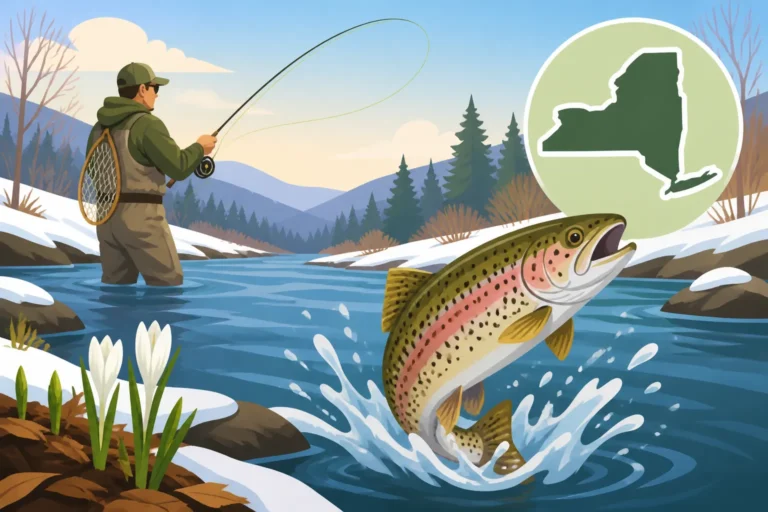
- Rainbow Trout / Steelhead: Rainbow trout are widely stocked across the state. Their migratory form, known as steelhead, is a huge draw in the Great Lakes tributaries. These fish are powerful, acrobatic fighters, making incredible runs and aerial displays. Targeting them often involves heavy nymphing rigs with egg patterns, or stripping large streamers. A strong 7-9 weight rod and a good drag system on your reel are essential for these fish.
Salmon: New York offers exciting opportunities for salmon, primarily in the Great Lakes system and some landlocked populations.
- Chinook (King) Salmon: The largest of the Pacific salmon, these fish make spectacular fall runs up the Lake Ontario tributaries. They are incredibly powerful, challenging anglers with blistering runs. Heavy-duty fly tackle (9-10 weight rods) and large, weighted streamers or egg patterns are needed to intercept these fish.
- Coho (Silver) Salmon: Also found in the Great Lakes, Cohos are known for their aggressive strikes and acrobatic fights. They are often targeted with similar tactics to Chinooks, though sometimes smaller flies can be effective.
- Landlocked Atlantic Salmon: These beautiful fish are found in some of New York's larger lakes, notably in the Finger Lakes and Lake Champlain drainage. They feed on baitfish and offer a thrilling fight, often taken by trolling large streamers or casting baitfish imitations near lake inlets and outlets.
Fly fishing for these coldwater species demands precision, stealth, and an understanding of their seasonal movements and feeding habits. It’s a rewarding challenge that connects you deeply with the natural world.
Warmwater Wonders: Bass and Panfish
While trout and salmon often get the spotlight, New York's warmwater fisheries offer fantastic, often overlooked, fly fishing opportunities that are perfect for beginners and seasoned anglers alike. These species are generally more forgiving, eager to strike, and provide exciting action.
Bass:
- Largemouth Bass: The quintessential warmwater game fish. Largemouths love weedy lakes, ponds, and slow-moving rivers. They are aggressive predators that readily attack surface poppers, deer hair bugs, and various streamers. Fishing for largemouths on the fly is incredibly visual and exciting, as you watch the fish erupt on your fly. It’s a fantastic way to experience topwater action. Fly fishing for them is often about targeting structure like lily pads, fallen logs, or docks. Check out our New York Bass Season Dates to ensure you're fishing legally.
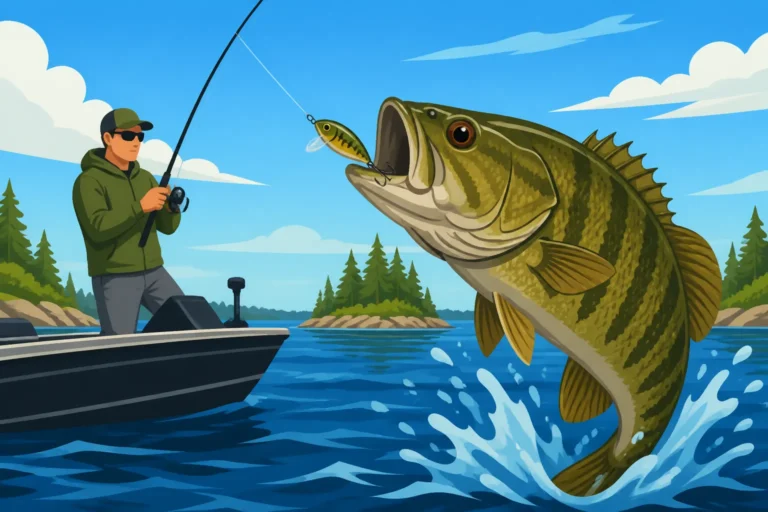
- Smallmouth Bass: Often called "bronzebacks" for their color and incredible fighting ability, smallmouths prefer cooler, clearer water than largemouths, thriving in large rivers, rocky lakes, and the Great Lakes. They are powerful fighters, making strong runs and sometimes jumping clear of the water. Streamers (like Clouser Minnows or Woolly Buggers), crayfish patterns, and even poppers are highly effective. You'll often find them around rocky points, current breaks, and gravel bars.
Panfish: These include species like bluegill, pumpkinseed sunfish, crappie, and yellow perch. They are often overlooked but offer some of the most consistent and enjoyable fly fishing, especially for beginners or those introducing kids to the sport.
- Bluegill and Sunfish: Found in virtually every pond and slow-moving stream in New York. They are eager biters and will attack tiny poppers, wet flies, and small nymphs with gusto. A light 2-4 weight rod makes even a small sunfish feel like a trophy. It's a perfect way to practice casting and hook setting.
- Crappie and Yellow Perch: These species can be found in larger schools in lakes and slower rivers. Crappie are particularly fun on small streamers or wet flies fished with a slow retrieve, offering a surprisingly strong fight for their size. Yellow perch will also readily take small nymphs or streamers.
Warmwater fly fishing is a wonderful way to enjoy the sport without the intensity often associated with trout or salmon. It's accessible, often productive, and incredibly fun.
Saltwater Thrills: Striped Bass and More
For the fly angler seeking a truly exhilarating challenge and powerful fish, New York's saltwater environment is a treasure trove. The dynamic coastal waters offer opportunities for strong, hard-fighting species that will test your gear and your angling prowess.
Striped Bass: These are the kings of New York's saltwater fly fishing. Stripers are migratory predators that inhabit the estuaries, bays, and coastlines, often in large schools. They will readily take flies that imitate the baitfish they feed on, such as bunker (menhaden), spearing, or sand eels.
- Targeting: Stripers can be found cruising shallow flats, ambushing baitfish near rocky structures, or smashing schools of bait on the surface in open water. The spring and fall migrations see huge numbers of fish moving along the coast and up major rivers like the Hudson. Fly fishing for them often involves casting large streamers (Clouser Minnows, Deceivers) into breaking fish or blind casting along promising structure. The Striped Bass Season on the Hudson Runs April Through November, offering ample opportunity to target these magnificent fish.
- Techniques: When fish are actively feeding on the surface, topwater poppers or Gurglers can create explosive strikes. Subsurface presentations with sinking lines or weighted flies are common when fish are holding deeper or feeding on bottom-dwelling bait. You'll need a stout 8-10 weight rod, a reel with a smooth, strong drag, and lines designed for saltwater conditions. The sheer power of a strong striper on the fly rod is an experience you won't soon forget.
Bluefish: Known for their voracious appetite and razor-sharp teeth, bluefish are aggressive fighters that can be a blast on a fly rod. They often chase bait in large, chaotic schools, creating exciting surface action. They'll readily hit large, flashy streamers, but be prepared for a toothy battle – a wire bite tippet is often a good idea to prevent cut-offs.
False Albacore (Albies): If you're looking for speed, false albacore are the ultimate challenge. These small tuna relatives are incredibly fast and powerful, making scorching runs that will test the limits of your drag system. They are often found busting bait on the surface in offshore waters and require accurate, quick casts with small, dense baitfish patterns. Their appearance is often fleeting, so readiness is key.
Other Saltwater Species: Depending on the season and location, you might also encounter other species on the fly, such as fluke (summer flounder), porgies (scup), or even tautog (blackfish) with specialized techniques.
Saltwater fly fishing is a dynamic and demanding pursuit, but the rewards of battling powerful game fish in a vast, open environment are truly exceptional. It requires dedication, but the thrills are unmatched.
Navigating New York's Fishing Regulations and Ethics
Before you even think about making your first cast in New York, it's absolutely essential to understand and abide by the state's fishing regulations. Not only is it the law, but it's also crucial for protecting our precious fisheries for future generations. Ignoring these rules can lead to hefty fines and loss of fishing privileges.
New York Fishing License and Registry Requirements
This is step one for any angler in New York State. Unless you fall into very specific exceptions (like fishing on a free fishing day or being under a certain age), you will need a fishing license.
- Freshwater Fishing License: Anyone 16 years of age or older needs a freshwater fishing license to fish in New York's inland waters. Licenses are available in various durations: annual, 7-day, or 1-day options, catering to residents and non-residents alike. You can purchase these online through the NYS DEC website, at DEC regional offices, or through numerous authorized license vendors like sporting goods stores and bait shops. It's really quite easy to get one, and our comprehensive New York Fishing License Guide breaks down all the options.
- New York Recreational Marine Fishing Registry: If you plan on fishing in New York's marine waters (e.g., Long Island Sound, the Atlantic Ocean, or tidal portions of rivers like the Hudson), you must register with the New York State Recreational Marine Fishing Registry. The good news is that this registry is generally free, but it is mandatory. Similar to the freshwater license, you can register online or through a licensed vendor. Even if you have a freshwater license, you'll still need to register for saltwater fishing.
- Stamps and Endorsements: While not as common for fly fishing as in other states, some specialized fishing might require additional stamps or endorsements. For instance, a "Trout/Salmon" stamp might be required in certain designated waters, though this is often integrated into the general license for freshwater fishing. Always double-check current regulations.
It's your responsibility to know the rules. Carry your license with you when fishing (a physical copy or digital on your phone, depending on current regulations) and be prepared to show it to an Environmental Conservation Officer (ECO) if requested. Fines for fishing without a license can be substantial, so don't risk it! The New York Fishing Regulations Explained guide details the legal framework for all types of fishing in the state.
Understanding Catch-and-Release Principles
Catch-and-release is a fundamental practice for many fly anglers, particularly when targeting sensitive species like wild trout or when fishing in waters with strict catch limits. However, simply releasing a fish isn't enough; it must be done properly to ensure the fish's survival.
Here are the core principles for effective catch-and-release:
- Minimize Fight Time: The longer a fish fights, the more exhausted it becomes, reducing its chances of survival. Use appropriate tackle that can subdue the fish quickly without overtiring it. For example, using a light 3-weight rod for a large steelhead is not responsible catch-and-release.
- Keep the Fish in the Water: This is perhaps the most important rule. Removing a fish from the water, even for a quick photo, deprives it of oxygen and can damage its delicate slime coat and internal organs due to gravity. If you must take a photo, do it quickly with the fish partially submerged.
- Handle with Wet Hands: If you need to touch the fish, wet your hands thoroughly first. Dry hands can remove the fish's protective slime coat, making it vulnerable to disease and infection.
- Avoid Squeezing: Never squeeze a fish, especially around its belly or gills. This can cause severe internal damage.
- Use Barbless Hooks: Barbless hooks (or hooks with the barb pinched down) cause less damage and are much easier to remove, resulting in less stress on the fish. Many special regulation waters in New York require barbless hooks.
- Proper Hook Removal: Use hemostats or needle-nose pliers to remove the hook gently. If the fish is deeply hooked and removal would cause more damage, it's often better to cut the line as close to the hook as possible, as the hook may eventually rust out.
- Revive the Fish: Hold the fish gently upright in the water, facing into a gentle current (or moving it gently back and forth in still water) until it regains its strength and can swim away on its own. Don't simply toss it back; wait until it gives a strong kick.
Many New York waters, especially certain sections of trout streams, are designated as "catch-and-release only" or have specific slot limits (e.g., you can only keep fish within a certain size range). Always consult the current DEC fishing regulations guide for the specific waters you plan to fish, as these rules can vary greatly from one stream to the next.
Ethical Angling and Conservation Practices
Beyond just licenses and catch limits, being an ethical angler means adopting a broader mindset of respect for the environment and fellow anglers. Fly fishing often cultivates a deep appreciation for healthy ecosystems, and our actions directly impact them.
- Leave No Trace: Pack out everything you pack in, and then some. This includes old fishing line, bait containers, and any other trash. Strive to leave the fishing spot cleaner than you found it.
- Respect Private Property: Always know if you're on public or private land. Obtain permission before accessing private property. Public fishing access (PFA) areas are clearly marked in New York.
- Be Considerate of Other Anglers: New York's popular waters can get crowded. Give other anglers plenty of space. Don't crowd someone's fishing spot, and be mindful of your casting arc. A friendly nod or greeting goes a long way. If you arrive at a spot where someone is already fishing, try to find a different access point or ask if it's okay to fish nearby.
- Avoid Spooking Fish: Move quietly along the bank or through the water. Loud noises, splashing, or running along the bank can spook fish for a wide area. Stealth is a virtue in fly fishing.
- Prevent the Spread of Invasive Species: New York is very proactive in combating invasive species. Always follow the "Clean, Drain, Dry" protocol for your waders, boots, boats, and gear. This means cleaning off all mud and vegetation, draining all water, and thoroughly drying your gear between fishing different bodies of water. This helps prevent the transfer of harmful organisms like whirling disease or zebra mussels.
- Understand and Report Violations: If you witness illegal fishing activity (e.g., poaching, over-harvesting, pollution), report it to the NYS DEC. These are conservation officers' jobs, and protecting our resources is everyone's responsibility.
By adhering to these ethical practices, we contribute to a healthier environment and ensure that the joys of fly fishing can be experienced by future generations of New York anglers.
Advanced Fly Fishing Strategies for New York Waters
Once you've mastered the basics of casting and understanding fish behavior, you'll naturally want to explore more specialized techniques to tackle the varied conditions and discerning fish in New York. Fly fishing offers a deep rabbit hole of strategies, each designed to present a fly in the most effective way possible for specific situations.
Techniques for Subsurface Success: Nymphing and Streamers
While the iconic image of fly fishing often involves a dry fly floating on the surface, the vast majority of a fish's diet comes from under the water. This is where nymphing and streamer fishing shine, accounting for the bulk of catches, especially for trout, salmon, and bass in New York.
Nymphing: This technique involves imitating the immature aquatic insects (nymphs, larvae, pupae) that live on the riverbed or drift in the current. It's incredibly effective because fish feed on these subsurface stages almost constantly.
- Indicator Nymphing: This is probably the most common nymphing technique. You use a floating indicator (like a small bobber) on your leader to suspend your nymph(s) at a controlled depth and to signal subtle takes. The goal is to get your nymph to drift naturally along the bottom, mimicking a dislodged insect. Weight (split shot or weighted flies) is often added to achieve the correct sink rate. This is highly effective in rivers like the Esopus or West Branch of the Delaware for trout, and crucial for catching steelhead in their spawning tributaries when they are keying in on eggs or nymphs.
- Euro Nymphing (or Tightline Nymphing): This more advanced technique omits the indicator and uses a specialized leader (often a sighter or sighter material) and typically longer, lighter rods to maintain direct contact with the flies. The angler follows the drift with the rod tip, feeling for subtle takes. It's incredibly sensitive and effective for presenting nymphs with perfect drift in varying currents, often used in competitive fly fishing. It's a highly productive technique in many of New York's famous trout streams where fish are selective and currents are complex.
- Jig Nymphs: Many modern nymphs are tied on jig hooks, which cause them to ride hook-point-up, reducing snags on the bottom and making them more effective. These are often used with Euro Nymphing setups.
Streamer Fishing: This technique involves imitating baitfish, crayfish, or other larger forage that larger predatory fish feed on. Streamers are often retrieved actively, giving them an enticing, lifelike motion.
- Retrieval Methods: Streamers are usually fished by casting them across or downstream and then retrieving them with varying stripping speeds and pauses. A slow, steady retrieve can imitate a cruising baitfish, while aggressive, erratic strips can mimic a fleeing or injured one. The retrieve should match the intended prey.
- Types of Streamers: From the classic Woolly Bugger (effective for nearly everything) to more complex baitfish imitations like Clouser Minnows or Deceivers (especially for bass and striped bass), and articulated flies that have multiple sections for added movement. Colors like black, olive, white, grey, and chartreuse are staples.
- Applications: Streamers are deadly for larger brown trout, smallmouth and largemouth bass, northern pike, and, of course, powerful Great Lakes steelhead and saltwater striped bass. They are particularly effective when fish are aggressive, water is high or slightly off-color, or during low-light conditions. Streamer fishing is often a more active and exciting way to fish, as strikes can be incredibly violent.
The Art of Dry Fly Fishing
For many, dry fly fishing is the purest form of fly fishing – the delicate presentation of an artificial insect floating on the surface, followed by the exhilarating visual of a fish rising to take it. It requires precision, patience, and a keen eye, but the reward is unmatched.
- Matching the Hatch (Again): While we discussed entomology, it's most acutely felt in dry fly fishing. When fish are "rising" (breaking the surface to feed), they are usually keying in on a specific insect that's hatching. Your goal is to identify what they're eating – size, color, and profile – and then select a dry fly that mimics it. This could be a tiny Midge, a Sulphur, a large Green Drake, or a terrestrial like an ant or grasshopper.
- Presentation is Paramount: A dry fly must float naturally, without any "drag" from your line pulling it unnaturally. This means meticulous casting, often with an upstream curve, and constant line mending to achieve a "dead drift." The lighter your tippet (the thinnest part of your leader), the less drag it creates, but also the easier it breaks. It's a delicate balance.
- Reading the Rise: Not all rises are equal. A subtle sip might indicate a fish taking tiny midges just below the surface film, while a splashy rise could mean an aggressive take on a larger caddisfly. Understanding these nuances helps you choose the right fly and how to present it.
- Finding the Seams: Fish often position themselves in current seams or eddies where natural insects accumulate. Casting to these "feeding lanes" and letting your dry fly drift through them is a key strategy.
New York's Catskill streams are legendary for their dry fly fishing, especially during the spring and early summer hatches. There's a certain magic to seeing a wild brown trout slowly sip your tiny dry fly off the surface. It's an art form that deeply rewards observation and finesse.
Integrating Other Techniques
The beauty of fly fishing is its adaptability. While nymphing, streamers, and dry flies cover a lot of ground, savvy New York anglers often integrate other techniques or modify these to suit specific scenarios.
- Wet Flies and Soft Hackles: These are older, often forgotten, patterns that imitate insects emerging from the bottom or drowning. Fished just below the surface, often in a swing across the current, they can be incredibly effective, especially when fish are not actively rising to dry flies but are not yet fully committed to nymphs on the bottom. Many Catskill anglers still swear by these.
- Tenkara: While not strictly "fly fishing" in the traditional sense (it uses a fixed line rod without a reel), Tenkara is gaining popularity in New York for small stream trout. It emphasizes simplified gear and precise presentations in tight quarters, often using a single "kebari" fly. It’s an ultra-light, minimalist approach that can be very effective and incredibly fun on smaller Adirondack or Catskill brooks.
- Switch and Spey Casting: For larger rivers, especially those with powerful salmon and steelhead runs like the Salmon River, two-handed "switch" and "Spey" rods allow anglers to cast long distances with minimal backcasting room, often making powerful "D-loops" that send the line out with incredible grace and power. These are ideal for swinging large streamers or weighted flies for anadromous species.
- Stillwater Tactics: For lakes and ponds, techniques vary. Stripping streamers, suspending nymphs under an indicator, or even casting large dry flies for bass are common. Using a float tube or kayak can open up vast amounts of otherwise inaccessible water.
- Mousing: In some waters, particularly for large brown trout or northern pike, night fishing with large "mouse" patterns (deer hair flies that imitate rodents) can produce explosive, heart-stopping strikes. It's a highly specialized but incredibly thrilling way to target trophy fish.
The key takeaway is that fly fishing is a continuous learning process. Don't be afraid to experiment, adapt, and learn from every outing. New York's diverse fisheries provide an endless classroom for developing new skills and discovering new favorite techniques.
Planning Your New York Fly Fishing Adventures
With such a vast and varied landscape for fly fishing, planning your trips in New York is an adventure in itself. Knowing the best times to go, where to find help, and how to stay safe will make your experiences much more enjoyable and successful.
Best Times of Year for Specific Species
Understanding the seasonal patterns of New York's game fish is crucial for maximizing your chances of success. Here’s a general rundown, but always remember that specific conditions (weather, water levels) can shift these timings.
- Spring (March – May): This is prime time for many species.
- Trout: The general trout season opens April 1st, and spring hatches like Hendricksons and Quill Gordons get trout actively feeding. Steelhead runs in the Great Lakes tributaries are often peaking. Look for rising fish on warmer days.
- Steelhead: The end of the winter run and the beginning of the spring run in tributaries to Lake Ontario and Lake Erie. Fish are often fresh from the lake and aggressive.
- Striped Bass: The Hudson River sees its major spring run of striped bass starting in April and May. Coastal striper action also heats up as fish migrate north.
- Warmwater Species (Bass, Pike): Begin to become active as water temperatures rise, especially late spring. Bass will move into shallower waters for spawning.
- Summer (June – August):
- Trout: Can be more challenging, especially in lower-elevation streams as water temperatures rise. Focus on early mornings, evenings, or higher-elevation, spring-fed streams. Terrestrial insects (ants, grasshoppers, beetles) become important dry fly patterns.
- Warmwater Species (Bass, Pike, Panfish): This is their peak season. Lakes and slow rivers offer fantastic action with poppers and streamers.
- Saltwater (Striped Bass, Bluefish): Consistent action along the coast, though fish may move to deeper, cooler water during heat waves. Topwater action can be great.
- Fall (September – November): A beloved season for many New York anglers.
- Salmon & Steelhead: The legendary fall runs of Chinook and Coho salmon, followed by aggressive steelhead, begin in the Great Lakes tributaries. This is a bucket-list experience for many fly anglers.
- Trout: Brown trout become very active and aggressive, feeding heavily before winter and often preparing for their own spawning rituals. Streamer fishing can be excellent.
- Striped Bass & Bluefish: The "fall run" along the coast is epic, as huge schools of baitfish migrate south, bringing stripers and blues with them. This is often the best time for consistent saltwater fly action.
- Winter (December – February):
- Steelhead: The Great Lakes tributaries offer incredible "winter steelheading" for hardy anglers. Fish hold in slower, deeper pools, but can be caught on nymphs and egg patterns. Our guide on How to Fish Cold Water in New York has tips for these challenging conditions.
- Ice Fishing (adapted fly gear): While not traditional fly fishing, some anglers use small jigs tipped with bait through the ice for panfish and walleye, which could technically be considered fly-like techniques.
Always consult the current New York State DEC fishing regulations for specific season dates, as they can vary by water body and species.
Finding Local Expertise: Guides and Shops
While this guide provides a foundation, there's no substitute for local knowledge. When visiting a new area or targeting a new species, tapping into local expertise can dramatically improve your experience and success.
- Fly Fishing Guides: Hiring a local fly fishing guide for a day or half-day is one of the best investments you can make, especially if you're new to an area or technique. A good guide will not only put you on fish but also teach you about local entomology, specific techniques for that water, and how to read the unique features of the stream or coastline. They often provide all the necessary gear and flies. New York has many excellent guides, from the legendary Catskill trout guides to steelhead guides on the Salmon River and saltwater captains on Long Island. Websites like Amazon might offer gear, but a local guide provides invaluable, hands-on knowledge. To find a guide that fits your needs, check out our resource on New York Fishing Charters and Guides.
- Local Fly Shops: These are true hubs of local knowledge. The staff at your local fly shop (e.g., Catskill Fly Fishing Center and Museum shop, or local shops near the Great Lakes tributaries) are usually passionate anglers who know the waters intimately. They can provide up-to-the-minute information on hatches, water conditions, productive flies, and access points. They are also excellent places to find specific gear, flies, and maps tailored to the region. Don't be shy about asking questions; fly shop staff are usually eager to help. Supporting these local businesses is also vital for the fly fishing community.
- Online Resources and Forums: Many online forums and local fishing groups (often on social media) provide a wealth of information. You can often find recent fishing reports, ask questions, and connect with other anglers. Just remember to take some information with a grain of salt and always prioritize ethical behavior.
Essential Safety Tips on the Water
Safety should always be your top priority when fly fishing. New York's diverse environments can present various hazards, and being prepared is key.
- Wear a PFD (Personal Flotation Device): If you're wading in deep or fast water, fishing from a boat (including a float tube or kayak), or near strong currents, always wear a PFD. In many cases, it's legally required. Even experienced waders can slip and fall, and a PFD can be a lifesaver.
- Wading Staff: A collapsible wading staff provides an extra point of contact and can be invaluable for navigating slippery, uneven riverbeds, especially in strong currents or murky water. Always test the depth and footing before taking a step.
- Know Your Limits: Don't wade into water that's too deep or too fast for your skill level. If in doubt, stay out.
- Check Weather Forecasts: New York weather can change quickly. Be aware of impending storms, sudden temperature drops, or high winds, especially when fishing on large lakes or in saltwater. Flash floods can be a danger in smaller streams.
- Dress in Layers and Avoid Cotton: As mentioned before, layering allows you to adjust to changing temperatures. Avoid cotton directly against your skin, as it loses its insulating properties when wet. Opt for wool or synthetic moisture-wicking materials.
- Carry Water and Snacks: Stay hydrated, especially on hot days or long hikes. Keep energy levels up with easily accessible snacks.
- First Aid Kit: A small, waterproof first aid kit should always be in your pack for minor cuts, scrapes, or hook punctures.
- Communicate Your Plans: Let someone know where you're going, when you expect to return, and who to contact if you don't check in.
- Sun Protection: Sunscreen, a wide-brimmed hat, and polarized sunglasses are essential to protect against harmful UV rays, even on cloudy days.
- Be Aware of Wildlife: New York is home to diverse wildlife, including black bears, coyotes, and venomous snakes (though rare). Know how to react if you encounter them.
- Use Proper Hook Handling: Be careful when tying on flies or unhooking fish. A stray hook can easily embed itself in your skin. Always carry hemostats or pliers for safe hook removal from both fish and yourself.
By being mindful of these safety tips, you can focus on the joy of fly fishing, knowing you're prepared for the unexpected.
Disclaimer
The information provided in this guide is for general informational purposes only and does not constitute legal advice. Fishing regulations in New York State can change frequently and vary by location, season, and species. Always consult the most current New York State Department of Environmental Conservation (DEC) Fishing Regulations Guide or the official DEC website before heading out to fish to ensure compliance with all applicable laws and rules. Fishing inherently carries risks; always prioritize your safety and exercise caution on and near the water.