Best Trolling Speed for New York’s Lake Ontario Salmon
There's nothing quite like the thrill of a screaming reel when a powerful Lake Ontario Chinook salmon decides to hit your spread. But let's be honest, getting to that point can be a real head-scratcher, especially when it comes to dialing in the perfect trolling speed. Too fast, too slow, and you might as well be dragging a brick through the water. This guide is all about demystifying the art and science of trolling speed for New York's majestic Lake Ontario salmon, helping you put more fish in the boat by understanding this crucial variable.
It's a common frustration among even seasoned anglers: you've got the right lures, you're at the right depth, but the fish just aren't biting. Often, the culprit is something as seemingly simple as your boat's speed through the water. Salmon are finicky creatures, and their activity levels, metabolism, and even their willingness to chase a bait are intimately tied to how fast or slow that bait is moving. Getting this just right can be the difference between a memorable day of bent rods and a disheartening trip with an empty cooler.
The Golden Range: Optimal Trolling Speeds for Lake Ontario Salmon
When you first venture out onto Lake Ontario, one of the first questions on any salmon angler's mind is, "How fast should I be trolling?" While there's no single magic number that guarantees success every time, there is definitely a widely accepted "golden range" that serves as an excellent starting point. Think of it as your base camp, from which you'll make nuanced adjustments throughout the day.
The Core Speed Zone for Chinook Salmon
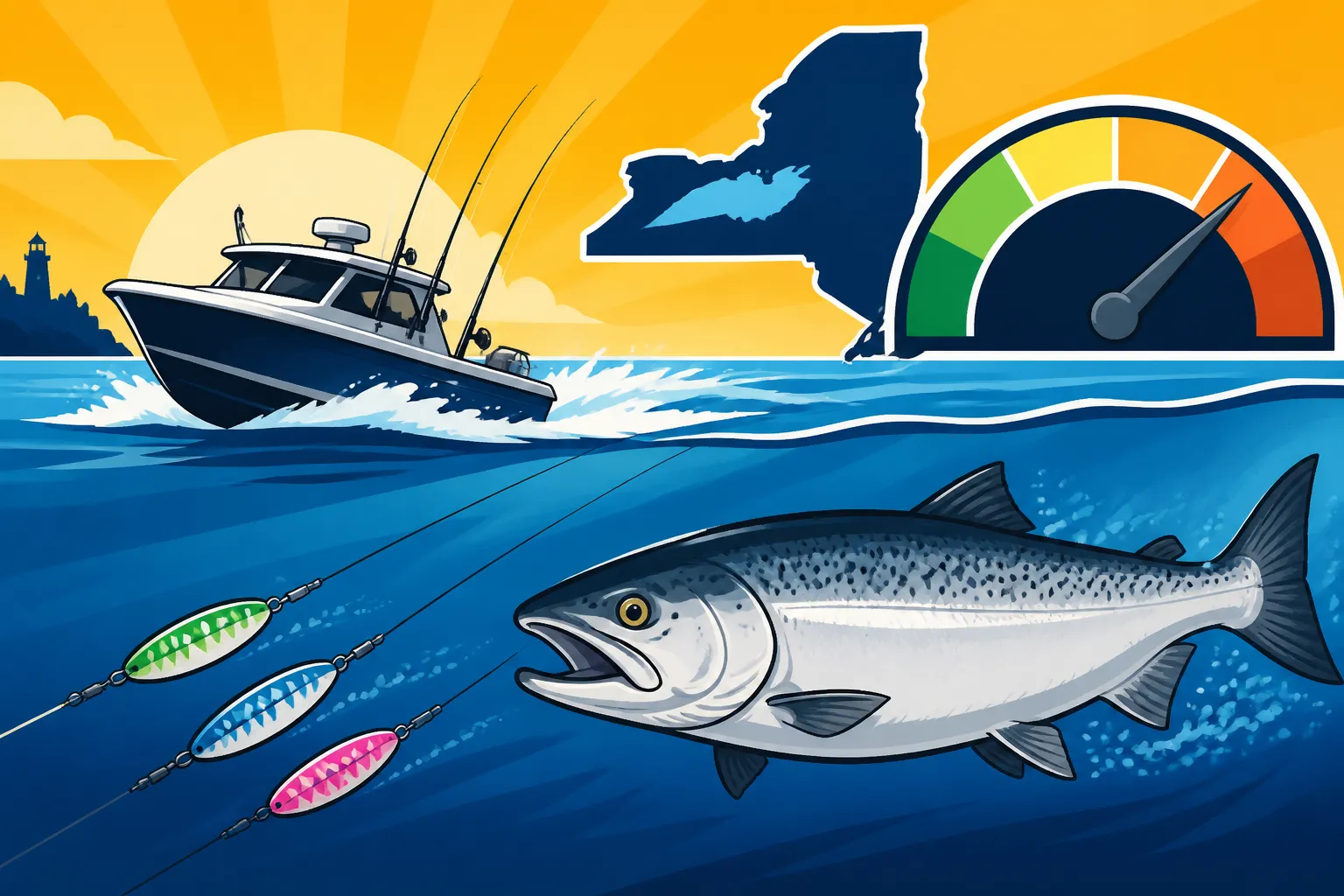
For Chinook salmon, often referred to as Kings, most successful anglers find their sweet spot within a GPS speed range of 2.0 to 3.5 miles per hour (mph). This isn't just a random guess; it’s a range that allows most popular salmon lures to exhibit their intended action—that tantalizing flutter, wobble, or kick that mimics an injured baitfish. Chinook salmon are apex predators, aggressive and powerful, but they still need to be able to track and ambush their prey effectively. Too fast, and they might miss the lure or decide it's too much effort. Too slow, and the lure might not have enough action to entice a strike, appearing lifeless and unappealing.
Within this range, many charter captains and serious recreational anglers often find themselves concentrating around 2.2 to 2.8 mph for most of their trolling time. This mid-range speed tends to be incredibly versatile, working well for a variety of conditions and lure types. However, don't be afraid to push the boundaries of this range; sometimes, a burst of speed up to 3.5 mph or a deliberate slowdown to 1.8 mph can be precisely what's needed to trigger a bite from reluctant fish. The key is to start within this core zone and then fine-tune based on how the fish are responding and what your electronics are telling you.
Distinguishing Between GPS Speed and Water Speed
Here's where things get a little more complex, and where many anglers can get tripped up: there's a significant difference between your boat's speed over ground (GPS speed) and its speed through the water (water speed). While your GPS unit provides an accurate measure of how fast you're moving relative to the earth, it doesn't account for currents. And believe me, Lake Ontario currents can be surprisingly strong and unpredictable, especially around major structures or in certain weather patterns.
Imagine you're trolling at a GPS speed of 2.5 mph, but there's a 0.5 mph current pushing against you. Your actual speed through the water, and thus the speed at which your lures are moving, would only be 2.0 mph. Conversely, if the current is pushing you from behind, your lures could be moving much faster through the water than your GPS indicates. This distinction is critical because it's the water speed that dictates how your lures are behaving and how the fish perceive them.
To get a truly accurate reading of your water speed, many serious salmon anglers invest in a paddlewheel sensor or a downrigger speed and temperature probe. These devices provide real-time data on how fast the water is actually flowing past your lure at fishing depth. Without this information, you're essentially guessing, and that can lead to a lot of wasted time and effort. You might think you're presenting a spoon perfectly at 2.5 mph, but a hidden current could be making it dart erratically at 3.5 mph or limp along at 1.5 mph. Tools like the Fish Hawk X4D or similar models are indispensable for serious Lake Ontario salmon fishing, as they provide temperature and true speed at the ball. You can often find a good selection of these marine electronics on Amazon.
Factors That Dictate Your Salmon Trolling Speed
While that golden range of 2.0-3.5 mph is a great starting point, understanding why you might need to adjust outside or within it is what separates a consistent angler from someone who just gets lucky now and then. There are several dynamic variables on Lake Ontario that will influence the best trolling speed on any given day.
Water Temperature and Fish Metabolism
One of the most critical factors influencing salmon behavior, and therefore your ideal trolling speed, is water temperature. Salmon, like all cold-blooded fish, have metabolisms that are directly tied to the temperature of the water they inhabit.
- Colder Water (Early Season/Deep Thermocline): When the water is colder, typically in early spring or when you're targeting fish in the deepest parts of the water column during summer, salmon are generally less active. Their metabolism slows down, and they're less inclined to chase a fast-moving bait. In these conditions, you'll often find more success by slowing your trolling speed down, perhaps to the lower end of the 2.0-2.5 mph range, or even slightly below if necessary. This allows the fish more time to react and investigate the lure, mimicking a slower, more easily caught prey item. Think of a lethargic alewife trying to escape.
- Warmer Water (Prime Thermocline/Aggressive Bites): Conversely, when the water temperature is ideal for salmon (usually in the 45-55°F range, often found within or just above the thermocline during the summer months), their metabolism is high, and they become much more active and aggressive. This is when you can often bump up your trolling speed into the 2.8-3.5 mph range. Faster speeds can trigger a reactionary strike, as the salmon see a bait trying to escape quickly and their predatory instinct takes over. To truly capitalize on these conditions, understanding New York Fishing Seasons Explained and specifically Best Time to Fish for Chinook Salmon on New York's Lake Ontario is crucial for timing your trips.
Lure Type and Action
Different lures are designed to perform optimally at specific speeds, and understanding this is paramount. Dragging a lure too fast or too slow can completely kill its intended action, making it look unnatural and unappealing to a discerning salmon.
- Flashers and Flies: These setups, such as the popular A-Tom-Mik or Dreamweaver flashers paired with an Oki or similar fly, are designed to create attraction and then present a trailing fly. They typically perform best at slower speeds, often in the 1.8-2.5 mph range (water speed). At these speeds, the flasher has a nice, rhythmic rotation or side-to-side kick, and the fly behind it dances and wiggles enticingly. If you troll these too fast, the flasher can "wash out" or spin uncontrollably, and the fly loses its natural action, often just streamlining behind the flasher without much movement. Learning How to Troll Spoons for Chinook Salmon also involves understanding the interaction with flashers.
- Spoons: Metal spoons, like Michigan Stingers, Dreamweaver Super Slims, or Silver Streaks, are incredibly popular for Lake Ontario salmon. Each spoon has a unique cup and bend that gives it a specific action—a flutter, a wobble, or a side-to-side dart. Generally, spoons come alive in the 2.2-3.2 mph range (water speed). You want to see that distinct "kick" or "flutter." If you go too slow, they might just drag lifelessly. Too fast, and some spoons can spin, causing line twist, or just move too erratically to imitate a struggling baitfish. It's often worth checking a new spoon right beside the boat at various speeds to see its action. For a deeper dive into these options, check out our guide on Best Lures for Chinook Salmon.
- Plugs: J-Plugs, Rapala Deep Dive plugs, and similar hard-bodied lures are designed to have a tight, aggressive wiggle. These often perform best at the higher end of the salmon trolling spectrum, sometimes from 2.5-3.5 mph or even slightly faster for certain models. The speed really makes these plugs "come alive," creating vibrations and a swimming action that aggressive salmon can't resist.
The key here is observation. If your lures aren't getting bit, but you're seeing fish on the sonar, experiment with small speed adjustments. Sometimes a subtle change of 0.1 or 0.2 mph is all it takes to make the lure look just right.
Baitfish Presence and Activity Levels
Salmon don't just eat for fun; they eat to survive. Their feeding behavior is heavily influenced by the presence and activity of their primary forage, which in Lake Ontario is largely alewives and, to a lesser extent, smelt.
- Mimicking Prey: If you're marking schools of baitfish that are moving quickly and erratically, perhaps being harassed by predators, then increasing your trolling speed to imitate a fleeing baitfish might be effective. Conversely, if the baitfish schools appear dense and relatively static on your sonar, suggesting they are either relaxed or perhaps dying off, a slower, more deliberate presentation might be the ticket.
- Matching the Hatch: Think about what those Chinook Salmon in New York are actually eating. Are the alewives in the area small and darting, or are they larger and moving more slowly? Your trolling speed should reflect the natural behavior of the baitfish you're trying to imitate. A general rule of thumb is that active, healthy baitfish often necessitate a faster retrieve or troll, while injured or struggling baitfish are best mimicked with slower, more erratic movements. Observing baitfish on your sonar can give you invaluable clues about their activity levels, which in turn helps you dial in your trolling speed.
Current Weather and Water Conditions
The prevailing conditions on Lake Ontario are rarely static, and they play a massive role in dictating how your boat moves and how fish react. Ignoring these can quickly lead to a frustrating day.
- Wind and Waves: High winds and choppy waves make it incredibly difficult to maintain a consistent speed. Your boat will surge forward and slow down with the waves, causing your lures to behave erratically. While some subtle speed fluctuations can be good (more on that later), extreme surges can make your lures look unnatural. In these conditions, you'll need to work your throttle much more actively to try and smooth out your speed. Sometimes, trolling directly into or with the waves is easier for maintaining consistency than taking them broadside. This is where a good autopilot system with a robust heading sensor can be your best friend. For more on this, check out How Weather Affects Fishing in New York can impact your day.
- Currents: As mentioned earlier, currents are a silent killer of consistent trolling speed. Strong subsurface currents can dramatically alter your lures' speed and depth, even if your GPS speed remains constant. This is where a true water speed indicator (like a paddlewheel or downrigger probe) becomes indispensable. If you notice your lures aren't getting bit despite good marks, it might be a hidden current messing with your presentation. Adjust your GPS speed up or down to compensate for the current, aiming for that optimal water speed.
- Barometric Pressure: While not directly affecting your boat's speed, rapidly changing barometric pressure can significantly impact fish behavior, making them more or less aggressive. A rising or steady high pressure often means active fish, allowing for faster trolling. A falling or low-pressure system can make fish lethargic, suggesting a slower presentation. Understanding Best Barometric Pressure for Fishing can give you an edge.
Monitoring and Adjusting Your Speed Like a Pro
Consistent success on Lake Ontario isn't about setting one speed and sticking to it all day. It's about constant monitoring, thoughtful adjustment, and a willingness to experiment. This iterative process is what elevates good anglers to great ones.
The Importance of Reliable Speed Monitoring Equipment
To truly dial in your trolling speed, you need more than just a basic speedometer. Relying solely on your boat's engine RPMs or even your GPS speed can be misleading due to currents and varying load conditions on your boat.
- GPS Unit: This is your baseline. It tells you your speed over ground. Modern GPS units found on marine electronics from brands like Humminbird or Lowrance offer highly accurate speed readings, which you can often purchase on Amazon. This is crucial for navigating and understanding your general progress.
- Paddlewheel Sensor: Mounted on your transom or through-hull, a paddlewheel sensor measures your boat's speed through the water. This is significantly more accurate for determining how fast your lures are moving relative to the water, especially in current. It helps you differentiate between boat speed and lure speed.
- Downrigger Speed and Temperature Probes: These are the gold standard for precision salmon trolling. Attached to your downrigger cable, they provide real-time readings of water temperature and true lure speed at the depth of your downrigger ball. This is invaluable, as current shears can mean vastly different water speeds at different depths. For example, the surface might be 2.5 mph, but at 80 feet, a strong current could be pushing your lure at 1.5 mph or pulling it at 3.5 mph. Knowing this allows you to adjust your boat's speed accordingly to maintain the desired lure speed at depth. Many such probes, like those from Fish Hawk, are available online. Getting adept at reading these electronics is also part of mastering How to Read a Fish Finder for New York Lakes.
Having a combination of these tools gives you a comprehensive picture of what your lures are actually doing. Without them, you're essentially flying blind.
The Art of the S-Turn and Speed Fluctuation
Sometimes, fish need a little extra coaxing. This is where the deliberate "S-turn" or "Z-pattern" comes into play, creating momentary speed fluctuations and changes in lure action that can trigger a strike. It's an advanced tactic, but an incredibly effective one for Lake Ontario salmon.
- How it Works: As your boat turns, the lures on the inside of the turn will slow down and drop slightly, while the lures on the outside of the turn will speed up and rise. This momentary change in speed and depth can often be the exact trigger a hesitant salmon needs to commit. It mimics a baitfish that's either injured and struggling (slowing down) or trying to escape quickly (speeding up).
- Executing Effectively: Don't make sharp, sudden turns that could tangle your lines. Instead, use long, sweeping turns. Monitor your fish finder and downrigger readings during the turn; often, you'll see fish react or even hit a lure during the acceleration or deceleration phase. Experiment with the degree and duration of your turns. Sometimes, just a slight, subtle S-turn is enough to get a fish to bite. This technique is often discussed in broader articles like Trolling Techniques for New York's Lakes.
Keeping a Detailed Fishing Log
Human memory is notoriously unreliable, especially when it comes to the exact details of a successful fishing trip. This is why keeping a detailed fishing log is one of the most powerful tools in your arsenal for understanding and optimizing your trolling speed.
- What to Record: For every successful bite (and even for unsuccessful periods), log your GPS speed, water speed (if available), depth, lure type and color, time of day, water temperature, weather conditions (wind, clouds, barometric pressure), and any specific boat movements (like S-turns) that seemed to trigger a strike.
- Learning from Patterns: Over time, this data will reveal invaluable patterns. You'll start to notice that on sunny, calm days, salmon might prefer a faster troll with a specific spoon. On overcast, rougher days, a slower speed with a flasher and fly might be the ticket. These insights are gold. They take the guesswork out of future trips and allow you to quickly adapt to conditions. You can find simple waterproof fishing logbooks on Amazon, which make it easy to record these details right on the water.
Integrating Speed with Other Trolling Techniques
Dialing in your trolling speed is not an isolated task; it’s one component of a larger system. How you manage your speed directly impacts other critical aspects of your salmon fishing setup, particularly depth control and timing.
Speed and Depth Control Synergy
On Lake Ontario, precise depth control is paramount, and your trolling speed has a direct and significant impact on where your lures are running. This interconnectedness is often overlooked, leading to lures being presented above or below the active fish.
- Downrigger Blowback: The faster you troll, the more "blowback" your downrigger cables will experience. Blowback refers to the angle at which your downrigger cable trails behind the boat. At higher speeds, the water resistance on the cable and downrigger ball will cause them to rise in the water column and trail further back. If you set your downrigger to 100 feet at 2.0 mph, increasing your speed to 3.0 mph might lift your ball (and therefore your lure) to 85 or 90 feet. This means you need to adjust your downrigger depth deeper to compensate for higher speeds, or shallower for slower speeds, to keep your lures in the strike zone. Our guide on How Deep to Troll for Salmon on New York's Lake Ontario delves into this further.
- Diver Depth: Similarly, directional divers (like Dipsy Divers or slide divers) are also affected by speed. Their dive curve, which dictates how deep they run, is calculated for specific speeds. Faster speeds can make them run deeper or shallower depending on the specific model and setting, and also increase the tension on the line, affecting how they trip. It’s crucial to understand your gear's dive curves at various speeds. If you're marking fish at a consistent depth, you need to be constantly aware of how your current trolling speed is affecting the actual depth of your presentations.
Matching Speed to the Time of Day and Season
The time of day and the specific season you're fishing on Lake Ontario can significantly influence both salmon activity and their preferred trolling speed. These aren't hard and fast rules, but strong tendencies to consider.
- Early Morning and Late Evening (Low Light): These periods often see salmon moving shallower to feed. With lower light conditions, salmon may be more inclined to chase a faster-moving lure, as it offers a quick, opportunistic meal before daylight or after sunset. However, they can also be more hesitant. This is a prime time for experimentation, trying both slightly faster and slightly slower than your average, combined with those S-turns. For more on this, check out Best Time of Day to Troll for Salmon in New York.
- Mid-Day (Bright Sun): During the brightest parts of the day, especially on clear water days, salmon often retreat to deeper, darker water or hug tight to the thermocline. They can become more lethargic or shy. This is often a time to experiment with slower trolling speeds, making your lure appear less aggressive and more like an easy target.
- Seasonal Patterns:
- Spring: Early in the spring, water temperatures are colder. Salmon are often found in shallower water following bait. Slower trolling speeds, perhaps in the 1.8-2.5 mph range, are often productive.
- Summer: As summer progresses and a strong thermocline develops, salmon are concentrated in the cooler water of the thermocline. Their metabolism is high, and they can be very aggressive. This is often when faster speeds (2.5-3.5 mph) shine.
- Fall: As salmon begin their pre-spawn staging near tributaries, they can become incredibly aggressive, but also very finicky. They might chase faster presentations with large spoons or plugs one day, and demand a slow, subtle flasher-and-fly the next. This transition period requires constant adjustment and close attention to fish behavior. You can learn more about general salmon behavior in How to Fish for Salmon in New York.
Ultimately, mastering the art of trolling speed for Lake Ontario salmon is a journey of continuous learning and adaptation. There's no substitute for time on the water, meticulous observation, and a willingness to try new things. Pay attention to every detail—the temperature, the current, the lure action, the fish activity on your sonar—and make small, calculated adjustments. Over time, you'll develop an intuitive feel for what the fish want, and those screaming reels will become a more frequent, exhilarating sound.
Disclaimer
The information provided in this guide is for general informational purposes only and is based on common angling practices and publicly available knowledge. Fishing conditions, regulations, and fish behavior can vary significantly. Always consult the latest New York State Department of Environmental Conservation (NYSDEC) fishing regulations before heading out. Fishing involves inherent risks; please exercise caution and prioritize safety on the water.