How to Tell a Muskie From a Pike
It's a common scenario: you've battled a powerful, toothy predator to the boat, and as it lies there, gleaming in the sunlight, a flicker of doubt hits you. Is it a magnificent muskellunge, the fish of a thousand casts, or a formidable northern pike? For many anglers in New York, telling these two impressive species apart can be incredibly tricky, leading to confusion about regulations and even bragging rights. This guide will help you understand the subtle yet critical differences between muskies and pike, ensuring you can confidently identify your catch on the water.
The Common Angler's Confusion: Why Muskies and Pike Look So Alike
Let's be honest, from a quick glance, a muskie and a pike can look almost identical. They're both long, torpedo-shaped, greenish-golden fish with prominent duckbill-like snouts and rows of intimidating teeth. They inhabit similar cool, clear freshwater environments across New York and often share overlapping territories, adding to the confusion. It’s no wonder so many of us find ourselves second-guessing our identification skills, especially when the fish is thrashing at the side of the boat!
Shared Features and Initial Impressions
Both muskellunge and northern pike are apex predators in their respective ecosystems, known for their powerful strikes and fierce fights. They belong to the same family, Esocidae, which explains their striking resemblance. When you first hook into one, whether it's on a deep-diving crankbait or a massive bucktail, the sheer power and aggression they display are incredibly similar. Their overall body shape, the placement of their dorsal and anal fins far back on their bodies (perfect for ambush attacks), and those sharp, conical teeth are all shared traits that make initial identification a real head-scratcher.
Imagine you're fishing a weedy bay on Chautauqua Lake, known for both species, and you've just landed a decent-sized fish. It's long, green, and has a mouth full of teeth. Your heart is pounding, and the excitement of the catch might make you jump to conclusions. You might think, "This is definitely a pike!" only to have a more experienced angler politely correct you. This is why knowing the nuanced differences, beyond the general "long, green, and mean" description, is so important for anyone looking to seriously fish New York's fantastic waters. Understanding New York's Most Popular Freshwater Fish helps, but specific identification is key.
The Frustration of Misidentification
The frustration isn't just about getting the name right for your photo op, though that's certainly part of it! Misidentifying a muskie for a pike, or vice versa, can have real consequences. New York State has very specific regulations for both species, including different minimum size limits, daily creel limits, and even seasons in some waters. If you mistakenly keep a muskie under the legal size because you thought it was a legal-sized pike, you could face hefty fines. The reverse is also true; releasing a trophy pike because you thought it was a small muskie might mean missing out on a legal catch. This isn't just about rules; it's about respect for the resource and doing your part for conservation. You'll want to review New York Fishing Regulations Explained before every trip.
Furthermore, the sheer difficulty of landing a true trophy muskie has earned it the moniker "the fish of a thousand casts." There's a certain reverence among anglers for the muskellunge that simply isn't matched by the more numerous northern pike. So, while both are fantastic sport fish, there's a different level of achievement associated with a muskie. Correct identification ensures you're giving credit where credit is due and accurately sharing your fishing stories.
Key Distinguishing Features: A Head-to-Tail Guide
Okay, let's get down to brass tacks. While they look similar, there are definitive ways to tell these two magnificent fish apart. It's all about paying attention to the details, especially around the head and body. Think of it like a biological detective game.
Head Markings: The "Scale" of the Story
This is often the most reliable way to differentiate between a muskie and a pike. It comes down to the scaling on their cheeks and gill covers (operculum).
- Northern Pike: Look closely at the gill cover. A northern pike will have scales on the entire upper half of its gill cover, but only on the upper half of its cheek. The lower half of the cheek will be bare. Think "pike have patches."
- Muskellunge: A muskellunge is quite different. It will have scales only on the upper half of both its gill cover and its cheek. The bottom halves of both will be completely bare, looking smooth and unscaled. Think "muskies are mostly naked" (on their lower cheeks and gill covers).
It takes a moment to examine, but once you know what to look for, it's pretty clear. You might need to gently hold the fish steady for a quick inspection, but always prioritize the fish's safety. For more details on these incredible fish, check out Northern Pike in New York and Muskellunge in New York.
Here’s a simple table to help you remember the key differences:
| Feature | Northern Pike | Muskellunge |
|---|---|---|
| Cheek Scales | Fully scaled on upper half | Scaled only on upper half |
| Gill Cover Scales | Fully scaled on upper half | Scaled only on upper half |
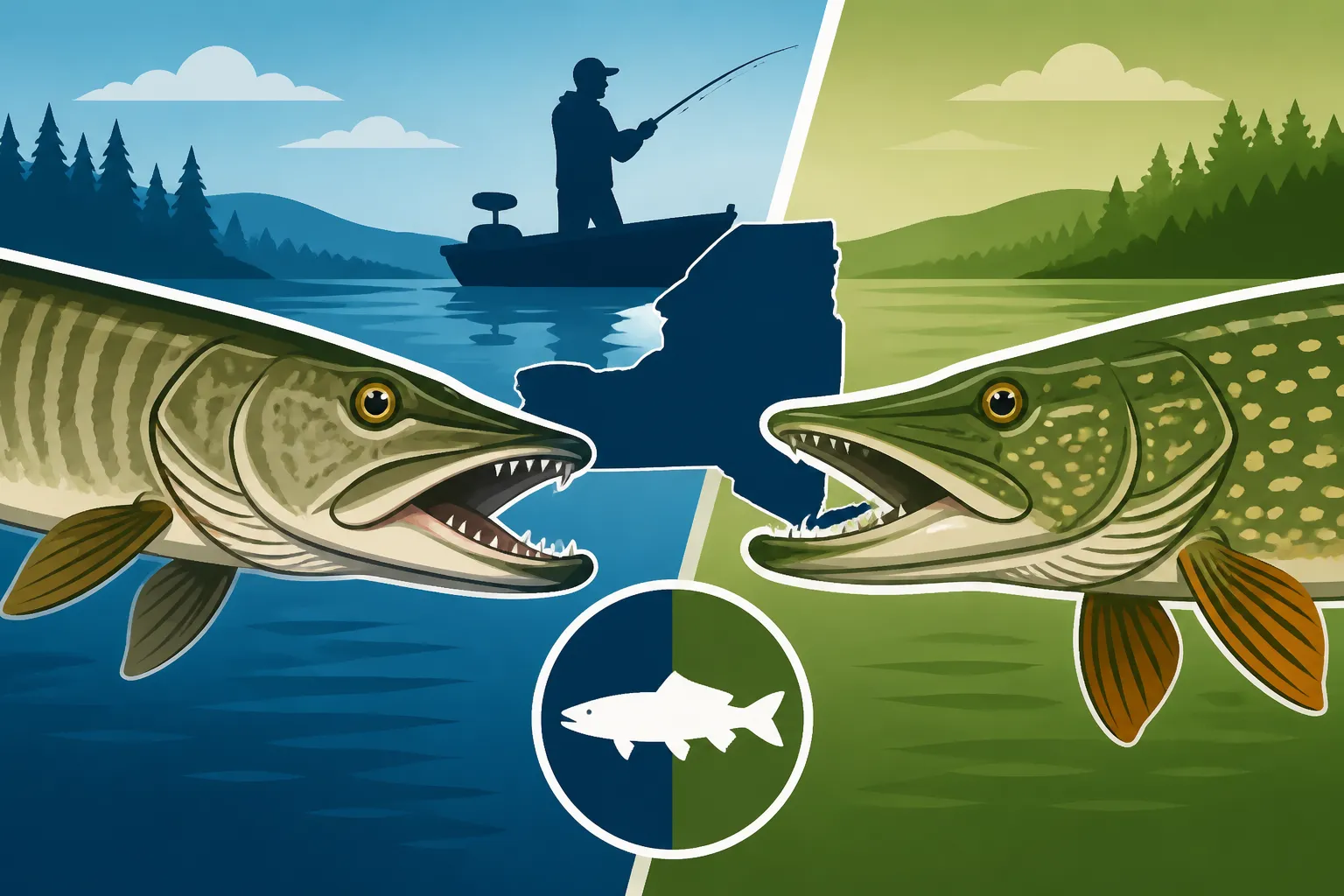
| Body Pattern | Light spots on a dark background | Dark spots, bars, or stripes on a light background |
| Tail Fin Shape | Often more rounded or slightly forked | More deeply forked and pointed |
| Pores on Underside of Jaw | Typically 5 or less per side | Typically 6 or more per side |
Body Patterns: Spots, Bars, and Stripes
While the scaling on the head is the most definitive, the body pattern is also a strong indicator, though it can sometimes be more variable depending on the specific water body and subspecies.
- Northern Pike: Generally, northern pike have a darker background color with lighter, often bean-shaped, spots or markings. Their overall appearance tends to be more uniformly dark with these lighter flecks. The spots usually don't form distinct patterns, but rather a scattering of light over dark.
- Muskellunge: Muskies, on the other hand, typically display darker markings (spots, bars, or stripes) on a lighter, often golden or greenish-silver, background. Some muskies, especially the "clear" phase ones, might have very few markings, making them even trickier. Tiger muskies, a sterile hybrid of muskie and pike, are easily identifiable by their pronounced dark vertical bars on a light background. This distinction is crucial, as the regulations for a pure muskie are different than for a pike.
Think of it this way: if you see bright spots on a dark fish, it's likely a pike. If you see dark spots or bars on a brighter fish, you're probably looking at a muskie. This can be a bit harder to judge quickly, especially in varying light conditions or with dirty water, but it's a good secondary clue after checking the scales.
Fin Differences: The Tale of the Tail
Another subtle but telling difference can be found in their caudal (tail) fin.
- Northern Pike: The tail fin of a northern pike tends to be more rounded at the tips of the lobes and often less deeply forked. It might appear almost spatulate or squarish at the ends of the fork.
- Muskellunge: Muskies generally have a more deeply forked tail fin with noticeably pointed tips on the lobes. It looks sharper and more defined.
This fin shape difference, while less pronounced than the head scaling, can still serve as a helpful clue, especially when combined with the other features. It's a subtle elegance versus a more robust, rounded form. Looking at pictures of both side-by-side on Amazon for example, when searching for muskie or pike lures, can sometimes help you visualize these differences more clearly.
Habitat and Behavior Clues: Beyond Physical Appearance
Beyond their physical characteristics, understanding where these fish like to hang out and how they behave can also offer clues to their identity. While there's certainly overlap, they do show some preferences.
Preferred Waters and Cover
Both species are ambush predators, meaning they love to lurk in cover, waiting for an unsuspecting meal to swim by. However, their preferred "ambush points" can differ slightly.
- Northern Pike: Northern pike are often found in shallower, weedy areas of lakes, slow-moving rivers, and even large ponds. They are incredibly tolerant of diverse water conditions and can thrive in systems that might be a bit too warm or murky for muskies. They are frequently associated with dense aquatic vegetation, fallen trees, and shallow bays where they can hide and dart out to strike. You'll find them in places like Black Lake, many Adirondack ponds, and the shallow bays of larger lakes.
- Muskellunge: Muskies, on the other hand, generally prefer larger, cooler, and clearer bodies of water. Think of the deeper sections of the St. Lawrence River, the Finger Lakes, or Chautauqua Lake. While they also use cover, they often relate to deeper weed lines, rocky points, submerged timber, and steeper drop-offs. They can be more elusive, utilizing vast expanses of water and open structure in addition to shoreline cover. They’re less likely to be found in very shallow, stagnant, or overly turbid waters compared to pike.
If you're fishing a relatively small, weedy pond, your chances of catching a pike are significantly higher. If you're out on a vast, deep lake targeting big fish, then a muskie is a much more probable target, although pike will certainly be present too!
Feeding Habits and Aggression
Both are voracious eaters, but there's a subtle difference in their typical prey and overall aggressiveness, particularly towards lures.
- Northern Pike: Pike are generally less selective feeders. They'll gobble up just about anything that fits in their mouth: smaller fish, frogs, crayfish, and even small waterfowl or rodents. They are often more aggressive and less finicky when it comes to striking a lure. If you're getting consistent strikes on a variety of baits, especially smaller ones, you might be in a good pike fishery. They can be found hunting along weed edges with surprising frequency.
- Muskellunge: Muskies are renowned for being pickier and harder to entice. While they also eat a wide variety of prey, they often key in on larger forage fish like suckers, ciscos, and even smaller pike. They are known for "following" lures right to the boat, inspecting them, and then turning away without striking, earning them their "fish of a thousand casts" reputation. When they do strike, it's often with incredible violence. If you're throwing massive baits all day without many bites, but when you do get a strike, it's an absolute freight train, you might be dealing with muskies. When buying lures on Amazon, you'll notice muskie baits are often much larger and heavier than typical pike lures. For more about their diets, check out What Muskellunge Eat and What Northern Pike Eat.
The "follow" is a classic muskie behavior, less commonly observed with pike, though it does happen. Muskies are simply more cautious and often require more persuasion or a "figure eight" maneuver at the boat to finally commit to a strike.
Why Correct Identification Matters in New York
Beyond the thrill of identifying your catch accurately, knowing whether you've hooked a muskie or a pike is absolutely vital for legal, ethical, and conservation reasons when fishing in New York State. This isn't just about following rules; it's about being a responsible angler who contributes to healthy fish populations.
Understanding Regulations and Catch Limits
New York's Department of Environmental Conservation (DEC) sets specific regulations for different fish species, and muskellunge and northern pike are no exception. These regulations can vary significantly, not just between the two species but also by water body and time of year. For instance, the New York Muskellunge Minimum Size Limit is notoriously high in many waters, often 40 or even 54 inches in trophy waters like the St. Lawrence River and Chautauqua Lake. This reflects their slower growth rate and the desire to protect these magnificent fish until they've had a chance to spawn multiple times.
In contrast, Northern Pike Season and Limits might allow for a smaller minimum size and a higher daily creel limit in many areas. Imagine the severe penalty if you mistook a 38-inch muskie for a large pike and kept it, when the muskie minimum was 54 inches! Not only would you face a fine, but you'd also be removing a valuable, slow-growing trophy fish from the population. Always consult the current DEC fishing regulations guide, which you can often pick up at your local tackle shop or find online. It's your fishing Bible.
Conservation and Responsible Angling
Muskies are generally less numerous and slower-growing than northern pike. They take many years to reach trophy sizes, and their populations can be more fragile. Correct identification plays a direct role in conservation efforts. When anglers accurately identify and adhere to regulations, they help ensure that muskie populations can thrive and continue to provide incredible angling opportunities for future generations. This is especially true for catch-and-release practices, which are widely encouraged for muskies. Knowing what you've caught means you can handle it appropriately, minimizing stress if it needs to be released.
For example, when you catch a muskie, proper handling is paramount. That means using large nets, keeping the fish in the water as much as possible, minimizing handling time, and using appropriate tools to remove hooks. If you treat every toothy predator like a common pike, you might inadvertently cause harm to a muskie that needs extra care for a successful release. Being a responsible angler means doing your part to protect these amazing fish. It's about ensuring the future of New York's incredible fisheries for all of us who cherish them.
Disclaimer
This article is for general informational purposes only and does not constitute professional advice. Laws, prices and regulations vary by location and change over time. Consult a qualified professional for guidance on your specific situation.