New York Statewide Trout Daily Limit Explained
It’s incredibly frustrating to plan a perfect day on the water, only to realize you’re not entirely sure about the fishing regulations, especially when it comes to something as specific as daily limits for trout. New York State has a fantastic diversity of trout fishing opportunities, but with that comes a sometimes bewildering array of rules. This guide is here to untangle the confusion and clearly explain the New York statewide trout daily limit, so you can fish with confidence and stay on the right side of the law.
Understanding New York's Trout Management Philosophy
Before we dive into the nitty-gritty numbers, it’s helpful to understand why these regulations exist. It's not just to make things complicated for anglers; there’s a much bigger picture at play here. The New York State Department of Environmental Conservation (DEC) carefully crafts these rules to ensure healthy fish populations for generations to come, while also trying to provide enjoyable fishing experiences for everyone.
Why Limits Exist: Balancing Angler Experience and Conservation
Think about it: if there were no limits on how many trout you could keep, or how small they could be, our beautiful trout streams and lakes would quickly become depleted. Overfishing can decimate populations, especially for species like trout that can be sensitive to environmental changes and angling pressure. The daily limit is a fundamental tool for conservation, acting as a safeguard to prevent too many fish from being removed from a system.
But it's not just about protecting the fish; it's also about protecting the fishing experience. Nobody wants to spend a day on the water only to find barren streams or tiny fish. By managing populations responsibly, the DEC ensures that there are enough healthy, catchable trout for everyone to enjoy. These regulations contribute to sustainable fisheries, which means more memorable days for you, me, and our kids in the future. It’s a delicate balance, and these rules are designed to maintain that equilibrium. If you're looking for an overall understanding of the rules, our comprehensive guide on New York Fishing Regulations Explained can provide a great starting point.
Statewide vs. Special Regulations: The Crucial Distinction
Here's where a lot of the confusion often creeps in, and it's absolutely vital to grasp this distinction. When we talk about the "statewide" trout daily limit, we're referring to the general rule that applies to most waters across New York. It's the default setting, if you will. However, New York is vast and incredibly diverse, with thousands of miles of streams and countless lakes. Many of these specific bodies of water have unique characteristics – perhaps they support a particularly fragile wild trout population, or they are heavily stocked, or they are managed for trophy fish.
Because of these variations, the DEC implements "Special Regulations" on certain waters. These special rules supersede the statewide general regulations. They might involve different daily limits, different minimum size requirements, specific tackle restrictions (like artificial lures only), or even entirely different seasons. For instance, a small, pristine wild brook trout stream in the Adirondacks might have a much lower daily limit or a higher minimum size than a heavily stocked, easily accessible stream in a more populated area. Understanding these special regulations is key to avoiding an accidental violation, and knowing where to find this information is just as important. Our guide on New York Special Regulations Waters List can give you a better idea of where these might apply.
The General Statewide Trout Daily Limit in New York
Let's cut right to it and clarify the most common rule you'll encounter. This is the bedrock regulation for trout fishing in New York, applying to the vast majority of lakes, ponds, and streams that aren't designated as "special regulation" waters.
The Standard Rule: How Many Trout You Can Keep
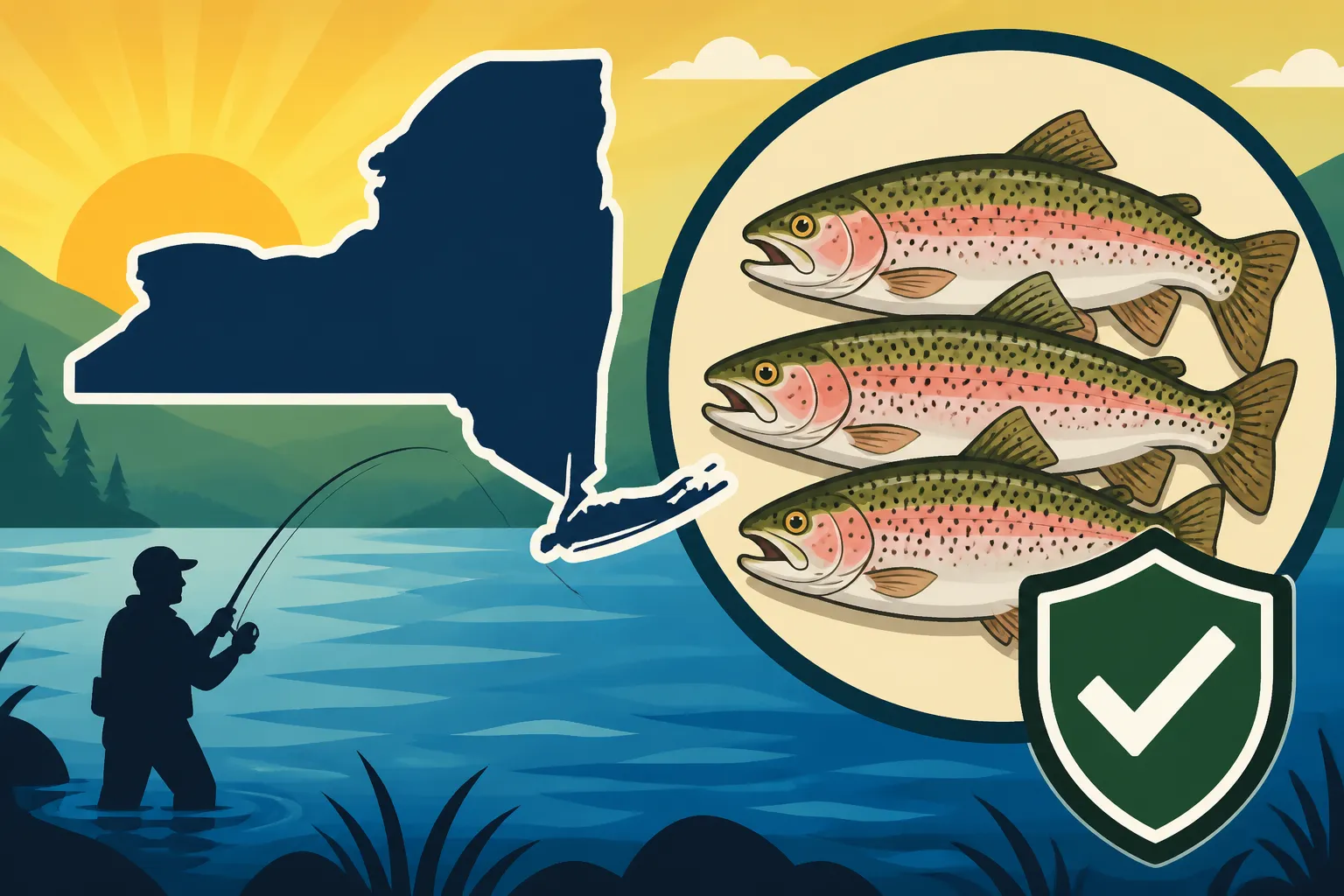
For most of New York's freshwater bodies, the general statewide daily limit for trout is five trout per day. This limit applies to a combination of brook trout, brown trout, rainbow trout, and their hybrids (like tiger trout). So, whether you catch five brook trout, or two browns and three rainbows, as long as it totals five fish from these species, you've reached your daily creel limit.
It's important to remember that this is a daily limit, meaning it resets at midnight. You can't, for example, catch five trout on Monday evening, keep them, and then catch five more first thing Tuesday morning and claim they're part of Monday's limit. Each 24-hour period (or rather, each calendar day for practical purposes) has its own distinct limit. This applies whether you're fishing a popular stream or a quiet pond. For a deeper dive into the basic requirements for fishing, you might want to read our New York Fishing License Guide.
Size Matters: Minimum Length Requirements for Trout
Beyond just the number of fish, the DEC also sets minimum length requirements for trout. This is another crucial conservation tool, as it allows younger, smaller fish a chance to grow, mature, and reproduce before they are harvested. For the general statewide regulations, any trout you keep must be at least 12 inches long. This applies to brook trout, brown trout, and rainbow trout.
So, when you catch a trout, the first thing you should do after identifying it (if you're planning to keep it) is measure it. A small, retractable measuring tape or a rigid ruler is an absolute essential for any tackle box. You can often find decent, easy-to-read measuring tapes or even specialized fishing rulers on platforms like Amazon. If you catch a beautiful trout that's only 10 or 11 inches, you must carefully release it, even if you haven't reached your five-fish limit. Keeping an undersized fish, even accidentally, can result in a fine. Always measure from the tip of the snout to the end of the tail with the lobes compressed.
The "Trout Stamp" and Its Role
Many anglers wonder about a "trout stamp" when discussing trout fishing regulations. Historically, trout stamps were an additional license or permit required in some states for those who wished to fish for trout, with the funds often earmarked specifically for trout management and stocking programs.
In New York, however, there is no separate "trout stamp" requirement for recreational anglers. If you possess a valid New York State Freshwater Fishing License, you are legally entitled to fish for trout in appropriate waters, provided you adhere to all other regulations, including daily limits and size restrictions. While some other states might still have these additional stamps, New York has integrated the privilege of trout fishing directly into the standard freshwater license. So, if you're holding a valid New York fishing license, you're good to go on that front. You can learn more about this by checking out our post on What Is a Trout Stamp?.
Decoding Special Regulation Waters for Trout
While the statewide limit of five trout at 12 inches is the general rule, New York State has a multitude of waters with "special regulations." These are often some of the best and most unique fishing opportunities, but they absolutely require anglers to pay extra attention to the specific rules for that particular body of water. Ignoring these special regulations is a common mistake and can lead to penalties.
Navigating the Nuances of Catch-and-Release Seasons
One of the most common special regulations you'll encounter involves catch-and-release seasons. Many prime trout streams and rivers, especially those known for wild trout or high-quality fisheries, have extended catch-and-release periods. For example, the general trout season often closes in mid-October, but many specially designated trout waters remain open for catch-and-release fishing through the winter and early spring until the general season reopens on April 1. During these catch-and-release periods, the rule is crystal clear: all trout caught must be immediately and carefully released, regardless of size. No fish can be kept. This allows anglers to enjoy fishing during colder months without impacting spawning or over-wintering fish populations.
It's critical to understand that even if you're fishing a designated catch-and-release stream, you still need your regular New York fishing license. These regulations are designed to protect the resource while still offering extended angling opportunities. Always check the specific rules for the water you plan to fish, as the dates for catch-and-release seasons can vary. Our guide on New York Catch-and-Release Trout Fishing Rules delves deeper into this topic.
Designated Trout Waters: Specific Limits and Exceptions
Beyond catch-and-release, many streams, rivers, and even lakes have daily limits and size restrictions that differ significantly from the statewide standard. These "Designated Trout Waters" might have:
- Lower Daily Limits: Instead of five, a stream might only allow two or three trout per day to protect a sensitive population.
- Higher Minimum Size Limits: To encourage trophy growth, some waters may require trout to be 15, 18, or even 21 inches before they can be kept.
- Species-Specific Limits: Some waters might have limits that differentiate between species, e.g., "1 brown trout, 2 rainbow trout, none for brook trout."
- Tackle Restrictions: "Artificial Lures Only" or "Fly Fishing Only" rules are common in these special regulation areas, often to reduce mortality rates for released fish.
- Closed Sections or Seasons: Certain stretches of a river might be closed entirely to fishing during sensitive periods like spawning.
A fantastic example of this can be found in some of the renowned streams within the Catskills, known internationally for their fly fishing. Many of these waters, such as portions of the Beaverkill River or Willowemoc Creek, have very specific regulations regarding daily limits, size, and tackle. These are often highlighted in the New York DEC Fishing Regulations Guide because they are so important.
Identifying Special Regulations: Your Essential Tools
So, how do you know if the water you're heading to is under special regulations? There are a few indispensable tools every New York angler should use:
- The New York State Freshwater Fishing Regulations Guide: This is your bible. The DEC publishes an updated guide annually, available as a physical booklet at most license vendors (like bait shops, sporting goods stores, and town clerk offices) or as a free PDF download on the DEC website. It contains a detailed section listing all special regulations by county and specific water body.
- DEC Website & Fishing Map: The DEC website has an interactive fishing map where you can zoom in on specific lakes and streams to see the applicable regulations. This is incredibly helpful for on-the-go checking via your smartphone.
- Local Knowledge & Signs: Don't underestimate the power of local bait shop owners, guides, or fellow anglers. They often have real-time information. Additionally, many special regulation waters will have signs posted at public access points detailing the rules.
Always, always consult the current year's regulations guide before you hit a new spot or if you have any doubts. The rules can change from year to year, so relying on old information is a recipe for trouble. Being well-informed is part of being a responsible angler.
Practical Scenarios and Common Misconceptions
Even with the regulations laid out, real-world fishing situations can sometimes throw curveballs. Let's tackle some common questions and scenarios that often lead to confusion about trout limits.
What If I Catch More Than My Limit?
This is a fantastic problem to have – it means you're having a successful fishing day! But what happens when you've already kept your five legal trout, or the three legal trout allowed in a special regulation zone, and you catch another keeper-sized fish? The rule is simple and non-negotiable: you must immediately and carefully release any additional trout caught after you have reached your daily limit.
Keeping a sixth trout, even if it's a magnificent specimen, after you've already kept five, is a violation. This applies even if you intend to release one of the fish you previously kept. Once a fish is "kept" (meaning it's in your cooler, on a stringer, or otherwise clearly retained), it counts towards your limit. You can't swap fish out. This is why it's a good practice to stop fishing for trout once you've hit your limit if you intend to keep them. If you want to continue fishing for fun, switch to a catch-and-release approach, perhaps using artificial lures to minimize harm to the fish. Products like barbless hooks, which you can find on Amazon, can also help ensure a safer release.
Mixing Species: Does the Limit Apply to All Trout Combined?
Yes, for the general statewide limit, the "five trout" rule refers to an aggregate limit of brook, brown, and rainbow trout. This means you can't keep five brown trout and then another five rainbow trout. Your total combined catch of these species cannot exceed five fish in a single day, provided they all meet the minimum 12-inch size requirement.
However, this is another area where special regulations can introduce exceptions. Some designated waters might have separate limits for different trout species, or specific regulations for unique species like lake trout or landlocked salmon, which are often managed under different rules entirely. Lake trout, for example, typically have different daily limits and size restrictions than brook, brown, or rainbow trout, even in the same body of water. Always double-check the specific regulations for the water you are fishing to understand if the aggregate limit applies or if there are species-specific allowances. For clarification on how many trout you can keep per day in New York, our dedicated article How Many Trout Can You Keep Per Day in New York? will be quite useful.
Fishing with Kids: Do Their Catches Count?
This is a common and important question, especially for families introducing children to the joy of fishing. In New York State, individuals under the age of 16 do not need a fishing license to fish for freshwater fish, including trout. This is a wonderful incentive to get youngsters involved in the sport, as discussed in detail in our post, Do Kids Need a Fishing License to Fish in New York?.
However, when it comes to daily limits, any fish kept by an unlicensed angler (like a child under 16) still counts towards the group's total daily limit or, more accurately, the licensed adult's daily limit if they are actively assisting. If a child is fishing completely independently and not under the direct supervision or assistance of a licensed adult who is also fishing, then their catch could be considered separate, but this is a grey area often best avoided by assuming a collective limit for the fishing party.
A licensed adult fishing with a child should consider the child's kept fish as part of their own daily limit to stay safely within the regulations. For example, if you, a licensed adult, catch and keep three trout, and your unlicensed 10-year-old catches and keeps two trout, your group has reached the statewide limit of five trout. It’s always best to err on the side of caution and assume a combined limit when fishing with unlicensed youth. The spirit of the law is to prevent circumvention of daily limits by having multiple unlicensed individuals in a party.
Essential Gear for Responsible Trout Fishing
Being a responsible angler isn't just about knowing the rules; it's also about having the right tools to implement them, especially when it comes to catch and release or accurately measuring your catch.
Measuring Your Catch Accurately
As we've already covered, minimum size limits are a crucial part of trout regulations. An inaccurate measurement can lead to an accidental violation. Therefore, having a reliable measuring device is non-negotiable.
- Ruler or Measuring Tape: A simple, rigid ruler or a soft, retractable measuring tape is perfect. Make sure it's long enough for the species you're targeting (at least 15-18 inches for most trout). Many anglers prefer measuring boards, which are essentially flat rulers with a stop at one end. You just place the fish's nose against the stop and read the length. These can be particularly handy for quick, accurate measurements. You can find many portable, waterproof options on Amazon that fit easily into a tackle box or vest. When measuring, lay the fish flat, nose at the zero mark, and compress the tail lobes to get the total length. Always handle the fish gently and quickly during this process.
Tools for Safe Catch and Release
Even if you intend to keep your limit, you'll inevitably catch fish that are undersized, or you might hit your limit and continue fishing catch-and-release. Proper catch-and-release techniques dramatically increase a fish's survival rate.
- Forceps or Pliers: These are absolutely essential for quickly and safely removing hooks, especially when fish are "deep hooked" or have swallowed the bait. Trying to dig a hook out with your fingers is not only difficult but also stressful for the fish and can cause more damage. Long-nosed pliers or hemostatic forceps allow for precise hook removal with minimal handling.
- Knotless Landing Net: A good quality, knotless rubber or silicone mesh net is a game-changer. Traditional knotted nylon nets can strip off a fish's protective slime coat (its first line of defense against disease) and damage fins. A soft, knotless net cradles the fish, preventing injury and making it easier to control the fish for hook removal and release, especially if you're fishing alone.
- Barbless Hooks: While not always required by regulation (except in some very specific special regulation waters), using barbless hooks or crimping down the barbs on your existing hooks with pliers makes hook removal incredibly quick and causes much less trauma to the fish. This is a simple step that significantly improves a fish's chances of survival after release.
Equipping yourself with these tools shows respect for the resource and contributes to the health of New York's fantastic trout fisheries.
New York Statewide Trout Daily Limit Summary Table
To help consolidate all this information, here's a quick reference table summarizing the general statewide trout regulations versus what you might expect in special regulation waters. Remember, this is a general guide, and you should always check the specific regulations for the water body you plan to fish.
| Regulation Aspect | General Statewide Rules (Most Waters) | Common Special Regulation Examples |
|---|---|---|
| Daily Limit (Brook, Brown, Rainbow Trout) | 5 trout (aggregate) | 1, 2, or 3 trout (aggregate or species-specific) |
| Minimum Length (Brook, Brown, Rainbow Trout) | 12 inches | 10, 15, 18, or 21 inches (varies greatly by water) |
| Catch-and-Release Season | Generally, closed after October 15 (check specific opening/closing dates) | Often extended through winter/early spring (e.g., Oct 16 – Mar 31) |
| Tackle Restrictions | No general restrictions (check local ordinances) | "Artificial Lures Only," "Fly Fishing Only," "Single Hook Only" |
| Trout Stamp Required | No (covered by freshwater license) | No |
| Lake Trout/Landlocked Salmon | Different specific regulations (not part of the 5 trout aggregate) | Specific limits and sizes; may be catch-and-release only in some waters |
This table should give you a clearer visual of the difference between the broad rules and the highly specific ones. It's a snapshot, but it drives home the point that details matter when you're targeting trout in New York. You can also review the New York Freshwater Fishing Rules for a broader understanding of regulations beyond just trout. When the season changes, it's always a good idea to consult New York Trout Season Opening Day and our detailed post on New York Statewide Trout Bag Limit to ensure you're compliant.
Disclaimer
The information provided in this guide is intended for general informational purposes only and is subject to change. While we strive to be accurate and up-to-date, it is the sole responsibility of each angler to consult the current official New York State Department of Environmental Conservation (DEC) Freshwater Fishing Regulations Guide prior to fishing. Always prioritize safety and adhere to all local, state, and federal laws and regulations.