New York Striped Bass Length Requirements
Navigating the ever-changing world of New York's fishing regulations can feel like trying to untangle a particularly stubborn knot in your fishing line. For striped bass anglers, specifically, understanding the precise length requirements is paramount, not just for conservation but to avoid the headache of fines or confiscated fish. This guide aims to clear up all that confusion, giving you the definitive scoop on what you need to know to fish legally and responsibly for stripers in New York.
Understanding New York's Striped Bass Regulations
Before we dive into the nitty-gritty of measuring your prized striper, it's really important to understand why these rules are in place. It's not just to make life harder for us anglers; these regulations are the backbone of conservation efforts, designed to protect the striped bass population, which has faced significant challenges over the years. Getting caught unaware of the current rules can not only lead to an unpleasant encounter with a New York Environmental Conservation Officer (ECO) but also inadvertently harm the very fishery we all love.
The Importance of Conservation and Management
Striped bass, often called "rockfish" by some, are an iconic species, cherished by anglers across the Northeast. Their migratory patterns take them through various state waters, making their management a complex, multi-state effort. Unfortunately, decades of overfishing and environmental pressures have led to periods where the population was severely depleted. To combat this, agencies like the New York State Department of Environmental Conservation (DEC) work closely with regional bodies like the Atlantic States Marine Fisheries Commission (ASMFC) to set rules that promote sustainable fishing. These rules are constantly evaluated and adjusted based on scientific stock assessments, aiming to ensure that there are enough breeding fish to keep the population healthy for future generations. For a broader look at all the rules, check out our guide on New York Fishing Regulations Explained.
How Regulations Are Established
The process of setting striped bass regulations is a scientific and collaborative one, albeit sometimes a frustrating one for us on the water. It starts with biologists studying the stock — how many fish there are, their age, their spawning success, and mortality rates. Based on this data, harvest limits are recommended to rebuild or maintain healthy populations. These recommendations then go through various committees and public comment periods, where anglers and other stakeholders can voice their opinions. Finally, rules are implemented, often including bag limits (how many fish you can keep) and slot limits (specific length ranges). It’s a delicate balancing act to allow recreational fishing while protecting the species, and sometimes, the science dictates changes that feel restrictive, but they're always for the long-term health of the fish.
Overview of Key Regulatory Goals
The primary goal behind all striped bass regulations is sustainability. This breaks down into a few key areas: protecting juvenile fish so they can grow to maturity and reproduce, and safeguarding the spawning stock—the larger, older fish that contribute most to future generations. Length limits, particularly "slot limits," are a direct tool for achieving this. By only allowing anglers to keep fish within a specific size range, they aim to let the younger fish mature and protect the largest, most prolific breeders. This strategy helps ensure a diverse age structure within the population, which is crucial for resilience against environmental changes and fishing pressure.
Specific Length Requirements for Striped Bass in New York
Now for the information you've likely been looking for: the actual numbers! New York's striped bass length requirements are incredibly specific and, crucially, can vary depending on where you're fishing. This isn't a "one-size-fits-all" situation, so paying close attention to your location is key.
The Marine Waters Slot Limit Explained
For most of New York's marine waters, including the Atlantic Ocean, Long Island Sound, and coastal bays, striped bass are managed under what's called a "slot limit." This means you can only keep fish that fall within a very specific length range, and anything outside that range must be immediately released.
As of the current regulations (it's always wise to double-check the latest DEC guidelines, as these can change quickly based on stock assessments), the marine waters slot limit for striped bass is typically 28 to 31 inches. This means:
- Any striped bass smaller than 28 inches must be released.
- Any striped bass larger than 31 inches must also be released.
You are generally allowed to keep one fish per person per day within this slot limit. This slot limit strategy is intended to protect both the young, immature fish and the large, highly reproductive females, allowing them to continue contributing to the spawning stock. It's a critical tool in the overall effort to rebuild and maintain healthy striped bass populations. Remember, these regulations apply to anyone fishing for striped bass in New York's marine district, whether you're on a private boat, a charter, or fishing from shore. For general licensing info, don't forget to review the New York Fishing License Guide to ensure you're covered.
Hudson River Specific Regulations
The Hudson River is a major spawning ground for striped bass, and as such, it has its own distinct set of regulations, often more restrictive than the marine waters. This is because protecting the fish in this critical breeding habitat is paramount for the entire East Coast population.
Historically, the Hudson River's striped bass regulations have involved a different slot limit, and often an earlier season closure than marine waters. As of recent regulations, the Hudson River slot limit for striped bass is typically 18 to 21 inches. Again, this means:
- Any striped bass smaller than 18 inches must be released.
- Any striped bass larger than 21 inches must also be released.
Similar to marine waters, the daily bag limit is generally one fish per person per day within this smaller slot. The season for striped bass fishing in the Hudson River also has specific start and end dates, which can vary year to year. For example, you might find the New York Striped Bass Season Closure Dates on the Hudson are earlier than you'd expect in marine areas. There are also important rules about what gear you can use, such as the Striped Bass Circle Hook Requirement for bait fishing, which is designed to reduce mortality for released fish. Understanding these nuances is vital if you plan to target stripers upriver.
Changes and Updates to Regulations
One of the most frustrating aspects of striped bass fishing is how frequently the regulations seem to change. It feels like every year there's a new tweak to the slot limit, the bag limit, or the season dates. This isn't arbitrary; it reflects the ongoing scientific assessment of the striped bass stock. When the population outlook is concerning, regulations become more restrictive to reduce harvest. When the stock shows signs of improvement, there might be slight adjustments to ease restrictions.
This constant evolution means that what was legal last year might not be legal this year. It's not enough to just know the rules once; you need to stay vigilant. Always, and I mean always, check the current New York DEC fishing regulations guide before you head out. You can usually find the most up-to-date information on the DEC website, often in an annual fishing guide or via special announcements. Don't rely on hearsay or what a buddy told you last season. A quick check can save you a lot of trouble.
Regional Variations and Special Rules
As we touched on, New York's diverse geography means that even within the state, striped bass regulations aren't uniform. The vast marine environment of Long Island Sound and the Atlantic coast contrasts sharply with the freshwater-influenced Hudson River estuary, and these ecological differences necessitate distinct management approaches.
Long Island Sound and Coastal Waters
Anglers fishing in Long Island Sound, Block Island Sound, or the open Atlantic Ocean off Long Island and New York City, fall under the general marine waters regulations. This typically means adhering to the 28 to 31-inch slot limit and a one-fish-per-person daily bag limit. These areas are heavily frequented by migratory striped bass that are moving up and down the coast, providing ample opportunities for both shore and boat anglers. However, it's not just about the length of your catch; remember that if you're fishing in these marine waters, you'll also need to be registered with the New York Recreational Marine Fishing Registry, even if it's a free registration. This registration helps the state collect vital data on fishing effort, which in turn informs future regulations.
Coastal bays and estuaries, like Peconic Bay, Shinnecock Bay, and Great South Bay, also generally follow the same marine slot limits. However, always be mindful of any local signage or special regulations that might apply to specific tributaries or enclosed areas within these larger bodies of water. The sheer abundance of baitfish in these areas makes them prime locations for striped bass during their feeding migrations, so they are popular spots for those looking to hook into a keeper.
The Hudson River Striped Bass Management Zone
The Hudson River is truly a unique ecosystem for striped bass. It's not only a significant migratory pathway but also a critical spawning and nursery ground. Because of this, the Hudson is managed as a distinct zone, extending all the way from the federal dam in Troy down to the Tappan Zee Bridge (Mario M. Cuomo Bridge) where it meets the marine district.
Within this specific management zone, the much tighter 18 to 21-inch slot limit applies, again with a one-fish-per-day bag limit. This narrower slot is a deliberate effort to protect the bulk of the spawning stock that utilizes the river. You'll often find a seasonal closure here, too, which is critical to observe. The Why Is Hudson River Striped Bass Season Closed in Winter? article explains the conservation reasons behind these closures. Additionally, specific rules regarding bait and tackle, such as the mandatory use of circle hooks when fishing with natural bait, are enforced to minimize harm to any released fish. Anglers targeting striped bass in the Hudson River should carry a current copy of the DEC regulations or have them readily accessible on their phone, as confusion can easily arise given the different rules compared to marine areas.
Why Regional Differences Exist
The reason for these regional distinctions boils down to scientific management and the specific ecological roles different waters play for striped bass. The Hudson River, being a primary spawning area, requires stricter protection for mature, spawning-sized fish. The goal here is to maximize the reproductive success of the population. Marine waters, while also important for stripers, primarily serve as feeding and migratory corridors for a broader mix of age classes.
The regulations reflect these differing needs. For instance, allowing anglers to keep larger fish in marine waters (up to 31 inches) is permissible because those fish are generally not in a critical spawning phase and are part of a larger, coast-wide migratory population. In contrast, the much smaller slot limit on the Hudson ensures that almost all mature, spawning bass are released unharmed to complete their reproductive cycle. It's a complex, but necessary, approach to managing a highly migratory and ecologically vital species like the striped bass.
Measuring Your Striped Bass Correctly
So, you've hooked a beautiful striped bass! Your heart is pounding, and you're already thinking about dinner. But before you decide to keep it, you need to make absolutely sure it meets the legal length requirements. Mis-measuring is a common mistake that can lead to a violation, even if it's unintentional.
Standard Measuring Practices
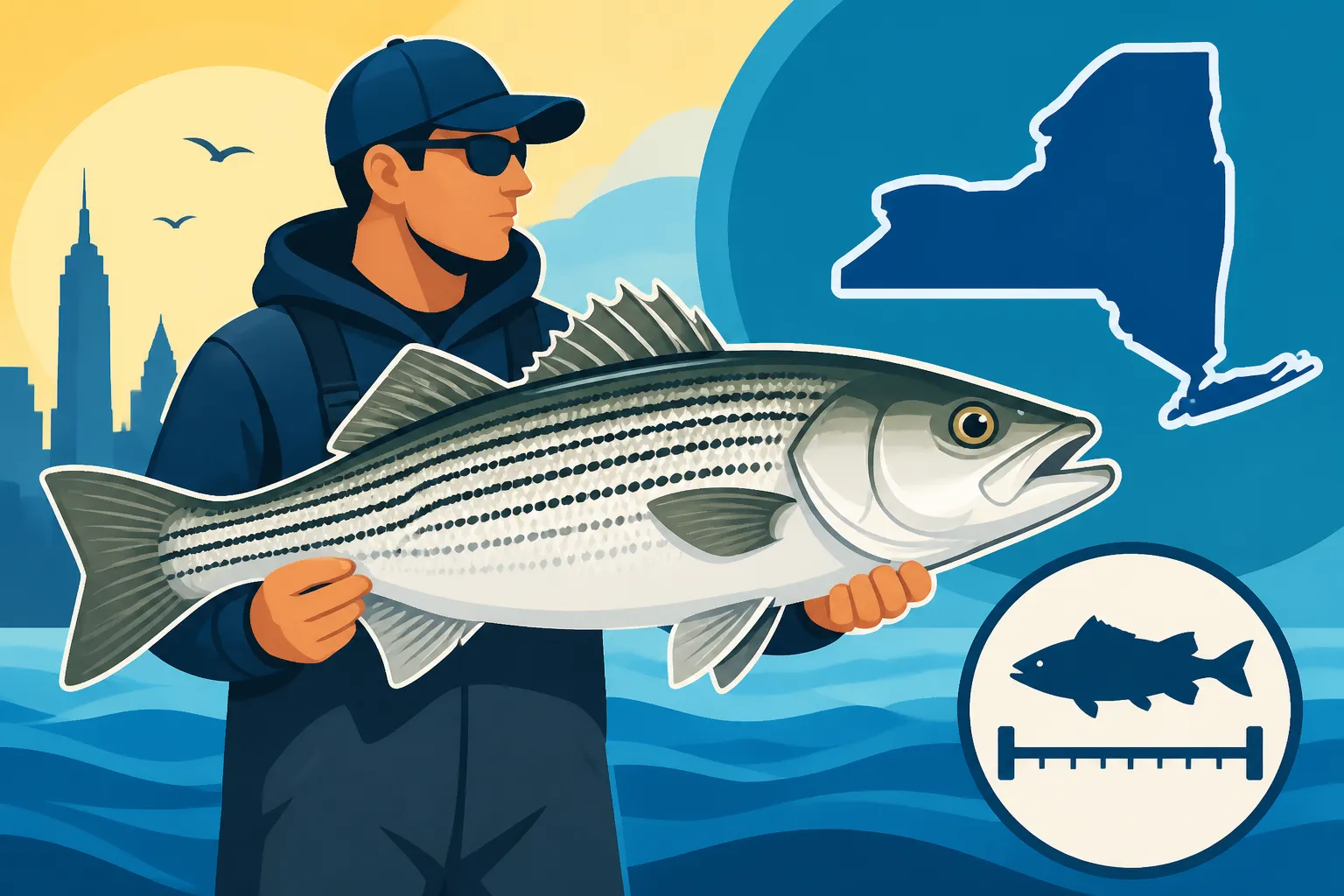
Measuring a fish might seem straightforward, but there's a correct way to do it, especially for legal purposes. For striped bass in New York, the measurement is taken from the tip of the snout (mouth closed) to the farthest tip of the tail (tail compressed). This is often referred to as "total length."
Here's a step-by-step guide to accurate measurement:
- Lay the fish flat: Place the fish on a flat surface or a measuring board.
- Close the mouth: Gently push the fish's mouth closed to ensure the snout is at the starting point (zero end) of your measuring device.
- Compress the tail: Pinch the tail fin together to get the maximum length. The tail should be measured to the very tip, not just where the fork is.
- Read the measurement: Read the measurement at the farthest point of the tail.
It's crucial to be gentle and quick, especially if you plan to release the fish. Minimizing its time out of water is key to its survival. Many anglers will take a photo of the fish on a measuring device as proof, which can be helpful, but remember, the ECO's measurement is the final word if there's a dispute.
Essential Gear for Accurate Measurement
While a standard tape measure might seem sufficient, dedicated fish measuring devices are often more accurate and easier to use, especially when dealing with a flopping fish.
- Fish Measuring Boards: These are rigid boards, often made of plastic or wood, with a built-in ruler and a stop at one end for the fish's snout. They ensure a consistent measurement every time and are less prone to error than flexible tape measures. Brands like Frabill or Rapala make excellent, durable measuring boards. You can often find a good selection of these on Amazon if you're looking to upgrade your gear.
- Adhesive Rulers: These can be applied to your cooler, boat gunwale, or even a paddle, providing a convenient and always-present measuring tool. Just make sure the surface is flat and the adhesive is strong enough to withstand the elements.
- Retractable Tape Measures: While not ideal for precise measurements on a squirming fish, a good quality, wide, retractable tape measure can work in a pinch. Just be extra careful to keep it straight and ensure the tail is compressed.
Having a clear, easy-to-read measuring device is not just a convenience; it's a necessity for legal compliance. Don't leave it to guesswork.
Common Mistakes to Avoid
Even experienced anglers can make mistakes when measuring, especially in the excitement of a catch.
- Measuring to the Fork: Some fish species are measured to the fork of the tail, but striped bass are measured to the total length, with the tail compressed. Always confirm the specific measuring method for the species you're targeting.
- Not Compressing the Tail: If you don't squeeze the tail lobes together, your measurement will be shorter than the actual length, potentially causing you to keep an undersized fish.
- Measuring on an Uneven Surface: A fish draped over a cooler lid or a bent boat cushion won't give an accurate reading. Always use a flat, rigid surface.
- Guessing: Never guess a fish's length. Even if it looks "about right," a few inches can make all the difference between a legal catch and a violation.
- Not Checking Current Regulations: As mentioned, regulations change. What was a legal slot last year might not be this year. Always confirm the latest numbers before you go.
By being meticulous and having the right tools, you can ensure that every striped bass you keep is within the legal limits, giving you peace of mind and contributing to responsible angling.
Penalties and Enforcement for Striped Bass Violations
Let's face it, nobody wants to get a ticket or have their fish confiscated after a great day on the water. But ignorance of the law is no excuse, and violating striped bass regulations in New York can carry some hefty consequences. Understanding these potential penalties should be enough motivation to always double-check the rules and measure accurately. If you're ever curious about the broader implications, our article Fishing Without a License in New York: What Happens covers general violations.
Fines and Legal Ramifications
Getting caught with an undersized, oversized, or over-the-limit striped bass in New York is no minor infraction. The penalties for such violations can include significant monetary fines, which can quickly add up, especially for repeat offenses or multiple illegal fish. These fines are often determined by the specific nature of the violation and can range from hundreds to thousands of dollars.
Beyond the immediate financial hit, there can be other legal ramifications. Depending on the severity and history of violations, you could face:
- Confiscation of your catch: Any illegally caught fish will be seized by the DEC.
- Confiscation of fishing gear: In some serious cases, your rods, reels, or even your boat could be seized.
- Loss of fishing privileges: Your fishing license could be suspended or revoked for a period, preventing you from fishing legally in New York.
- Criminal charges: While less common for minor length violations, egregious or repeated offenses can lead to more serious charges, particularly if combined with other infractions like resisting arrest or providing false information.
These aren't just theoretical possibilities; Environmental Conservation Officers (ECOs) are out there actively patrolling, and they take these violations very seriously. For a more detailed look at the financial consequences, consult Penalties for Fishing Without a License in New York.
The Role of Environmental Conservation Officers (ECOs)
New York's Environmental Conservation Officers are the frontline enforcers of all fishing and wildlife laws. These are trained law enforcement professionals with the authority to stop, inspect, and issue tickets to anglers who are not in compliance. They patrol lakes, rivers, and coastal waters, often by boat, and can also be found at popular fishing access points, docks, and boat launches.
ECOs are highly knowledgeable about the intricate fishing regulations and are skilled at identifying fish species and accurately measuring them. Their job isn't just to write tickets, though; they also play a vital role in educating the public and ensuring the long-term health of New York's natural resources. If an ECO approaches you, always be polite, cooperative, and honest. They are simply doing their job to protect the resource for everyone. Having your New York Fishing License Guide readily available, along with your measuring device, shows that you're a responsible angler.
Avoiding Accidental Violations
No one sets out to violate fishing regulations, but accidental violations happen more often than you might think. Here’s how to minimize your risk:
- Read the Regulations Annually: Don't rely on memory or old guides. The DEC's official fishing regulations guide is updated every year, and it’s your best resource. Keep a copy in your tackle box or on your phone.
- Know Your Location: Be keenly aware of where you are fishing, especially if you're near the boundary between marine waters and the Hudson River management zone. Different rules apply!
- Carry Proper Measuring Gear: A reliable measuring board or device should be standard equipment. Don't rely on approximations. If you're looking for a good, durable measuring tape to keep in your tackle box, there are plenty of options on Amazon.
- When in Doubt, Release: If a fish is borderline in length or you're unsure if it meets the slot limit, the safest bet is always to release it. A live fish is always better than a costly ticket.
- Understand Other Rules: Beyond length, remember bag limits, season dates, and specific gear restrictions (like circle hooks for striped bass bait fishing). Our article on How to Fish for Striped Bass in New York covers various techniques and related rules.
By being proactive and diligent, you can enjoy your striped bass fishing without the worry of running afoul of the law.
Responsible Angling and Conservation for Striped Bass
Beyond simply adhering to the length requirements and other regulations, responsible angling for striped bass goes a step further. It involves adopting practices that promote the health and survival of the fish, especially those you intend to release. Every angler plays a role in the conservation of this magnificent species.
Catch-and-Release Best Practices
Given the slot limits, many striped bass caught will need to be released, especially the big breeders or the smaller juveniles. Practicing proper catch-and-release techniques is crucial to ensure these fish survive and thrive.
- Minimize Fight Time: Bring the fish to the boat or shore as quickly as possible to reduce stress and exhaustion.
- Use Appropriate Tackle: Don't underpower your tackle. Using gear that's too light can prolong the fight and exhaust the fish, making it less likely to survive release.
- Use Barbless or De-barbed Hooks: Barbless hooks are much easier to remove, causing less tissue damage. You can easily pinch down barbs on your hooks with a pair of pliers.
- Handle With Care: Avoid touching the fish's gills or eyes. Support its body horizontally, especially if it's a larger fish, to protect its internal organs. If possible, keep the fish in the water while you remove the hook.
- Quick Hook Removal: Have long-nose pliers, de-hookers, or jaw spreaders ready to remove hooks quickly and efficiently. If a hook is deeply embedded and cannot be removed without causing further harm, cut the line as close to the hook as possible.
- Revive the Fish: If the fish seems lethargic, hold it upright in the water, facing into the current, and gently move it back and forth until it regains its strength and swims away on its own.
By following these practices, you significantly increase the chances of a released striped bass surviving to spawn another day. This is a critical component of ensuring the future of fishing for Fish Species You Can Catch in New York.
Understanding Striped Bass Biology
A deeper understanding of striped bass biology helps anglers appreciate the "why" behind the regulations and fosters a greater sense of stewardship. Striped bass are anadromous, meaning they spend most of their lives in saltwater but migrate to freshwater rivers, like the Hudson, to spawn. This migration is energetically demanding, and they are particularly vulnerable during this time.
Female striped bass are incredibly prolific, with larger females producing exponentially more eggs than smaller ones. This is why protecting those bigger fish (especially in spawning grounds) is so vital. They are long-lived, some reaching 30 years or more, and grow to impressive sizes, sometimes exceeding 50 pounds in New York waters. Their diet is varied, ranging from bunker and herring to crabs and squid, which influences what works as Best Bait for Striped Bass. Knowing these aspects helps us understand their vulnerability and the importance of responsible angling, especially during critical times like the spring run.
Supporting Sustainable Fisheries
Every time you buy a fishing license, register your marine fishing activities, or adhere to regulations, you're directly contributing to sustainable fisheries. The fees from licenses help fund conservation programs, stock assessments, habitat restoration, and enforcement efforts by the DEC.
Beyond compliance, consider getting involved in local fishing clubs or conservation organizations that advocate for striped bass and other marine species. These groups often participate in public comment periods for proposed regulation changes, providing a collective voice for anglers. Educating fellow anglers, especially newer generations, about responsible practices is also invaluable. By being an informed and ethical angler, you become part of the solution, helping to ensure that the thrill of catching a striped bass remains a cherished part of New York's angling heritage for years to come.
Disclaimer
The information provided in this guide is for general informational purposes only and is based on current understanding of New York State fishing regulations. Fishing regulations, including length limits, bag limits, and season dates, are subject to change by the New York State Department of Environmental Conservation (DEC) at any time. It is the responsibility of every angler to consult the most current official New York DEC Fishing Regulations Guide before engaging in any fishing activity. Failure to do so may result in fines or other penalties. This guide does not constitute legal advice.