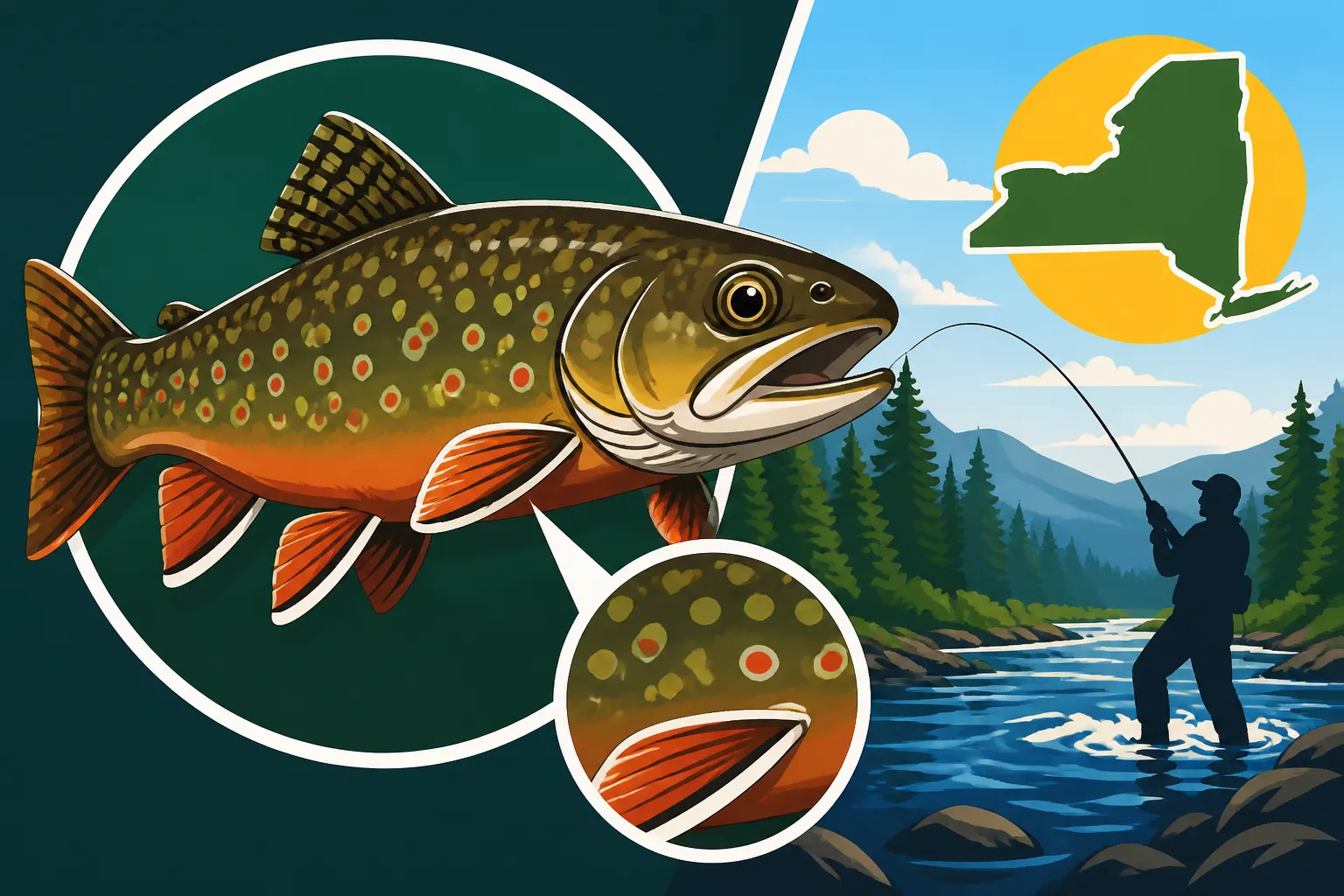
How to Identify a Brook Trout
Have you ever stood streamside in New York, admiring a beautifully colored trout, only to wonder, "Is this a brook trout or something else?" It's a common dilemma, as several trout species share similar habitats and can even look quite alike at first glance. This guide is here to cut through that confusion, helping you confidently identify a brook trout (or "brookie" as we often affectionately call them) and understand what makes these native New York gems so special.
The Brook Trout's Distinctive Appearance
Brook trout are, without a doubt, one of New York's most visually striking fish. Their vibrant colors and unique patterns make them a true joy to behold, especially during their spawning season. However, these features can sometimes be subtle, and knowing exactly what to look for is key.
Body Shape and Fin Characteristics
When you first hold a brook trout, you'll notice its generally sleek, torpedo-like body, which is perfectly adapted for navigating fast-flowing, cold water. They aren't as robust or heavy-bodied as some other trout species, possessing a more streamlined profile. The mouth is fairly large, extending back to or slightly beyond the rear margin of the eye. This isn't a tiny nibbler; they're opportunistic predators.
One of the most defining characteristics of a brook trout, one that often separates it immediately from a brown or rainbow, is its fins, particularly the lower fins. Take a close look at the pectoral, pelvic, and anal fins. You'll almost always see a distinct white leading edge, followed by a thin black stripe, and then the main color of the fin itself, which is often reddish-orange. This "white-black-red" fin pattern is a classic brook trout identifier. This vibrant trim really pops, especially when contrasted against their darker bodies or the muted colors of a stream bed.
Colors and Patterns: The Hallmark of a Brookie
Now, let's talk about the paint job. Brook trout are a riot of color, and it's their intricate patterns that truly set them apart. Their backs are usually a dark olive green, often with wavy, worm-like markings that we call "vermiculations." These markings are incredibly effective camouflage, allowing them to blend seamlessly with rocky streambeds and submerged logs. It's a key feature that helps differentiate them from other trout, which typically have spots rather than these swirling patterns on their backs.
Moving down their sides, you'll see a scattering of pale, light-colored spots – yellow, cream, or even slightly green. Interspersed among these lighter spots are the truly iconic "haloed" red or orange spots, sometimes called "blue halos" or "red spots with blue halos." These are red or orange spots surrounded by a faint, lighter blue ring. No other trout species in New York consistently exhibits this specific combination of vermiculations on the back and haloed spots on the sides. The belly can range from white to creamy yellow, often turning a brilliant orange or red, especially on males during the spawning season. This dazzling display is why many anglers consider them the most beautiful of all trout.
Size and General Proportions
While size isn't a definitive identification marker, it can offer some clues, particularly when considering typical specimens in New York. Brook trout generally don't grow as large as brown trout or steelhead (sea-run rainbow trout) in many New York waters, especially in the smaller, colder streams they tend to inhabit. A brook trout in a mountain stream might be just 6-10 inches long, while a larger one from a bigger lake or river system might reach 12-16 inches. Anything much larger than that is quite rare, though trophy brookies do exist in specific, well-managed waters.
Their proportions usually reflect their environment. Those in tiny creeks are often slender and compact, built for quick dashes for insects. Larger specimens from bigger bodies of water might be a bit chunkier, but they rarely achieve the sheer mass that a large brown trout or a full-grown Chinook salmon might boast. Brook Trout in New York gives a great overview of where these fish thrive.
Distinguishing Brook Trout from Similar Species
The real challenge for many anglers isn't identifying a trout, but rather distinguishing between the different trout species that call New York home. Brown trout, rainbow trout (especially steelhead), and even lake trout can sometimes be confused with brook trout, particularly by new anglers or in certain lighting conditions. Let's break down the key differences.
Brook Trout vs. Brown Trout
This is perhaps the most common identification conundrum in New York's freshwater streams. Brown trout are incredibly resilient and widespread, often coexisting with brook trout. However, there are several reliable ways to tell them apart. First, look at the spots. Brown trout are characterized by distinct dark spots (black or sometimes reddish-orange) on their sides, often with pale halos, but they lack the prominent blue halos of the brook trout. Crucially, brown trout usually have spots extending onto their adipose fin (the small, fleshy fin near the tail), and often all the way down their tail fin itself. Brook trout rarely have spots on their tail fin, and if they do, they're typically faint.
Next, consider the vermiculations. While a brown trout might have some indistinct wavy patterns, they won't have the pronounced, worm-like markings on their back that are a signature of the brook trout. Then, there are those distinctive lower fins: the white leading edge followed by a black stripe, then the reddish-orange, is almost exclusively a brook trout trait. Brown trout fins tend to be more uniform in color, often yellowish or brownish, lacking that crisp white-black border. Finally, the tail fin of a brown trout is usually square or slightly emarginate (slightly forked), whereas the brook trout's tail fin is noticeably more forked. For a deeper dive, check out Brook Trout vs Brown Trout: Key Differences.
Brook Trout vs. Rainbow Trout (Steelhead)
Rainbow trout, including their anadromous (sea-run) form, steelhead, are another popular New York species. Visually, they often present a different challenge than brown trout. The most obvious identifier for a rainbow trout is the distinct, often iridescent, pink or red band running horizontally along its side, from the gill plate to the tail. This "rainbow" stripe is usually absent in brook trout, though a spawning male brook trout can have vibrant red sides, it won't be a distinct band.
Rainbow trout also have many small, dark spots scattered across their bodies, including their dorsal fin and, very notably, their tail fin. Their tail fin is typically quite spotted and slightly forked or square. Unlike brook trout, rainbow trout do not have vermiculations on their back, nor do they possess the bright white leading edges on their lower fins. Their mouths are also typically smaller than a brook trout's, not extending as far back past the eye. If you're struggling with similar-looking fish, you might find more help in How to Identify a Steelhead vs a Brown Trout.
Brook Trout vs. Lake Trout
While less common to confuse, especially in typical stream fishing scenarios, lake trout are also char, like brook trout, and share some general characteristics. However, lake trout are generally much larger fish, often inhabiting deep, cold lakes, a very different environment from the small, shallow streams brook trout prefer. Lake trout are typically darker, often grey, brownish, or olive, with numerous irregular, light-colored spots all over their body, including the head, dorsal fin, and tail fin. These spots are usually much smaller and less defined than the spots on a brook trout.
Lake trout also possess a deeply forked tail, much more pronounced than the moderately forked tail of a brook trout. They lack the vibrant colors and vermiculations of a brook trout. While they are both members of the Salvelinus genus (chars), their appearances and typical habitats are quite distinct. If you're fishing in a larger lake setting, you can learn more about these powerful fish in Lake Trout in New York.
Here’s a quick comparison table to help visualize the key differences:
| Feature | Brook Trout (Salvelinus fontinalis) | Brown Trout (Salmo trutta) | Rainbow Trout (Oncorhynchus mykiss) |
|---|---|---|---|
| Back Pattern | Wavy, worm-like vermiculations | Few, if any, vermiculations | Mostly unpatterned, small spots |
| Side Spots | Pale spots with red/orange spots surrounded by blue halos |
Dark spots (black/red) with or without pale halos; no blue halos |
Many small, dark spots |
| Lower Fins | Distinct white leading edge, followed by black, then red/orange |
More uniform, yellowish/brownish; no prominent white edge |
More uniform, no prominent white edge |
| Tail Fin | Moderately forked; usually unspotted or faintly spotted |
Slightly forked or square; often spotted |
Slightly forked or square; heavily spotted |
| Lateral Stripe | Absent | Absent | Often distinct pink/red stripe |
| Mouth | Large, extends to or beyond eye | Extends to or beyond eye | Smaller, typically not beyond eye |
Habitat Clues and Behavioral Traits
Sometimes, where you catch a fish can be as informative as its physical appearance. Brook trout have very specific preferences when it comes to their environment, and understanding these can bolster your identification skills.
Preferred Environments and Water Conditions
Brook trout are quintessential cold-water fish. They absolutely thrive in small, clear, cold streams, rivers, and high-elevation lakes. Think pristine mountain streams in the Adirondacks or Catskills, with plenty of oxygen, undercut banks, and rocky bottoms. These waters are often fed by springs, keeping temperatures consistently cool, even in summer. If you're pulling a colorful trout out of a tiny, bubbling creek where the water feels icy cold, chances are very high it's a brook trout.
They are less common in larger, warmer, or more turbid rivers and lakes where brown trout and rainbow trout often dominate. Brookies are also quite sensitive to pollution and habitat degradation, which is why their presence is often an indicator of excellent water quality. You'll find them holding in pools, behind rocks, under fallen logs, or near any structure that provides cover and a break from the current. A good New York fishing map or guide can often indicate which waters are prime brook trout territory. Always double-check New York Freshwater Fishing Rules before you head out.
Spawning Colors and Seasonal Variations
One of the most spectacular times to identify a brook trout is during its spawning season, typically in the fall (September through November) when water temperatures drop. During this period, their colors intensify dramatically. Males, in particular, become incredibly vibrant, with their bellies, lower fins, and sometimes even their lower jaw turning a brilliant orange or fiery red. Their vermiculations become more pronounced, and the blue halos around their red spots really stand out.
These "spawning colors" are a temporary display, a sign of their readiness to reproduce. Outside of spawning season, while still beautiful, their colors might be a bit more subdued, with the reds and oranges fading slightly to more muted tones. However, the core identification features – the vermiculations, the haloed spots, and the white-edged fins – will remain. It's a reminder that fish, like all wildlife, can show seasonal shifts in their appearance.
Why Accurate Identification Matters
Beyond the simple satisfaction of knowing what you've caught, accurate fish identification is crucial for several practical and ethical reasons, especially when you're out fishing in New York.
Understanding Regulations and Catch Limits
Different fish species often have different regulations, and trout are no exception. New York's fishing regulations can vary not just by species, but also by water body, region, and time of year. For instance, brook trout might have a different minimum size limit or daily creel limit than brown trout or rainbow trout in the same stream. In some "heritage" or "wild brook trout" waters, special regulations might be in place to protect these native populations, sometimes even requiring catch-and-release only.
Misidentifying a fish could lead to inadvertently violating regulations, which nobody wants. Always carry a copy of the current New York fishing regulations, or have access to the official DEC app on your phone. Even better, consider a laminated field guide for fish identification that you can keep in your vest or tackle box. You can often find excellent field guides on retailers like Amazon that are specific to New York's freshwater fish. Knowing exactly what you've caught ensures you're complying with the law and contributing to sustainable fishing practices. New York Fishing Regulations Explained is an excellent resource for understanding these rules.
Conservation and Species Preservation
Brook trout hold a special place in New York's angling community because they are the state's only native stream-dwelling trout species. All other trout (browns, rainbows) were introduced from other regions or continents. This makes brook trout particularly important from a conservation standpoint. Are Brook Trout Native to New York? delves into this fascinating history, highlighting why they're so cherished. They are also New York's official state fish! Knowing how to identify them helps anglers appreciate their unique ecological role and supports efforts to protect their often-fragile habitats.
When you can confidently identify a brook trout, you're better equipped to participate in citizen science efforts, report unusual catches, or simply exercise responsible angling, such as practicing proper catch-and-release techniques for wild populations. For instance, if you encounter a brook trout in a marginal habitat, you might be more inclined to release it carefully, knowing its importance. Protecting these beautiful fish ensures future generations of anglers can also experience the thrill of catching a true New York native. This is especially vital in areas with New York Catch-and-Release Trout Fishing Rules.
Enhanced Angling Experience
Ultimately, being able to identify your catch adds a deeper layer of appreciation to your time on the water. It connects you more intimately with the ecosystem and the specific species you're pursuing. Imagine pulling in a fish and not just thinking "it's a trout," but knowing with certainty, "This is a magnificent brook trout, with those distinct vermiculations and blue-haloed spots, a true native of this cold, clear water!" It's a satisfying feeling that enriches every fishing trip.
This knowledge also helps you refine your techniques. If you're consistently catching brook trout in a particular type of water, you can then tailor your bait, lures, or fly patterns to target them specifically. For instance, smaller flies and stealthier approaches are often key for the skittish brookies in smaller streams. Having a comprehensive understanding of the fish you're targeting, including how to identify them, makes you a more knowledgeable, effective, and responsible angler. You might even want to pick up a detailed New York fish identification poster or book from Amazon to help you study up before your next trip.
Disclaimer
This article is for general informational purposes only and does not constitute professional advice. Laws, prices and regulations vary by location and change over time. Consult a qualified professional for guidance on your specific situation.