Best Dry Fly Patterns for Catskills Trout
For any angler who's spent time on the legendary waters of the Catskills, you know the challenge: those wild, wily trout can be incredibly selective. One minute they're rising aggressively, and the next, they're ignoring everything you throw at them. It's often because they're keyed into a specific insect hatch, making the choice of dry fly pattern absolutely critical. This guide is all about helping you decode those subtle clues and arm you with the best dry fly patterns to fool even the most discerning Catskill trout.
Understanding the Catskills' Unique Ecosystem and Hatches
The Catskill Mountains, often called the "Birthplace of American Fly Fishing," offer some of the most hallowed trout waters in the Northeast. Rivers like the Beaverkill, Willowemoc, Esopus, and Neversink are renowned not just for their beauty, but for the challenging, educated trout that call them home. These rivers are rich with aquatic insect life, and understanding the dominant hatches is the first step to becoming a successful dry fly angler here.
The Importance of Matching the Hatch
You hear the phrase "match the hatch" constantly in fly fishing, but nowhere is it more critical than in the Catskills. These trout, often descendants of wild populations, see a lot of flies from a lot of anglers. They're not easily fooled. When a specific insect hatch is in full swing, trout will often refuse anything that doesn't closely mimic the size, shape, and color of the natural insect emerging from the water. It's a classic case of supply and demand: when thousands of natural insects are available, a trout doesn't need to be greedy or take risks.
Think of it this way: if you're at a buffet with endless plates of your favorite gourmet meal, would you pick up a plate of plain toast? Probably not. Catskill trout operate on a similar principle. If they're seeing hundreds of tiny Sulphur mayflies floating by, they're not going to bother with a large, flashy Stimulator that doesn't resemble their current meal. Successfully matching the hatch means presenting a fly that the trout perceives as just another easy meal, making all the difference between a fishless day and a memorable one. To truly dive deeper into this critical skill, you might want to read our guide on How to Match the Hatch on Catskills Streams.
Key Insect Hatches in the Catskills
The Catskills are home to a vibrant community of aquatic insects, primarily Mayflies, Caddisflies, and Stoneflies. Each has its season and unique characteristics, and trout can become incredibly focused on them.
- Mayflies (Ephemeroptera): These are perhaps the most iconic and important insects for dry fly anglers. They have upright wings and two or three tails. Their life cycle includes nymphs, duns (subimago, which are essentially immature adults that float on the surface before flying off to molt one last time), and spinners (the mature adults that return to the water to mate and lay eggs). Trout often key in on the duns and spinners. Key Catskill mayflies include Hendricksons, Sulphurs, Blue-Winged Olives (BWOs), Light Cahills, Green Drakes, and Tricos.
- Caddisflies (Trichoptera): Caddisflies are another huge category. Unlike mayflies, they have tent-shaped wings that fold back over their bodies and typically have two antennae. Their larval stage often involves building cases out of stones or twigs. Caddis hatches can be explosive, with adults skittering across the water's surface, often eliciting aggressive strikes from trout. They are particularly abundant in late spring and summer.
- Stoneflies (Plecoptera): While not as prolific as mayflies or caddisflies in many Catskill stretches, stoneflies are important. They are generally larger insects, often with two pairs of wings that lay flat over their back and two prominent tails. Their nymphs are crawlers, and when they emerge, they often crawl out of the water onto rocks or streamside vegetation to hatch. However, some species do emerge on the surface, and larger patterns can be quite effective, especially after heavy rains or in faster, rockier sections of rivers.
Understanding when these different insects typically emerge is key to preparing your fly box. Our comprehensive New York Fishing Seasons Explained article can give you a broader overview of seasonal changes across the state, which applies to insect activity as well.
Essential Dry Fly Patterns for Catskills Mayflies
Mayflies are the bread and butter of Catskill dry fly fishing. Their predictable emergence cycles and distinctive profiles make them a prime target for trout, and therefore, for anglers. Having the right imitations on hand is non-negotiable for success.
Classic Baetis (Blue-Winged Olive) Imitations
Blue-Winged Olives, or BWOs, are tiny but mighty. They typically hatch on cooler, overcast days, often in the early spring, late fall, and even during mild winter days. These small, dark mayflies can bring even the most sluggish trout to the surface. When you see tiny, olive-bodied insects drifting on the surface, or trout subtly sipping, it's usually a BWO hatch.
The most popular BWO dry fly patterns include the standard BWO Parachute, the Sparkle Dun, and the classic Quill Gordon if you're looking for something slightly different. The Parachute Adams, in smaller sizes (18-22), can also effectively mimic a BWO dun. These flies should be tied with a sparse hackle and wing to accurately imitate the delicate nature of the natural insect. I always keep a variety of BWO patterns in my fly box, from size 18 down to a minuscule 22. You can find excellent selections of these patterns on platforms like Amazon, often in multi-packs that cover various sizes and stages.
Hendrickson and March Brown Patterns
As spring truly settles in, typically around late April to mid-May, the Hendrickson hatch explodes on Catskill rivers. This is one of the most anticipated hatches of the year, bringing large trout to the surface with gusto. Hendricksons are medium-sized mayflies with reddish-brown bodies and dun-colored wings. They provide some of the most exciting dry fly fishing opportunities.
Effective Hendrickson patterns include the traditional Hendrickson Dry, the Comparadun Hendrickson, and the Sparkle Dun Hendrickson. For spinners, the Red Quill Spinner is a must-have. A well-tied Hendrickson pattern, drifting drag-free, can lead to spectacular strikes. Following the Hendricksons, often in late May, come the March Browns. These are slightly larger, tan-bodied mayflies that also bring strong rises. The March Brown Dry, Comparadun, and Hare's Ear patterns are great choices here. Many local fly shops, or even Amazon, offer "Catskill hatch kits" that include these critical early-season patterns.
Sulphur and Light Cahill Imitations
When summer arrives, and water temperatures warm, the Sulphur hatch becomes dominant. These small, pale yellow mayflies are present throughout late spring and summer evenings, often producing consistent rises right at dusk. Sulphurs can be particularly challenging because they are often tiny (sizes 16-20) and require precise presentation.
My go-to Sulphur patterns include the Sulphur Parachute, the Sulphur Comparadun, and the classic Sulphur Dun. For spinner falls, a Pale Evening Dun (PED) Spinner is excellent. A few weeks later, or sometimes overlapping, you'll find the Light Cahill hatch, another pale yellow to cream-colored mayfly, usually a bit larger than Sulphurs (sizes 12-16). The Light Cahill Dry, Wulff, and Paradun are all excellent choices. These hatches are fantastic times to target specific fish you see rising. If you're planning a trip, be sure to check hatch reports for Best Catskills Fly Fishing Streams to know what's active.
Trico and Isonychia Patterns
Later in the summer, especially on calm mornings, you might encounter the Trico hatch. These are truly tiny mayflies, often called "the angler's curse" due to their minuscule size (20-28) and the incredibly selective feeding they induce. When Tricos are on, you'll see trout sipping almost imperceptibly, often feeding on the spinner fall right at dawn. A black-bodied Trico Spinner or Trico Parachute is essential, but be prepared for delicate leaders and challenging casts.
On the other end of the size spectrum, the Isonychia (often called "Slate Drakes") hatch in late summer and early fall. These are larger, dark-bodied mayflies (sizes 10-14) that can emerge quickly and in fast water. Trout will often move for these robust insects. A Rusty Spinner or a Dark Cahill pattern can effectively imitate them. These larger patterns are a welcome change from the tiny mid-summer fare and can elicit aggressive strikes.
Dry Fly Patterns for Catskills Caddisflies and Stoneflies
While mayflies might get most of the glory in the Catskills, completely overlooking caddisflies and stoneflies would be a huge mistake. These insects provide critical food sources for trout at various times of the year and often bring a different kind of excitement to the dry fly game.
Caddisfly Essentials: Elk Hair Caddis and X-Caddis
Caddis hatches can be more erratic and aggressive than mayfly hatches. Instead of simply drifting, caddisflies often skitter across the water's surface as they emerge or lay eggs, which can trigger an explosive, predatory response from trout. They are generally abundant from late spring through early fall.
The Elk Hair Caddis is, without a doubt, one of the most versatile and effective dry flies ever created, and it's absolutely indispensable in the Catskills. It floats well, is relatively durable, and can imitate a wide range of caddis species simply by varying its size and body color (e.g., olive, tan, brown, black). I carry them in sizes 12-18. When fish are aggressively slashing at skittering naturals, a quick twitch of your Elk Hair Caddis can often induce a strike. The X-Caddis is another fantastic pattern, especially for more subtle caddis emergers, as its trailing shuck offers a realistic impression of a caddis struggling to break free of its nymphal shuck. These two patterns alone can cover a huge percentage of the caddisfly activity you'll encounter. You can easily stock up on these versatile flies by looking for various colors and sizes on Amazon.
Stonefly Patterns for Larger Trout
While dense stonefly hatches aren't as prevalent on most Catskill trout streams as they might be on, say, some Western rivers, certain species are present and can be important, particularly in faster, rockier sections. Stoneflies are generally larger insects, and when they emerge, they represent a substantial meal for a trout.
The Stimulator is the most renowned stonefly dry fly pattern, and for good reason. It's a buoyant, bushy fly that can imitate a large adult stonefly, but it's also versatile enough to mimic large caddis or even a grasshopper. I often fish Stimulators in sizes 8-12, particularly in stretches with broken water or when I'm prospecting for larger, aggressive fish. Colors like yellow, orange, and olive are productive. While you might not always see an obvious stonefly hatch, having a Stimulator or two in your box is smart for those moments when you want to throw something big and bold to trigger a reaction strike, especially on a larger river like the Delaware, which has some substantial stonefly populations. Our guide on Fishing the Delaware River in New York covers more details on that river's unique opportunities.
Versatile Attractor and Terrestrial Dry Flies
Sometimes, trout aren't keyed into a specific hatch, or perhaps there simply isn't one happening. These are the times when "attractor" patterns or terrestrials shine. These flies don't necessarily imitate a specific aquatic insect perfectly but rather represent a general meal or something that accidentally fell into the water, triggering an opportunistic strike.
Go-To Attractor Patterns: Adams and Parachute Adams
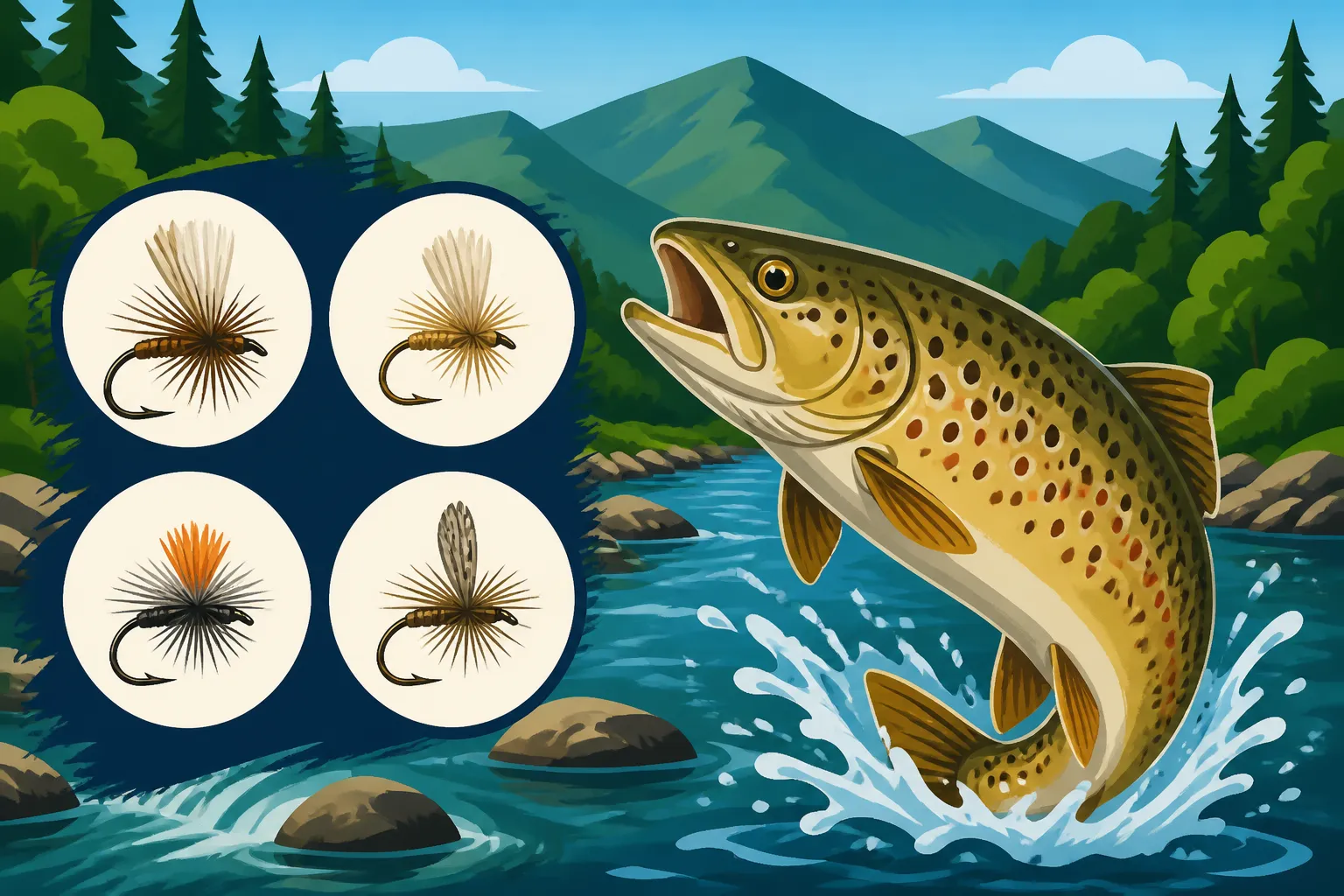
If there's one dry fly that every Catskill angler should have in their box, it's the Adams or, more commonly, the Parachute Adams. This fly is often called the "utility player" or "Swiss Army knife" of dry flies because it can imitate so many different insects. Its mixed hackle and grizzly/brown wings give it a buggy, generalist appearance that trout often find irresistible, even when they're being finicky.
The Parachute Adams, in particular, is a phenomenal pattern. Its parachute-style hackle allows it to sit low in the water, mimicking an emerger or spent spinner, while the white post makes it easy for the angler to see. I carry Parachute Adams in sizes 10-22, and it's often the first fly I'll tie on if I don't see any specific hatch occurring. It's a fantastic searching pattern and often proves effective when nothing else is working. It's a generalist that fish somehow seem to recognize as food. You can find excellent quality Parachute Adams flies on Amazon, often in bulk packs which is great because you'll use them a lot!
Terrestrial Patterns: Ants, Beetles, and Hoppers
Late summer and early fall are prime times for terrestrial fishing in the Catskills. As the weather warms, ants, beetles, and grasshoppers become more active along the banks, and inevitably, some of them end up in the water. Trout know this and will often shift their feeding focus from aquatic insects to these land-dwelling treats.
- Ants: Often overlooked, ant patterns (black, cinnamon, or red in sizes 14-20) can be deadly, especially on slow, clear pools or undercut banks. Trout love ants, and they can be present throughout much of the warm season.
- Beetles: Foam beetles (black or brown in sizes 12-16) are great for bank-side fishing, especially near overhanging vegetation. They plop down with a satisfying "splat" that can attract attention.
- Hoppers: Grasshopper patterns (Dave's Hopper, Charlie Boy Hopper, or similar foam hoppers in sizes 8-14) are excellent for fishing along grassy banks or during windy days when natural hoppers might be blown into the water. The bigger meal these represent can draw larger trout out from cover.
Fishing terrestrials often involves casting tight to the bank, under branches, or along current seams where these insects might fall in. These patterns are less about delicate presentation and more about placement and the "plop" factor.
Wulff Series Flies for Rough Water
The Wulff series of dry flies (Royal Wulff, Gray Wulff, White Wulff, Black Wulff) are Catskill originals, developed by the legendary Lee Wulff. These flies are characterized by their bushy, deer-hair wings and hackle, making them incredibly buoyant and visible, even in turbulent or broken water. They don't perfectly mimic any single insect but are fantastic general attractor patterns or can imitate larger mayflies.
The Royal Wulff, with its peacock body and red band, is perhaps the most famous and is a fantastic all-around searching pattern. It floats like a cork and can be seen easily from a distance, which is a huge advantage in faster runs or when fishing in low light. When you're fishing a strong, broken current, or simply want a highly visible fly that won't get drowned, a Wulff pattern in sizes 10-16 is a superb choice. They're also incredibly durable, standing up to multiple fish and casts. Learning How to Fly Fish the Beaverkill River or How to Fly Fish the Ausable River will almost certainly involve utilizing a Wulff pattern at some point due to their versatility in varied conditions.
Tips for Successful Dry Fly Fishing in the Catskills
Having the right flies is just one piece of the puzzle. How you approach the water, present your fly, and equip yourself are equally important for consistent success in the Catskills.
Reading the Water and Trout Behavior
Before you even make your first cast, spend time observing the water. Are fish rising? If so, how are they rising? Are they subtly sipping, indicating small emergers or spinners, or are they slashing aggressively, suggesting caddis or larger mayflies? What direction are they feeding? Are there any insects on the water? This observation period is often called "reading the water" and it's paramount.
Look for current seams, eddies, undercut banks, and the tails of pools—these are prime holding lies for trout waiting for food. A rising trout often creates a "porthole" on the surface; if you see this, note the precise spot and direction of the current. Pay attention to the speed and rhythm of the rises. A slow, methodical rise might indicate a fish cruising a feeding lane, while a rapid, splashy rise could mean an opportunistic take. Our general guide on How to Trout Fish in New York provides a solid foundation for understanding trout behavior across different water types.
Presentation and Drag-Free Drifts
Catskill trout are notoriously line-shy and sensitive to drag. A drag-free drift means your fly floats at the same speed as the natural current, without being pulled or pushed unnaturally by your fly line. This is much harder than it sounds, especially in complex currents.
Techniques like "mending" (repositioning your fly line upstream or downstream while the fly is drifting to prolong a drag-free float) and casting "slack line" casts (like S-curves or parachute casts) are crucial. When casting to a rising fish, aim your cast a few feet upstream of the fish, allowing your fly to settle and drift naturally into its feeding lane. Often, one perfect, drag-free drift is worth ten sloppy ones. If you're struggling to get a take on a specific pattern, try a slightly different presentation or angle before changing flies. Sometimes, a tiny change in your drift makes all the difference. Even if trout aren't rising, you can always try techniques like How to Nymph Fish for Trout to target them subsurface, which often requires similar presentation skills.
Choosing the Right Gear
While any decent fly rod can catch a trout, having the right gear for Catskill dry fly fishing can significantly enhance your experience and success.
- Rod: A lightweight fly rod, typically a 7.5 to 9-foot, 3 or 4-weight, is ideal for delicate presentations with small dry flies. This lighter setup protects fine tippets and makes casting accurately a joy. For a more detailed breakdown of what rod might suit you, check out our article on Best Rod Weight for New York Trout Streams.
- Reel: A simple, reliable reel that balances your rod is all you need. The drag system isn't as critical for trout as it is for larger game fish, but a smooth drag is always nice.
- Fly Line: A good weight-forward floating line is essential for dry fly fishing, allowing for easy casting and mending.
- Leaders and Tippet: A long leader (9-12 feet) with a fine tippet (5X to 7X) is crucial for delicate presentations and minimizing drag. The longer and finer your leader, the less likely trout are to be spooked by your line, and the better your chances of achieving a natural drift. Brands like Rio, Scientific Anglers, and Orvis offer excellent leaders and tippet material which you can find on Amazon or at your local fly shop.
Always remember to bring a net, forceps or hemostats for hook removal, and perhaps a small fly patch or drying agent for your flies. And of course, always be sure to have your New York Fishing License Guide handy and understand all New York Freshwater Fishing Rules before heading out.
Key Catskills Dry Fly Patterns at a Glance
To give you a quick reference, here's a table summarizing some of the essential dry fly patterns discussed for the Catskill region:
| Fly Pattern | Primary Imitation | Best Season | Key Sizes | Notes |
|---|---|---|---|---|
| Parachute Adams | General Mayfly, BWO, Attractor | All Season | 12-22 | The ultimate all-rounder, excellent visibility, low float. |
| Elk Hair Caddis | Caddisfly Adults | Late Spring – Fall | 12-18 | Versatile, buoyant, great for skittering presentations. |
| Hendrickson Dry | Hendrickson Mayfly (Dun) | Early – Mid Spring | 12-14 | Essential for one of the most prolific early hatches. |
| Sulphur Parachute | Sulphur Mayfly (Dun) | Late Spring – Summer | 16-20 | Crucial for delicate evening rises on warm nights. |
| Blue-Winged Olive Dry | Baetis Mayfly (Dun) | Early Spring, Fall, Winter | 18-22 | Small, dark patterns for cooler, overcast days. |
| Royal Wulff | Large Attractor, General Mayfly | All Season | 10-16 | High-floating, visible, great for broken water or prospecting. |
| Stimulator | Stonefly, Large Caddis, Hopper | Summer – Fall | 8-14 | Excellent searching pattern, good for larger fish in faster water. |
| Light Cahill Dry | Light Cahill Mayfly (Dun) | Summer | 12-16 | Pale-bodied pattern for warmer evening hatches. |
| Black Ant | Terrestrial Ant | Summer – Early Fall | 14-20 | Effective when fish are looking for land-based insects. |
| Trico Spinner | Trico Mayfly (Spinner) | Late Summer – Early Fall | 22-28 | For tiny, challenging morning spinner falls; requires fine tippet. |
Disclaimer
This article is for general informational purposes only and does not constitute professional advice. Laws, prices and regulations vary by location and change over time. Consult a qualified professional for guidance on your specific situation.