Seneca Lake Lake Trout Depths in New York
Trying to find lake trout in a vast, deep expanse like Seneca Lake can feel like searching for a needle in a haystack, especially when you know they prefer certain depths but aren't sure exactly where to start looking. It's a common struggle for anglers, whether you're a seasoned veteran or just starting out on this incredible Finger Lake. This guide will take the guesswork out of the equation, breaking down the specific depths where you can expect to find Seneca Lake's elusive lake trout throughout the year and the techniques that will help you bring them to the net.
Understanding Seneca Lake's Unique Environment for Lake Trout
Seneca Lake isn't just any body of water; it's a unique, deep, and cold-water ecosystem that provides an ideal habitat for lake trout. Knowing a bit about its characteristics helps immensely in understanding why these fish behave the way they do and, most importantly, where they choose to reside. It’s a game of temperature, oxygen, and food, all dictated by the lake's incredible depth.
The Deep, Cold Waters Lake Trout Love
Seneca Lake holds the title for the deepest of New York's Finger Lakes, plunging down to over 600 feet in some areas. This extreme depth is crucial for lake trout, as they are cold-water species that thrive in temperatures generally ranging from 45 to 55 degrees Fahrenheit (7 to 13 degrees Celsius). Unlike many other game fish that prefer warmer waters, lake trout will seek out the coldest, most oxygenated water available. During the warmer months, this means a retreat to the deep, dark abyss.
Throughout the year, Seneca Lake undergoes a process called thermal stratification, where distinct layers of water form based on temperature. The deepest parts of the lake remain consistently cold, offering a stable environment for lake trout even when surface temperatures soar. This provides them with a refuge from both heat and predators. Understanding this stratification is key; the "thermocline" – the layer where water temperature changes most rapidly – often acts as a highway or a ceiling for many fish species, including the baitfish that lakers feed on.
Seasonal Movements and Forage Base
Lake trout are not static creatures; their depth preferences shift significantly with the seasons, driven primarily by water temperature, oxygen levels, and the availability of their main food sources. In Seneca Lake, the primary forage for lake trout consists of alewives and smelt. These baitfish also have their preferred temperature ranges, and where they go, the lake trout often follow.
During different times of the year, these baitfish schools will move up or down in the water column, responding to light penetration, temperature, and even predator avoidance. For instance, alewives tend to be more active and can be found shallower in cooler months, while in summer, they often school tightly near the thermocline. By understanding these seasonal migrations of both the trout and their food, you can predict with much greater accuracy the depths at which you’ll find the lakers. This interconnected dance between predator and prey is fascinating and fundamental to successful Seneca Lake fishing. If you're looking for more general insights into the species, our guide on Lake Trout in New York offers a broader perspective.
Prime Lake Trout Depths by Season
The beauty of fishing Seneca Lake for lake trout lies in its year-round potential, but success hinges on adapting your strategy to the seasonal changes. What works in April certainly won't cut it in August, and knowing the depth ranges is your secret weapon.
Spring: Shallow to Mid-Depths
As the ice retreats from Seneca Lake, usually by late March or early April, the water column begins to cool and mix. In early spring, the lake trout, invigorated by the cold, oxygen-rich water, will often cruise much shallower than they do in summer. You can find them anywhere from 20 to 60 feet deep, sometimes even shallower if there's an abundance of baitfish close to shore or around structure. This is a fantastic time for casting or flat-line trolling closer to the surface.
As spring progresses into May and early June, and the surface water slowly warms, the lake trout will start to descend. You'll typically find them in the 40 to 80-foot range, though they might still make forays into shallower waters during low-light conditions or when actively chasing schools of alewives. This transitional period requires constant adjustment, so pay close attention to your electronics and the behavior of the bait. Many anglers consider this a prime time for exciting action before the summer deep-water retreat. For a more general overview of fishing times, check out Best Time of Year to Fish in New York.
Summer: The Deep Water Retreat
Summer on Seneca Lake brings warm surface temperatures, forcing lake trout into their deep-water sanctuaries. This is when the lake's immense depth truly comes into play. From late June through September, lake trout will primarily congregate in the colder, oxygenated waters below the thermocline. Expect to find them anywhere from 70 to 180 feet deep, with some larger fish occasionally holding even deeper. The precise depth will vary slightly depending on the year, the specific location, and where the most prominent baitfish schools are holding.
This time of year demands specialized gear like downriggers and heavy weights to get your lures down to the strike zone. Trolling spoons, flies, or stickbaits at these profound depths can be incredibly effective. Sometimes, lake trout will suspend slightly shallower if a dense school of baitfish is present at, say, 60 feet, but they will rarely venture into the warmer water above the thermocline for extended periods. When the sun is high and the surface water is bathwater warm, those lakers are enjoying the cool comfort of the deep. If you're heading out for this, our guide on How to Fish Deep Water Lake Trout in Summer on New York's Finger Lakes can provide additional tips. Sometimes, finding these deep-water fish requires a local expert, and a good way to connect with experienced captains is through platforms like FishingBooker, which lists many excellent Seneca Lake charters.
Fall: Return to Shallower Waters for Spawning and Feeding
As autumn's chill starts to permeate the surface of Seneca Lake, the entire water column begins to cool and eventually "turns over," meaning the warm surface water mixes with the colder deep water. This process, typically starting in late September and continuing through October and November, signals a significant change for lake trout. They will begin to migrate shallower, often to depths of 30 to 80 feet, especially as they prepare for their spawning ritual.
Lake trout typically spawn over rocky shoals and reefs in the fall. During this pre-spawn and spawning period, they can be found relatively shallow, sometimes even in 15 to 30 feet of water, making them accessible to different fishing methods. After spawning, they will remain in these mid-depths, actively feeding to recover energy before winter fully sets in. This is another fantastic season for Seneca Lake trout fishing, offering diverse opportunities as fish move both horizontally and vertically. Understanding New York Fishing Seasons Explained can help align your trips with optimal conditions.
Winter: Under the Ice
When Seneca Lake freezes over, usually in the coldest parts of winter, lake trout become a prime target for ice anglers. Unlike other species that might hunker down near the bottom, lake trout under the ice often suspend at various depths. You can find them anywhere from 40 to 120 feet, though sometimes they’ll chase baitfish shallower or deeper. It’s not uncommon to catch them in the 60 to 80-foot range, often over deeper water where structure isn't directly below but nearby.
Jigging spoons or even small swimbaits are effective when dropped to these depths through the ice. It's crucial to use a fish finder (flasher or sonar) to pinpoint both the baitfish and the lake trout. Sometimes the fish will cruise just off the bottom, other times they'll be suspended 20 or 30 feet up in the water column, following the food. Adapting to their specific depth on any given day is key to success on the ice. While Seneca Lake doesn't always fully freeze, when it does, it offers incredible winter fishing opportunities. If you're fishing in colder conditions generally, our article on How to Fish Cold Water in New York has some excellent pointers.
Essential Techniques for Targeting Lake Trout at Specific Depths
Once you know where the lake trout are likely holding, the next step is getting your lure into their strike zone. Lake trout, especially in a deep lake like Seneca, often require specialized techniques and equipment to reach them effectively.
Mastering Downrigging and Deep Trolling
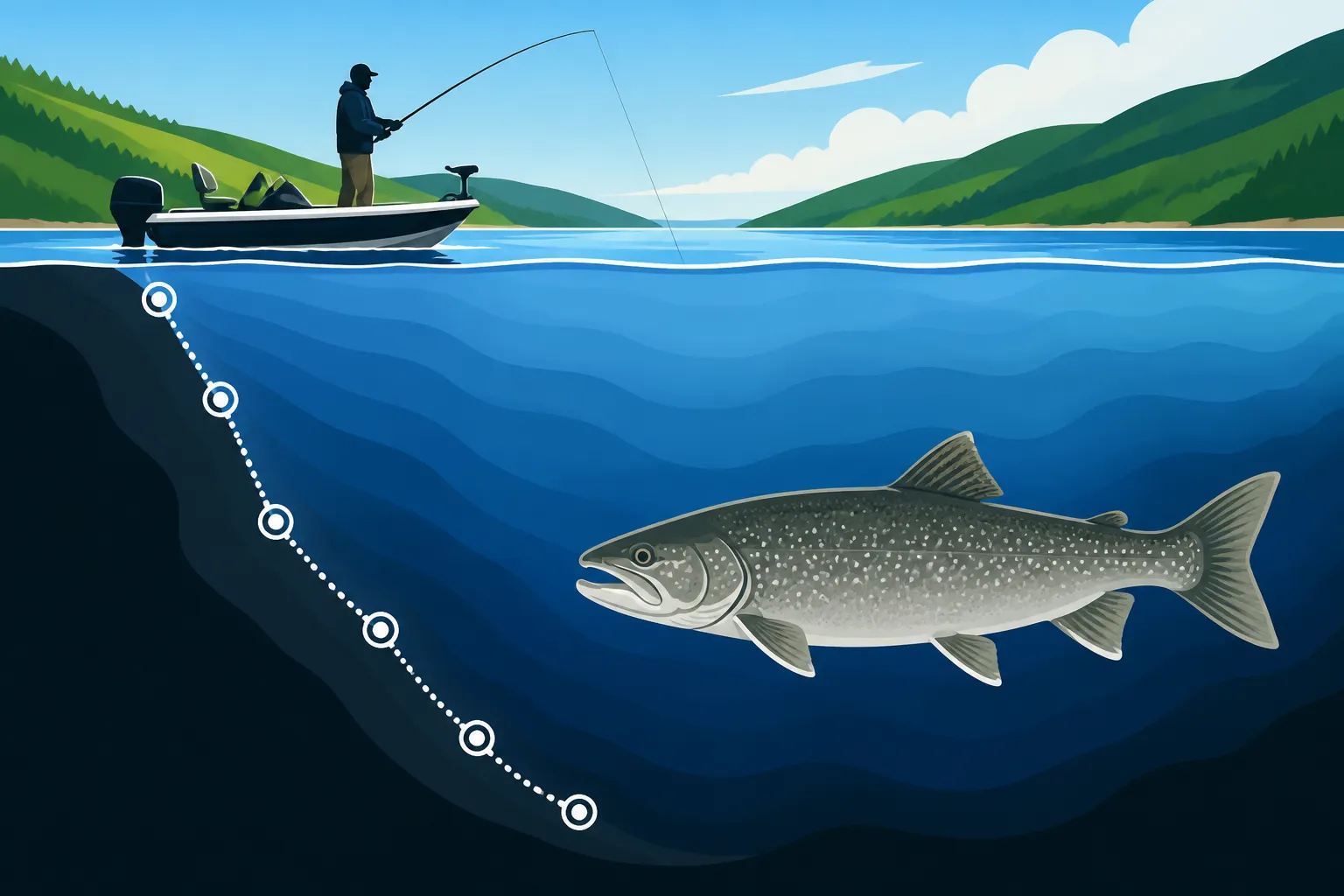
For consistently reaching lake trout in their deep summer haunts or when they are suspended at precise depths, downrigging is king. A downrigger uses a heavy ball (cannonball) to carry your fishing line, with an attached lure, down to a specific, pre-set depth. Once the desired depth is reached, the line is released from a clip, allowing your lure to swim freely behind the boat at that exact depth. This precision is invaluable for presenting baits effectively to deep-holding fish. Many experienced anglers utilize this method on Seneca Lake to target suspended fish.
When downrigging, you'll typically be trolling at speeds between 1.5 to 3 miles per hour. Common lures include large trolling spoons (like Sutton, Northern King, or Michigan Stinger), stickbaits (such as Rapala Deep Tail Dancers or Bomber Long A), and even flasher/fly combinations, where a dodger or flasher creates attraction, followed by a smaller fly or squid imitation. The length of line between your rod tip and the downrigger release clip (the "setback") can also influence the depth and action of your lure, so don't be afraid to experiment. For more details on this, our guide on Trolling Techniques for New York's Lakes is a great resource. You might consider hiring a local charter through a service like FishingBooker for your first deep trolling trip; they often have all the necessary gear and expertise to make your day productive.
Vertical Jigging and Drop-Shotting
While trolling is often the go-to, vertical jigging and drop-shotting can be incredibly effective, especially when you've pinpointed a school of lake trout on your electronics or are fishing a specific piece of structure. Vertical jigging involves dropping a heavy jigging spoon (like a Luhr-Jensen Crippled Herring or a Sven Myer Spoon) directly over fish and working it with a sharp, upward jerk followed by a controlled fall. The flash and erratic action of the spoon often trigger aggressive strikes from curious lakers.
Drop-shotting, a technique usually associated with bass fishing, can also be adapted for deep lake trout. It involves a weight tied to the very end of your line, with your hook (and bait, often a plastic minnow or Gulp! grub) tied directly to the main line a foot or two above the weight. This allows your bait to suspend enticingly at a fixed depth above the bottom or suspended fish, while your weight maintains contact with the desired depth. Both these methods benefit immensely from accurate boat positioning (often using a trolling motor with GPS Spot-Lock) and good sonar to track your lure and the fish.
Interpreting Your Electronics
In deep-water lake trout fishing on Seneca Lake, your fish finder is your most valuable tool. It's not just about seeing fish, but understanding the entire underwater landscape. Learn to identify the thermocline, which will appear as a distinct horizontal line where baitfish (and often lake trout) will congregate. Schools of baitfish will show up as dense clouds or arches, and where there's bait, there are usually predators.
Lake trout themselves will appear as large, distinct arches on your screen. Pay attention to whether they are on the bottom, suspended, or interacting with bait schools. Many modern fish finders offer side-imaging and down-imaging, which provide even more detailed views of structure and fish nearby. Understanding How to Read a Fish Finder for New York Lakes is a crucial skill. Learning to differentiate between bottom contours, ledges, and deep reefs is also vital, as these structures often attract and hold lake trout. If you're serious about deep-water fishing, investing time in learning your electronics will pay dividends. Many top guides listed on FishingBooker are masters of their electronics, using them to consistently put clients on fish.
Key Locations and Structure on Seneca Lake
While pinpointing exact GPS coordinates is difficult and ever-changing, understanding the types of structure and areas that consistently hold lake trout in Seneca Lake is far more valuable. Lake trout, like many predators, are creatures of habit and will relate to specific underwater features.
Understanding Reefs, Drop-Offs, and Ledges
Seneca Lake is characterized by its steep, deep drop-offs that plunge quickly into profound depths. These sharp contour changes are prime lake trout habitat. They provide ambush points, temperature breaks, and access to both shallow feeding grounds and deep-water safety. Look for areas where the bottom contour changes dramatically, such as underwater points, ledges, and submerged humps.
Reefs and rocky shoals, especially those that rise significantly from the lake bed but don't quite reach the surface, are also magnet for lake trout. These areas concentrate baitfish and provide structure for the trout to relate to. The edges of these reefs, where they drop off into deeper water, are particularly productive. These structural elements provide the thermal refuge and feeding opportunities that lake trout depend on throughout the year.
Best Areas to Focus for Deep Water Lake Trout
Generally, the central and northern sections of Seneca Lake, where the depths are most pronounced and the steepest drop-offs occur, tend to be highly productive for deep-water lake trout. The deep basins, particularly where current or subtle underwater features create unique dynamics, are excellent places to start. For example, areas near Dresden, Geneva, and Watkins Glen all offer access to significant deep water and classic lake trout habitat.
While specific hotspots can vary from day to day, focusing on the main lake basin, particularly the edges of historical underwater landslides or major drop-offs, will put you in the zone. These are the areas where the forage fish congregate, drawing in the hungry lake trout. Don't be afraid to explore, but always start by looking for those dramatic depth changes. Remember that reputable guides, many of whom are available for booking on FishingBooker, spend countless hours on these waters and have an intimate knowledge of the most productive spots on any given day.
Seasonal Lake Trout Depths on Seneca Lake
Here's a quick overview of where you can typically expect to find lake trout in Seneca Lake throughout the year. Keep in mind these are general guidelines, and daily conditions (weather, baitfish movement) can cause variations.
| Season | Typical Depth Range (feet) | Primary Factors Influencing Depth | Common Techniques |
|---|---|---|---|
| Early Spring | 20 – 60 | Cold water, mixing lake, baitfish moving shallow | Flat-line trolling, casting |
| Late Spring | 40 – 80 | Warming surface, fish starting to descend | Trolling, some jigging |
| Summer | 70 – 180+ | Warm surface, thermocline, cold water refuge | Downrigging, deep trolling, vertical jigging |
| Early Fall | 30 – 80 | Cooling water, lake turnover, pre-spawn | Trolling, casting, jigging |
| Late Fall | 15 – 50 (spawning) | Spawning activity on shoals, post-spawn feeding | Trolling, casting, jigging |
| Winter (Ice) | 40 – 120 | Under ice, suspended over deep water, baitfish | Vertical jigging, tip-ups |
Remember, these are average depths. Always use your fish finder to locate schools of baitfish and individual lake trout, as they will often be found in relation to their food source. It pays to check different depths until you find where the fish are active. Knowing the New York DEC Fishing Regulations Guide is also essential before heading out.
Disclaimer
Fishing conditions and regulations can change. Always consult the latest New York State Department of Environmental Conservation (DEC) regulations before heading out on the water. This guide is for informational purposes only and does not guarantee fishing success.