How to Downrig for Lake Trout
There’s nothing quite like the thrill of feeling that powerful tug on your line when you’re out on a New York lake, especially when you know it's a magnificent lake trout. But let's be real, these elusive beauties don't just hang out near the surface, waiting for any old cast. They dwell in the icy, dark depths, making them incredibly challenging to reach with traditional methods. That's where downrigging comes in—it's the absolute game-changer for consistently putting your lure right in front of those deep-water giants. This guide is all about demystifying the art of downrigging, helping you get your offerings down to where the fish truly live and dramatically increasing your chances of landing a trophy lake trout in New York's incredible waters.
Understanding Lake Trout Behavior and Habitat
To truly master the art of downrigging for lake trout, you first need to understand the fish themselves. They're not like your typical panfish or even most bass; they have very specific preferences that dictate where and when you'll find them. Knowing these habits is half the battle, making your downrigging efforts far more effective.
The Deep Secrets of Lake Trout
Lake trout, or "lakers" as many of us affectionately call them, are creatures of the deep. They thrive in cold, oxygen-rich water, typically preferring temperatures between 40-55 degrees Fahrenheit. This means that as the surface waters warm, especially during the summer months, these fish will retreat to the coolest, deepest parts of the lake. We're talking about depths of 50, 100, even 200 feet or more in some of New York's larger bodies of water. You won't find them basking in the sun like a largemouth bass; they are constantly seeking out their preferred thermal comfort zone.
Beyond temperature, lake trout are also opportunistic predators. They'll feed on a variety of forage, from smelt and alewives to sculpins and even smaller trout. Understanding their primary food sources in a particular lake can help you choose the right lures and presentations. For instance, if you know a lake is teeming with alewives, a lure that mimics their profile and flash will likely be more effective. Their preference for these deeper, colder environments also means they tend to be found around underwater structures like drop-offs, humps, ledges, and channels. These features provide cover, ambush points, and often hold baitfish, making them prime real estate for lakers.
When and Where to Find Them in New York
New York State boasts some incredible lake trout fisheries, particularly in its deep, glacially carved lakes. The Finger Lakes, like Seneca, Cayuga, and Keuka, are legendary for their laker populations, as are the Great Lakes such as Ontario and Erie. Each body of water has its own nuances, but the general principles remain the same. During the spring and fall, when surface temperatures are cooler, lake trout might be found in shallower waters, making them accessible to other fishing methods. However, once summer truly sets in, and the water stratifies into distinct thermal layers, that's when downrigging becomes absolutely essential to reach them.
For a deeper dive into the seasonal movements, check out our guide on New York Fishing Seasons Explained. Knowing the specific depths for lake trout in a particular lake, like understanding the Best Depth for Lake Trout in Summer on New York's Seneca Lake, can provide a significant advantage. This intimate knowledge of their seasonal patterns and preferred haunts is critical. Without a solid grasp of where these fish are likely to be hiding, even the most sophisticated downrigging setup won't guarantee success. The Finger Lakes, for example, are known for having extremely deep pockets where lake trout thrive year-round, making them prime targets for downrigging once the warm weather pushes fish deeper.
The Essentials of Downrigging for Lake Trout
Downrigging might sound complicated if you've never done it, but at its heart, it's a brilliant solution to a simple problem: how do you consistently present a lure at a precise, deep depth while trolling? Once you break it down, it's really quite intuitive and an absolute must for serious deep-water anglers.
What is Downrigging and Why is it Effective?
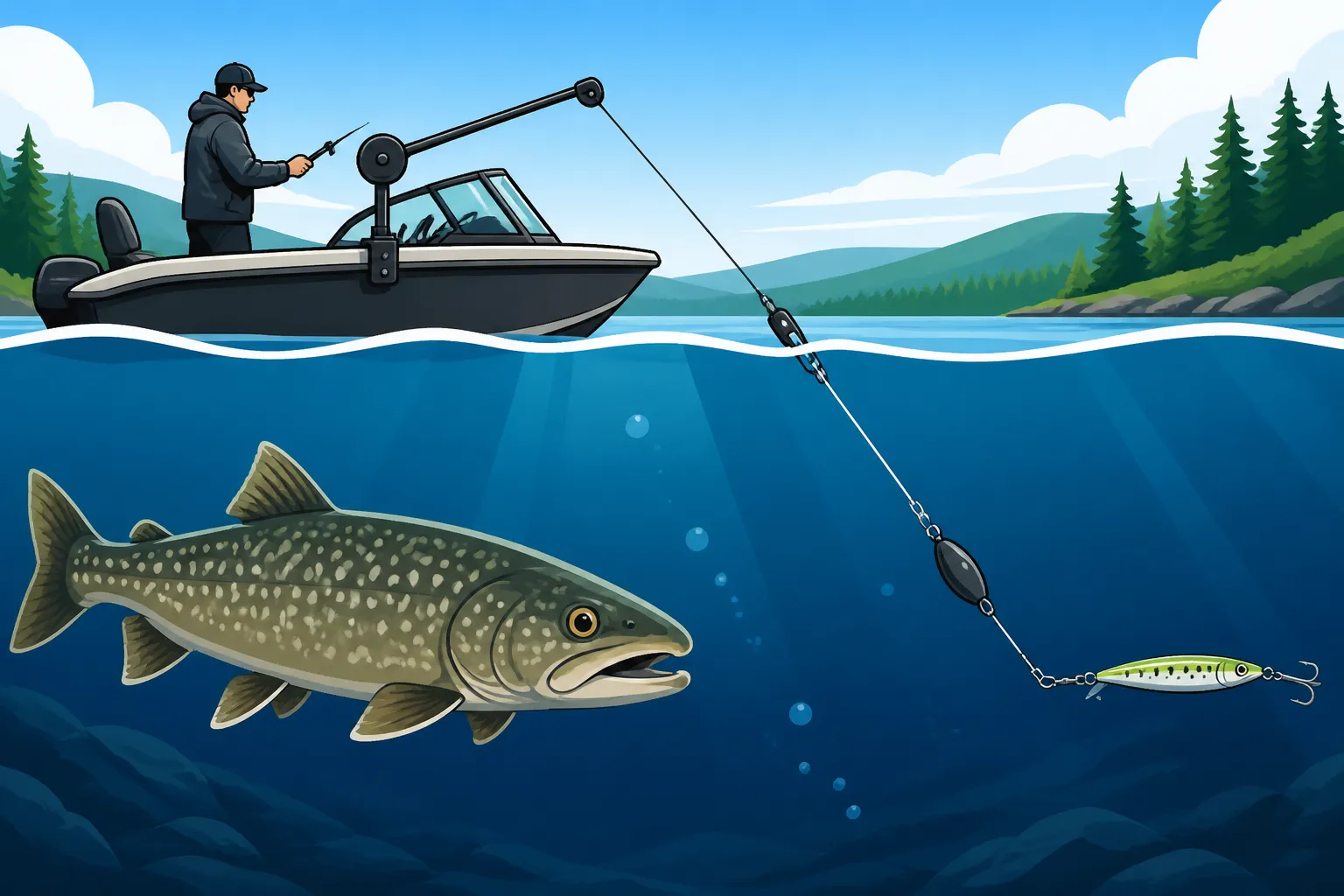
At its core, downrigging is a trolling method that allows you to present lures at a controlled depth, far below what a weighted line or diver could achieve efficiently. It uses a heavy weight (called a downrigger ball or cannonball) to pull your fishing line down to a specific depth. Your fishing line is attached to this weight via a release clip. When a fish strikes your lure, the tension pulls the line free from the clip, and you fight the fish directly on your rod, without the heavy downrigger ball interfering. This is incredibly effective for lake trout because it enables you to target the exact thermocline or structure where they are holding, something that would be nearly impossible otherwise.
The effectiveness comes from precision. Instead of guessing how deep your lure is, a downrigger tells you exactly. You can see fish on your sonar at 80 feet, set your downrigger to 80 feet, and know your lure is there. This eliminates a huge amount of guesswork, especially when you consider that lake trout often stack up in very narrow bands of preferred temperature. Without downriggers, your lure might be 10 or 20 feet above or below the fish, completely missing the strike zone. It truly gives you an edge in these deep-water scenarios.
Key Downrigging Equipment You'll Need
Getting set up for downrigging requires a few specialized pieces of gear beyond your standard rod and reel. Don't worry, it's not as overwhelming as it might seem.
First, you'll need the downrigger unit itself. These typically consist of a boom, a reel (either manual or electric) that spools the downrigger cable, a depth counter, and a base that mounts to your boat. Electric downriggers are a blessing for deep-water fishing, saving your arms from cranking up heavy weights all day, and you can find a good selection on platforms like Amazon.
Next is the downrigger weight, often called a ball or cannonball, which attaches to the end of the downrigger cable. These weights range from 6 to 15 pounds or more, with heavier weights being necessary for deeper depths or faster trolling speeds to prevent blowback (where the weight trails too far behind the boat). A common size for general lake trout fishing is a 10-pound torpedo or pancake style weight, as they cut through the water efficiently.
Then there's the release clip. This small but crucial device connects your fishing line to the downrigger cable (or the weight itself). It holds your line securely enough to pull the lure down, but releases it when a fish hits, allowing you to fight the fish unhindered. There are various styles, from simple pinch clips to adjustable tension clips, and experimenting with a few can help you find what works best for your specific setup and desired lure action.
Finally, you'll want specialized downrigger rods. While you can use a stout conventional rod, dedicated downrigger rods typically have a softer, more parabolic action. This flexible tip absorbs the tension of the downrigger weight and snaps back smoothly when the line releases, signaling a strike. Pair these with conventional reels spooled with monofilament or braid, suitable for the size of lake trout you expect to encounter. For a closer look at the species you'll be targeting, check out our guide on Lake Trout in New York.
Here's a quick look at common downrigger components:
| Component | Function | Key Considerations |
|---|---|---|
| Downrigger Unit | Lowers and raises the downrigger weight | Manual vs. Electric, Boom Length, Mounting Options |
| Downrigger Weight | Pulls fishing line to desired depth | Weight (6-15+ lbs), Shape (Torpedo, Pancake), Coating |
| Release Clip | Connects fishing line to weight/cable, releases on strike | Adjustable Tension, Ease of Use, Line Protection |
| Downrigger Rod | Absorbs weight tension, signals strikes | Action (Soft/Parabolic), Length (7-9 ft), Power |
| Conventional Reel | Holds fishing line, allows smooth drag | Line Capacity, Gear Ratio, Durability |
| Downrigger Cable | Connects unit to weight | Material (Stainless Steel, Braided Line), Strength |
Setting Up Your Downrigging System
Once you've got your gear, the next step is to get everything rigged up correctly on your boat. Proper setup is paramount for safety, efficiency, and ultimately, success on the water. A poorly set up system can lead to tangles, lost fish, and a lot of frustration.
Assembling Your Downrigger and Rod
Mounting your downriggers correctly on your boat is the first step. Most boats have designated areas or track systems for mounting, allowing for secure attachment. Ensure they are placed in a location where they are easy to access but also won't interfere with boat operations or other fishing lines. The boom should extend out enough to keep the downrigger weight clear of the boat's hull and propeller. Once the downrigger unit is securely mounted, thread the downrigger cable through the guides and attach your selected downrigger weight to the end. Some anglers prefer to use a snubber between the cable and the weight to absorb shock.
Now, let's talk about rigging your fishing rod. Take your downrigger rod and reel, making sure your reel is spooled with fresh line. While braid has its advantages for sensitivity, many downrigger anglers still prefer monofilament for its stretch, which can act as a shock absorber when a fish strikes and comes off the clip, especially for species like Lake Trout in New York. Tie on your leader, which should be fluorocarbon for its invisibility in water and abrasion resistance. The leader length can vary, but typically ranges from 6 to 20 feet, depending on the clarity of the water and how spooky the fish are. Finally, attach your chosen lure or bait to the end of your leader.
The Right Lures and Baits for Deep Water
Choosing the right lure is critical, and for lake trout, it's often about mimicking their primary forage. Spoons are incredibly popular and effective. Brands like Northern King, Michigan Stinger, and Dodger/Troll patterns in various sizes and colors are mainstays. The key is to match the hatch – if the lake has a lot of smelt, choose a spoon that imitates a smelt. If alewives are present, a silver or blue spoon might be the ticket. Experimentation is key, and having a good tackle box full of options, perhaps sourced from Amazon, will serve you well.
Stickbaits or crankbaits that dive to moderate depths but have an enticing wobble can also be effective when run on a downrigger. These are particularly good for fish that might be slightly higher in the water column or when trying to imitate larger forage. Another highly effective presentation, especially in clear water, is a flasher or dodger paired with a fly or squid imitation. The flasher creates a lot of action and attraction, while the trailing fly, often tied with Mylar or synthetic hair, provides the visual appeal. Many New York's Finger Lakes fishing guides swear by these combinations, especially for getting a reaction strike from finicky lakers. Consider checking out specific advice on How to Fish Deep Water Lake Trout in Summer on New York's Finger Lakes for tailored lure suggestions. Always double-check New York Freshwater Fishing Rules for any bait or tackle restrictions in your target waters.
Mastering Downrigging Techniques for Success
Getting the equipment set up is one thing, but truly mastering downrigging involves understanding how to deploy your lines, read your electronics, and make constant adjustments to stay in the strike zone. It's a dynamic process that rewards attention to detail and a willingness to adapt.
Deploying Your Lines and Achieving Depth
Once your boat is moving at your desired trolling speed (typically 1.5 to 3.0 mph for lake trout, but this can vary greatly depending on lure action and fish mood), it's time to deploy your lines. First, let out about 30 to 50 feet of fishing line from your rod, allowing your lure to get some distance behind the boat and start working. This is called the "lead." Next, clip your fishing line into the release clip on the downrigger cable. Make sure the clip has enough tension to hold the line securely but isn't so tight that a fish won't pull it free easily.
Once your line is clipped, slowly lower the downrigger weight to your target depth using the downrigger reel. Watch your depth counter closely. As the weight descends, keep an eye on your rod tip. It will bend under the tension of the downrigger weight. Once the weight reaches the desired depth, engage the rod holder. You'll want to apply just enough tension to keep the rod tip loaded, forming a nice arc. This ensures that when a fish strikes, the rod tip will "snap" back, signaling the release of the line. Learning how to manage multiple lines, especially if you're running two or three downriggers, takes practice to avoid tangles and keep everything working effectively.
Reading Your Electronics and Adjusting for Bites
Your boat's electronics, especially your fish finder or sonar, are your best friends when downrigging for lake trout. This is how you'll identify baitfish schools, underwater structure, and most importantly, the lake trout themselves. Pay close attention to the depth at which you're seeing fish. If you mark fish at 75 feet, that's where you want your lures. If they're at 90 feet, adjust your downriggers accordingly. Don't be afraid to adjust your depth by 5 or 10 feet regularly, even if you're not marking fish, as lakers can move vertically quite quickly. Our guide on How to Read a Fish Finder for New York Lakes can help you hone these critical skills.
Trolling speed is another vital component. Different lures have different optimal speeds, and fish often prefer a certain presentation. Too fast, and your lure might spin unnaturally or blow out. Too slow, and it might not have enough action. Experiment with speeds and observe how your lures perform. When you get a bite, note the depth, speed, lure color, and lead length that was successful. Lake trout often school, so where you catch one, there are likely more. Make a pass back through that same area, potentially with the same setup, to capitalize on the bite. Remember, successful downrigging is a constant process of observation, adjustment, and adaptation, so use your chart plotter to mark hot spots and track successful trolling passes. Consider also reviewing general Trolling Techniques for New York's Lakes to broaden your understanding.
Maximizing Your Lake Trout Downrigging Success in New York
While the core mechanics of downrigging are relatively straightforward, truly excelling at it involves a deeper understanding of environmental factors, boat control, and having a few tricks up your sleeve. Think of it as refining your technique to become a more consistent and confident angler.
Strategic Trolling and Boat Control
Effective downrigging is intrinsically linked to meticulous boat control. Your ability to maintain a consistent speed and track, even in wind or current, directly impacts your lure's presentation. Autopilot systems are a huge asset here, allowing you to focus on your lines and electronics rather than constantly steering. If you don't have an autopilot, use natural landmarks or your GPS track to keep a steady course. When making turns, ensure they are wide and gradual. Sharp turns can cause your downrigger weights to swing, tangle lines, or even pop clips prematurely. The outside lines will speed up and rise, while the inside lines will slow down and sink, offering different presentations which can sometimes trigger strikes.
Paying attention to structure on your sonar is also key. Don't just troll aimlessly; target underwater features like humps, drop-offs, and points where lake trout are likely to ambush baitfish. If you're fishing a specific lake like Seneca, remember that the Best Depth for Lake Trout in Summer on New York's Seneca Lake might shift throughout the day. By carefully observing your fish finder and noting where you see baitfish and marked trout, you can adjust your trolling path to repeatedly pass over these productive zones. This strategic approach, rather than just covering water, is what often separates a good day from a great day.
Adapting to Conditions and Local Expertise
Lake trout fishing is rarely a "set it and forget it" affair. Conditions on the water are constantly changing, and the most successful anglers are those who can adapt quickly. Wind can create chop, making boat control more challenging and influencing your lure's action. Strong currents, particularly in the Great Lakes or some river systems, can cause significant "blowback" on your downrigger weights, meaning your lure isn't as deep as your counter indicates. In these situations, you might need to use heavier weights or slow your trolling speed to keep your lures effectively in the strike zone. Sometimes, simply running your lures slightly off the marked fish can be the trick, as lake trout may be looking up for forage.
Don't underestimate the value of local knowledge. Chatting with other anglers at the boat launch, visiting local tackle shops, or even considering a trip with New York's Finger Lakes Fishing Guides can provide invaluable insights into current patterns, hot lures, and specific depths that are producing fish. Each lake has its own character, and what works wonders on Cayuga Lake might be less effective on Lake Ontario. Guides who spend every day on the water, whether it's a Cayuga Lake, New York Fishing Guide Rates trip or a full day out on Seneca, have their fingers on the pulse of the fishery and can often share subtle nuances that take years to learn independently. Look for updated information on local forums or dedicated New York fishing blogs for the latest bite.
Troubleshooting Common Downrigging Challenges
Even with the best gear and knowledge, downrigging can present its fair share of head-scratchers. Knowing how to troubleshoot common issues can save you a lot of frustration and keep your lines in the water where they belong.
Dealing with Line Release Issues and Tangles
One of the most common frustrations in downrigging is dealing with line release issues. If your line is constantly popping out of the clip without a fish striking, your release clip might be too loose, or your lure might be putting too much drag on the line. Try tightening the tension on your clip. Conversely, if you're getting strikes but the line isn't releasing, your clip is likely too tight. This can result in you fighting the fish with the added resistance of the downrigger weight, which is no fun at all and can lead to lost fish. Adjusting the clip's tension is usually a trial-and-error process, influenced by your trolling speed, lure size, and line diameter.
Tangles are another prevalent headache, especially when running multiple lines. The most common cause of tangles is improper spacing between your downrigger lines or allowing too much "blowback" (where the downrigger weight trails too far back and the lines get too close to each other). To prevent this, ensure your downriggers are spaced out on your boat, and use different lead lengths on each rod. For instance, if one lure is 30 feet behind the clip, maybe the next is 50 feet. Also, always keep your downrigger weights heavy enough for your trolling speed and depth to minimize blowback. Strong currents can also cause lines to drift into each other, so consider lighter lures or even temporarily reeling in lines when turning in strong currents. Patience and methodical deployment are your best friends in avoiding messy situations.
Overcoming "Blowback" and Current Challenges
Blowback is that vexing phenomenon where your downrigger weight, due to water resistance and trolling speed, doesn't actually reach the depth indicated on your counter. Instead, it "blows back" behind the boat, creating a longer angle on the downrigger cable and keeping your lure shallower than you intend. This is particularly problematic in deeper water or when fishing with faster trolling speeds. The solution involves a few strategies. First, use heavier downrigger weights. A 12-pound or 15-pound ball will cut through the water more efficiently than a 10-pound one, reducing blowback. You can find a good selection of various weight sizes on Amazon.
Secondly, you can reduce your trolling speed if conditions allow. Slower speeds mean less water resistance and therefore less blowback. However, sometimes fish prefer a faster presentation, so this isn't always an option. Thirdly, consider specialized downrigger weights with hydrodynamic designs, such as torpedo or pancake shapes, which are engineered to run deeper with less resistance. Finally, in strong currents, remember that the current itself can push your lure around. You might need to adjust your boat's heading to troll with or against the current to maintain a desired presentation, or even increase your downrigger's depth setting to compensate for the current's upward force on your line. Understanding these challenges and having a plan to address them will significantly improve your downrigging effectiveness. For a comprehensive look at the fish you'll be targeting, check out our guide on Fish Species Found in the Finger Lakes.
Disclaimer
This article is for general informational purposes only and does not constitute professional advice. Laws, prices and regulations vary by location and change over time. Consult a qualified professional for guidance on your specific situation.